

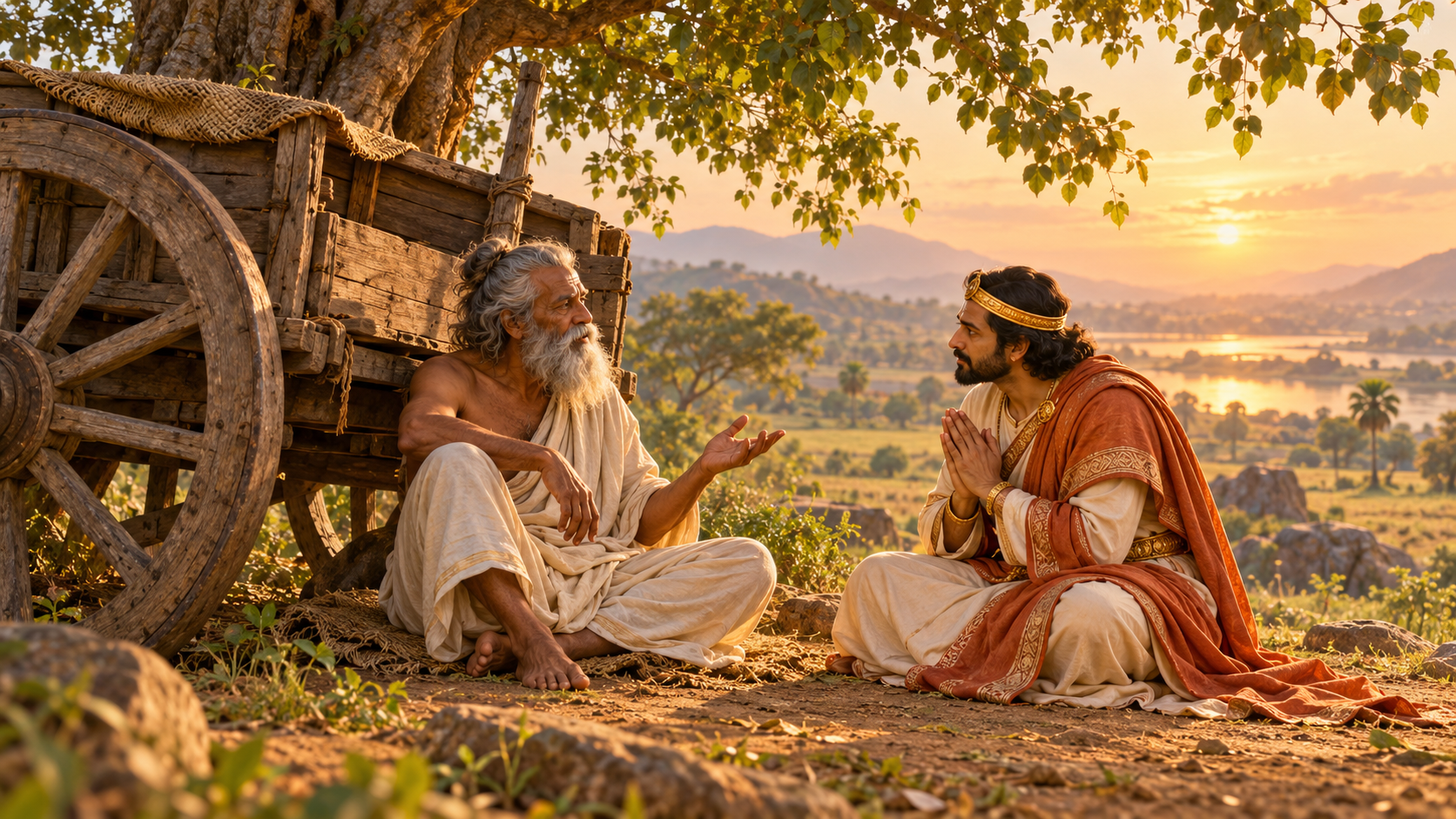
A generous person can still discover something essential that remains to be learned. The story of Raikva and Janashruti begins with a ruler who feeds others and offers shelter, then finds himself searching for a man whose wisdom has escaped public notice.
In the Chandogya Upanishad, sections 4.1–4.3, their meeting opens into Samvarga Vidya, a contemplation of gathering or absorption. The narrative moves from royal reputation to a humble cart, from an overheard conversation to the quiet mystery of life. For a devotional reader, it offers a way to reflect on generosity without becoming satisfied with praise.
1. Janashruti’s generosity lights the opening scene
Janashruti Pautrayana is introduced as a faithful and abundant giver. He has food prepared and establishes places where travellers can stay, wishing that people everywhere may eat what he provides. This description matters: his kindness is part of the story’s foundation.
The text does not begin by dismissing service. Before we hear about profound knowledge, we encounter the ordinary needs of people on a journey: somewhere to rest and something to eat. Spiritual reflection grows within a world where these needs remain real.
We can recognise the appeal of such a life. A person may support a family, welcome a guest or quietly help someone through a difficult day. These actions have worth even when they do not answer every question about existence. Janashruti’s journey allows generosity and further learning to stand together.
2. The swans speak of Raikva with the cart
One night, Janashruti overhears two hamsas flying above. These birds are commonly rendered as swans, although translations differ. One speaks of the ruler’s radiance; the other asks whether he is being compared with Raikva, the man associated with a cart.
A comparison with a winning throw of dice praises the scope of Raikva’s knowledge. The unfamiliar man now becomes the focus of Janashruti’s attention. He sends an attendant to find him, and after searching, the attendant discovers Raikva beneath a cart.
The change of setting is striking. Wisdom is found away from the scene of public honour. Raikva’s surroundings offer no grand announcement of his inner life.
A reflection for us is to loosen our expectations about where a meaningful lesson may come from. Someone’s clothing, occupation or visibility tells us little about the depth of their understanding. Listening requires room for surprise.
3. A difficult meeting becomes a teacher’s welcome
Janashruti first approaches with six hundred cows, a gold necklace and a mule-drawn carriage, asking Raikva to teach him the deity he worships. Raikva refuses this approach. The ruler returns with further offerings, including a thousand cows and a village; this time the teaching follows.
The ancient account also includes Janashruti’s daughter in a proposed marriage arrangement with Raikva. That detail belongs to the social setting of the narrative and should not be erased when retelling its sequence. Translations and commentaries differ in explaining aspects of Raikva’s words and the change between the two visits.
It is therefore too simple to say that Raikva rejects every gift or that the passage declares wealth worthless. He does accept the later approach. A devotional reading can nevertheless notice the movement from a celebrated giver’s position towards the willingness to become a learner.
That willingness has a familiar shape: we arrive with achievements, but learning asks us to attend to something we have not yet understood.
4. What Samvarga Vidya means in Raikva’s teaching
Raikva’s instruction concerns samvarga, often translated as absorption or gathering into oneself. With reference to the wider world, he points to vayu, air or wind. Fire subsides into air; the sun and moon, when they set, are spoken of as entering it; water, when it dries, is gathered into it.
With reference to the person, the corresponding focus is prana, the vital breath or life principle. In sleep, speech, sight, hearing and mind are described as being gathered into prana.
This is the Upanishad’s language of contemplation. Its correspondences invite reflection on the relationship between the world and the person. They should be read within that setting, without turning the imagery into a modern account of astronomy or physiology.
The familiar becomes a doorway into inquiry. A breeze, a fading flame, the silence of sleep: each can awaken a question about what sustains experience when its many activities grow quiet. The passage gathers our attention towards supporting realities that are easily overlooked amid visible events.
5. The hungry student brings wisdom back to daily life
Section 4.3 continues with another episode involving Shaunaka Kapeya, Abhipratarin Kakshaseni and a student seeking food. The student is initially given nothing. He challenges this refusal through words about the divine reality to which the food belongs. After reflection and a reply, food is given to him.
This scene is not a second visit by Janashruti. It is a further episode in the same section, linking the contemplative teaching with an encounter at a meal.
Read devotionally, the beginning and ending speak to each other. Janashruti’s hospitality opens the narrative; feeding a student appears as the teaching unfolds. Subtle thought remains close to the person standing before us.
We may carry that connection into our own lives. Let an act of giving remain generous even when no praise follows. Let a new question interrupt the comfort of feeling accomplished. And when spiritual discussion becomes elaborate, remember the simple grace of making room for another person.
Raikva and Janashruti’s meeting leaves us with both inquiry and care. A ruler seeks, an unexpected teacher speaks, and the everyday world becomes worthy of deeper attention.
Make space for mindful devotion
Explore thoughtfully chosen devotional essentials for a peaceful sacred space at home.
Frequently Asked Questions
Where is the story of Raikva and Janashruti found?
It appears in the Chandogya Upanishad, sections 4.1–4.3, at the beginning of its fourth chapter.
What does Raikva teach Janashruti?
He teaches Samvarga Vidya, contemplating air in the wider world and prana within the person as principles of absorption.
Does the story reject generosity?
No. Janashruti’s hospitality is honoured in the opening, and the section later returns to giving food. Humility and continued inquiry are devotional lessons we can draw from it.
Sources: Chandogya Upanishad 4.1, 4.2 and 4.3, translated by Max Müller; cross-checked with the International Gita Society’s Chandogya Upanishad collection. Applications to daily life are offered as devotional reflection.