
Some sacred stories stay with us because their turning point feels painfully familiar. A person begins with a generous intention, then slowly loses sight of what once gave life its direction. The story of King Bharata and the deer brings this movement into a quiet forest setting.
In the Bhagavata Purana, a devoted king leaves royal life behind, yet his spiritual journey remains unfinished. A helpless fawn enters that journey. Reading the account with care opens a tender question for devotees: how can we offer love wholeheartedly while keeping remembrance of Bhagavan alive?
1. A king whose heart turned toward Vasudeva
This Bharata is the son of Rishabhadeva in the Bhagavata Purana. Canto 5, chapter 7, in the Bhaktivedanta Book Trust translation describes his kingship and devotion to Vasudeva. After dividing his kingdom among his sons, he goes to Pulaha’s ashram. There his worship becomes simple, and his love for the Lord deepens.
The change is striking: someone accustomed to royal responsibility now finds fulfilment in a life centred on devotion. Yet the story invites us to look beyond the outward change of surroundings. Moving away from wealth or busyness does not remove every movement of the mind.
As a reflection for our own lives, this is humbling. A peaceful room, a pilgrimage, or a new routine can support us, but we still bring our habits of attention along. Even a sincere beginning needs continued care.
2. The motherless fawn at the river
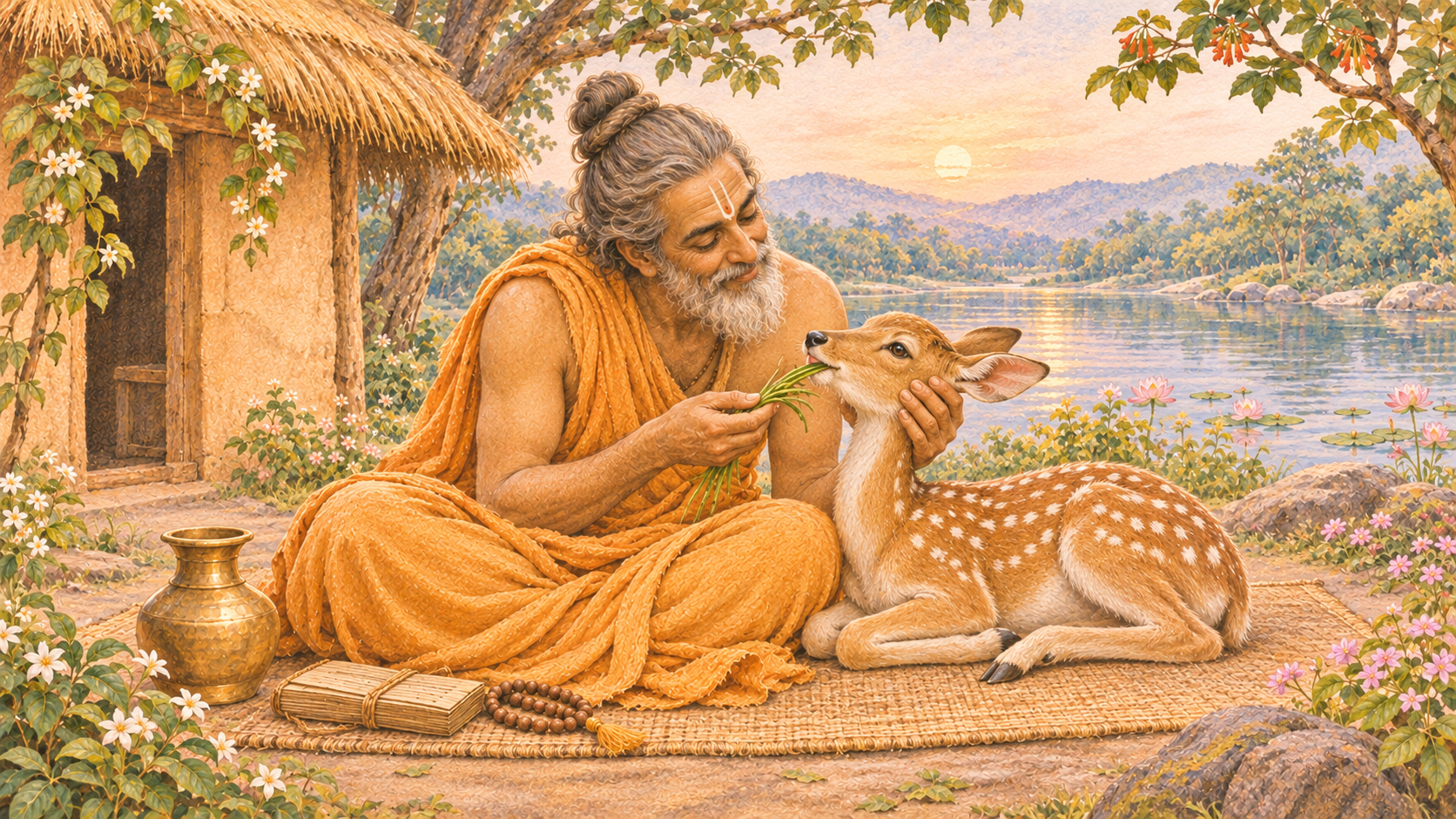
In Bhagavata Purana 5.8.2–8, a pregnant doe is frightened by a lion’s roar and leaps across the river. Her young falls into the water, and the mother subsequently dies. Bharata rescues the motherless fawn and brings it to his ashram.
Imagine the vulnerability of that encounter: a small creature carried by the current, unable to protect itself. A reader can pause here and recognise the goodness of responding to a being in need. The scene deserves that tenderness before we consider what follows.
In a devotional reading, the distinction between helping and possessing matters. Care attends to another being’s welfare. Possessiveness gradually makes our own need to feel necessary the centre of the relationship. The boundary can be difficult to notice while affection is growing.
3. When affection takes over attention
As chapter 8 continues, especially verses 11–15, Bharata becomes preoccupied with the deer. He interrupts worship to check on it and grows distressed when it is absent. The account traces an attachment that displaces his spiritual attention.
This movement can help us examine our own lives gently. Consider the difference between being available to someone and feeling unable to rest unless everything around them is under our control. The same outward act may arise from patience on one day and from anxious clinging on another.
The reflection need not become an accusation against parents, carers, or anyone carrying heavy responsibilities. Real care takes time and effort. Rather, the story gives us a language for noticing what happens within that effort. Can we serve with steadiness? Can we accept help? Can we remember that our love does not make us the sole source of another being’s safety?
4. A difficult turn, and remembrance that continues
Verses 27–31 describe Bharata dying absorbed in the deer and receiving a deer’s body, while retaining memory of his former life. The narrative does not end with that birth.
The following chapter introduces his later human birth. Bhagavata Purana 5.9.3 describes his remembrance of earlier lives through the Lord’s mercy. This is the figure known as Jada Bharata: outwardly appearing unresponsive to ordinary social expectations, inwardly absorbed in the Lord.
That continuation changes the emotional weight of the story. We can take its warning seriously without reducing Bharata’s entire journey to a single failure. For a modern reader reflecting devotionally, there is hope in the possibility of recognising a mistake and renewing one’s direction.
This is a scriptural account of rebirth, presented within the Bhagavata’s religious worldview. It should not be turned into a prediction about the destiny of a particular person who loves or cares for an animal.
5. Love with an inner place of return
What might we carry from this story into an ordinary day? One useful reflection is that devotion can give care an inner place of return. We may be deeply involved in someone’s needs while remembering that our ability to help is also a gift.
Such remembrance can make us more patient with limits. We can do the work before us, ask for support when needed, and resist measuring our worth by how indispensable we have become. Love has room to breathe when it includes trust and humility.
There is no need to imitate Bharata’s forest life to think about these questions. They belong wherever affection and responsibility meet: in families, friendships, service, and our relationships with living creatures. A quiet moment of honest attention may reveal whether care is widening our heart or narrowing everything around one fear.
For the devotee, the invitation is to keep turning toward Bhagavan while remaining attentive to those who need us. Love can be warm, responsible, and generous. With remembrance, it can also become less burdened by the demand to hold everything alone.
Explore devotional essentials for your home prayer space.
Frequently Asked Questions
Where is the story of Bharata and the deer?
It appears in the Bhagavata Purana, Canto 5. Chapter 7 introduces Bharata’s devotional life, chapter 8 tells the deer episode, and chapter 9 continues his journey.
Does the story condemn kindness to animals?
A careful devotional reading distinguishes the compassionate rescue from the consuming attachment that follows. The reflection concerns the direction of attention within affection.
Who is Jada Bharata?
Jada Bharata is Bharata in his later human birth. The Bhagavata describes him remembering his earlier lives and remaining inwardly devoted to the Lord.