

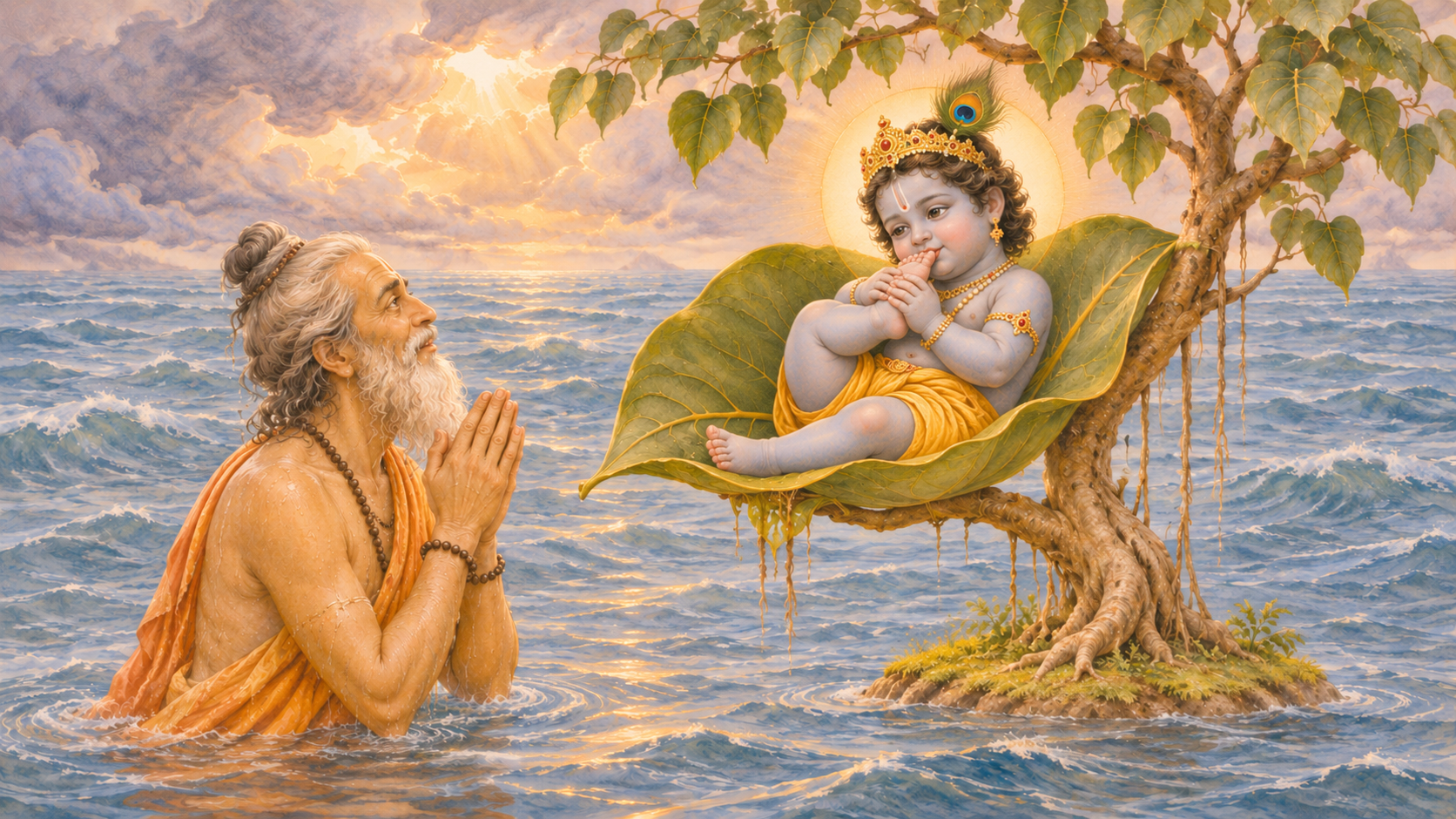
The story of Markandeya and the banyan leaf brings together two unforgettable images: a world swallowed by water and a smiling child resting upon a leaf. The sage has lost every familiar landmark. Yet the presence he encounters is gentle enough to awaken love.
This account comes from the Bhagavata Purana, especially Canto 12, Chapter 9. It invites us to consider the limits of our understanding and the closeness of the Divine. The following retelling stays with that chapter; the reflections are offered as devotional readings of its imagery.
1. A Sage Asks to Understand Maya
When Narayana offers Markandeya a blessing, the sage expresses gratitude for the Lord’s presence. He also asks to experience the Lord’s maya, the power through which beings perceive reality in divided forms. Narayana agrees. Markandeya continues his devotion at his hermitage, awaiting that experience. These events appear in Bhagavata Purana 12.9.1–9.
There is something deeply human about his request. Reading about a mystery and encountering it are different experiences. We may know that life changes, yet a sudden loss can reveal how much we depended on what seemed permanent.
As a devotional reflection, the opening honours sincere inquiry. A question can arise within love and reverence. Markandeya’s desire to understand does not make his devotion smaller; it gives the story its searching movement.
2. When Every Familiar Shore Disappears
A violent storm rises while the sage is beside the Pushpabhadra River. Waters overwhelm the world. Markandeya wanders through darkness, frightened and exhausted. The chapter describes this immense deluge as his experience of Vishnu’s bewildering power, unfolding after the blessing he requested.
For a reader, the absence of a shore is a powerful image of disorientation. A person who has always been capable may suddenly need support. Learning, discipline and experience remain valuable, while the feeling of complete control can fall away.
We need not turn the cosmic waters into a prediction about our own future. Their place here is within a sacred narrative. They allow us to sit beside a difficult question: where does the heart turn when its usual assurances no longer feel sufficient?
3. The Child in the Fold of a Leaf
Then Markandeya sees a young banyan tree on raised ground. On a branch lies a radiant infant within the fold of a leaf. The child holds a foot to his mouth. Seeing him, the sage’s exhaustion gives way to wonder. The scene is described in Bhagavata Purana 12.9.20–26.
The smallness of the leaf makes the scene especially tender. Amid overwhelming waters, attention settles on the familiar movement of a baby. Devotional imagination can rest here for a moment: the sacred is approachable, and awe can carry affection within it.
One possible symbolic reading sees the leaf as an image of apparent fragility. We often look for reassurance in whatever appears largest or strongest. This scene gently unsettles that habit. Its quiet centre invites attention before it offers an explanation.
4. An Entire Universe Within the Infant
As the sage approaches, the infant’s breath draws him inside. There Markandeya beholds the universe, including the Himalayas, the river and his own hermitage. An outward breath returns him to the waters. He sees the child again and longs to embrace him. Then the Lord, tree and flood disappear; Markandeya finds himself at his hermitage as before. The sequence concludes at 12.9.27–34.
The chapter identifies the child as the Lord. Within this Vaishnava account, the form belongs to Vishnu or Narayana. The universe within the infant expresses a divine vastness that ordinary measurements cannot contain.
For devotional contemplation, the familiar hermitage within that vastness is especially moving. Home has a place in the vision. Mountains and stars do not erase the small setting where a person has prayed, waited and loved. The intimate and the immeasurable meet in one scene.
5. Returning Home With Greater Humility
Markandeya returns to the place where the experience began. As readers, we can reflect on how an unchanged landscape might be seen with a changed heart. The riverbank can become a reminder of the mystery that surrounds ordinary life.
This is a gentle invitation to humility. We can fulfil our responsibilities wholeheartedly while acknowledging how little we grasp of existence. Trust leaves room for unanswered questions. Wonder can soften the impulse to explain everything immediately.
The banyan-leaf episode also offers a beautiful way to speak about the Divine with children: ask what they notice in the image, and listen. Adults may notice the flood first; a child may notice the baby’s foot or smile. Both responses can open a thoughtful conversation about love, fear and belonging.
Explore devotional essentials for your home prayer space.
Frequently Asked Questions
Where is this story told?
The flood and banyan-leaf vision appear in Bhagavata Purana 12.9, within the wider Markandeya narrative in Chapters 8–10.
Who is the child on the leaf?
In this account the child is the Lord, understood as Vishnu or Narayana, whose maya Markandeya had asked to experience.
What does the banyan leaf mean?
The text describes the leaf as the infant’s resting place. Reading it as a meeting of apparent fragility and divine vastness is a devotional interpretation.