
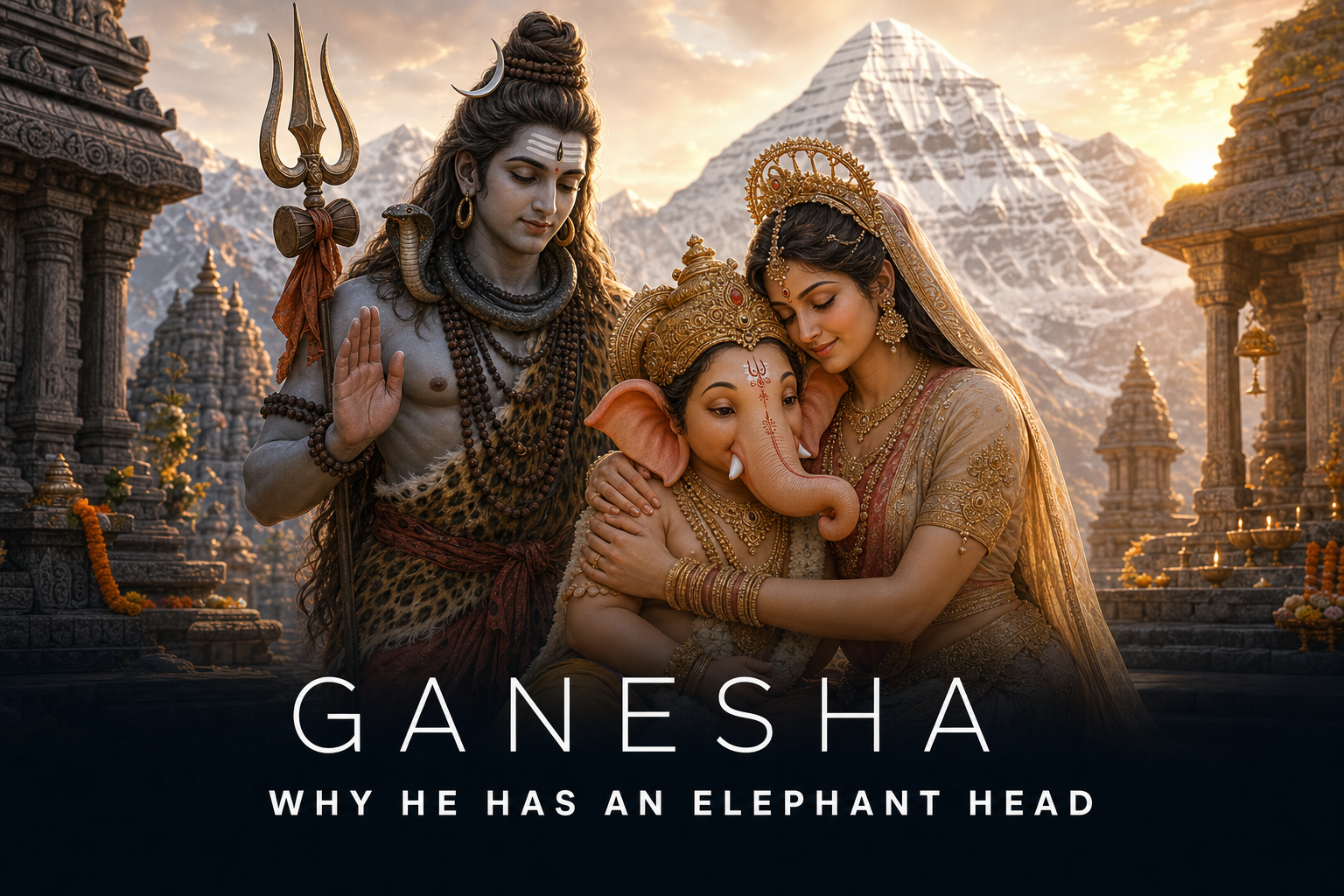
Of all the forms the Divine takes in the Hindu tradition, few are as instantly loved as Ganesha — the round-bellied, elephant-headed god who is prayed to before every wedding, every journey, every new beginning. Yet behind that gentle, familiar face lies one of the most dramatic and tender stories in all of Sanatana Dharma.
Why does Ganesha have the head of an elephant? The answer is not a simple curiosity of mythology. It is a story of a mother’s love, a father’s grief, and a promise that made a child the first among all the gods. Let us walk through the legend as it is told in the Shiva Purana, and uncover the meaning woven into every part of it.
A Mother’s Creation: How Ganesha Was Born
The story begins on Mount Kailash, the sacred abode of Bhagwan Shiva and Devi Parvati. Shiva, ever the great ascetic, would often leave for long stretches of meditation, and in his absence Parvati longed for a companion of her own — someone loyal, someone entirely hers.
One day, preparing to bathe, Parvati took the turmeric and sandalwood paste from her own body and shaped it into the figure of a boy. Breathing life into the form, she created a radiant son — strong, obedient and devoted to her alone. He was born not of the usual way, but of the pure will and love of the Mother Goddess herself. She gave him one simple duty: to guard the entrance and let no one pass while she bathed.
The Guardian at the Door
The boy took his mother’s command as sacred law. So when Shiva returned to Kailash and tried to enter, the child stood firm and blocked his path. Not knowing this was the great lord himself — and caring only for his mother’s word — he refused to let him in.
Shiva, astonished that a child would bar him from his own home, grew angry. Words turned to conflict, and in a moment of terrible fury Shiva struck off the boy’s head. The guardian who had done nothing but obey his mother lay lifeless at the threshold.
Why Shiva Gave Him an Elephant Head
When Parvati emerged and saw what had happened, her grief turned the heavens dark. The loving mother became Adi Shakti in her fiercest form, ready to dissolve all of creation unless her son was restored. The gods trembled and pleaded for mercy.
Realising the depth of his error, Shiva vowed to bring the boy back to life. He sent his ganas northward with instructions to return with the head of the first creature they found sleeping with its head pointing north — the auspicious direction. They came back with the head of a mighty elephant. Shiva placed it upon the boy’s body, breathed life into him once more, and the child rose again — now with the noble head of an elephant. From that moment he was known as Gajanana, the elephant-faced one.
The Blessing: First Among the Gods
To console Parvati fully and to honour the boy’s unshakable devotion, Shiva granted him a boon greater than any other. He declared that this child would be worshipped before all other deities — that no ritual, no yajna, no undertaking would succeed unless Ganesha was invoked first. He made him the lord of his ganas, giving him the name Ganapati, and the remover of all obstacles, Vighnaharta.
This is why, to this day, every prayer and every auspicious beginning opens with the words Om Shri Ganeshaya Namah. The boy who was created from love and lost to anger became the one whose blessing clears the path for all.
The Meaning Behind the Elephant Head
Ganesha’s form is not merely a tale — it is a teaching. Every feature carries a lesson for the seeker:
- The large head reminds us to think big and to seek wisdom above all.
- The great ears teach us to listen more and speak less.
- The small eyes point to concentration and single-minded focus.
- The long trunk shows adaptability — the strength to uproot a tree and the delicacy to lift a grain.
- The single tusk teaches us to hold on to the good and let go of the bad.
- The large belly reflects the capacity to digest all that life brings, both joy and sorrow, with peace.
- The humble mouse he rides represents the restless mind and desire, mastered and made to serve.
In this way, the elephant head is not a mark of loss but a crown of meaning. It transforms a story of grief into an eternal symbol of intelligence, patience and grace.
As Ganesh Chaturthi draws near, prepare to invite the remover of obstacles with authentic puja essentials, guided vrat eBooks and handcrafted devotional pieces — curated with devotion at The Divine Store.
Frequently Asked Questions
Who created Ganesha?
According to the Shiva Purana, Devi Parvati created Ganesha from the turmeric and sandalwood paste of her own body and gave him life, making him her devoted son and guardian.
Why is Ganesha worshipped first among all gods?
Shiva granted Ganesha the boon that he would be invoked before every ritual and new beginning, in honour of his devotion. As Vighnaharta, the remover of obstacles, his blessing is sought first so that all undertakings succeed.
What does Ganesha’s elephant head symbolise?
The elephant head represents wisdom, intelligence and the power of discrimination. His large ears teach us to listen, his small eyes teach focus, and his trunk reflects adaptability — turning his form into a guide for the seeker.