
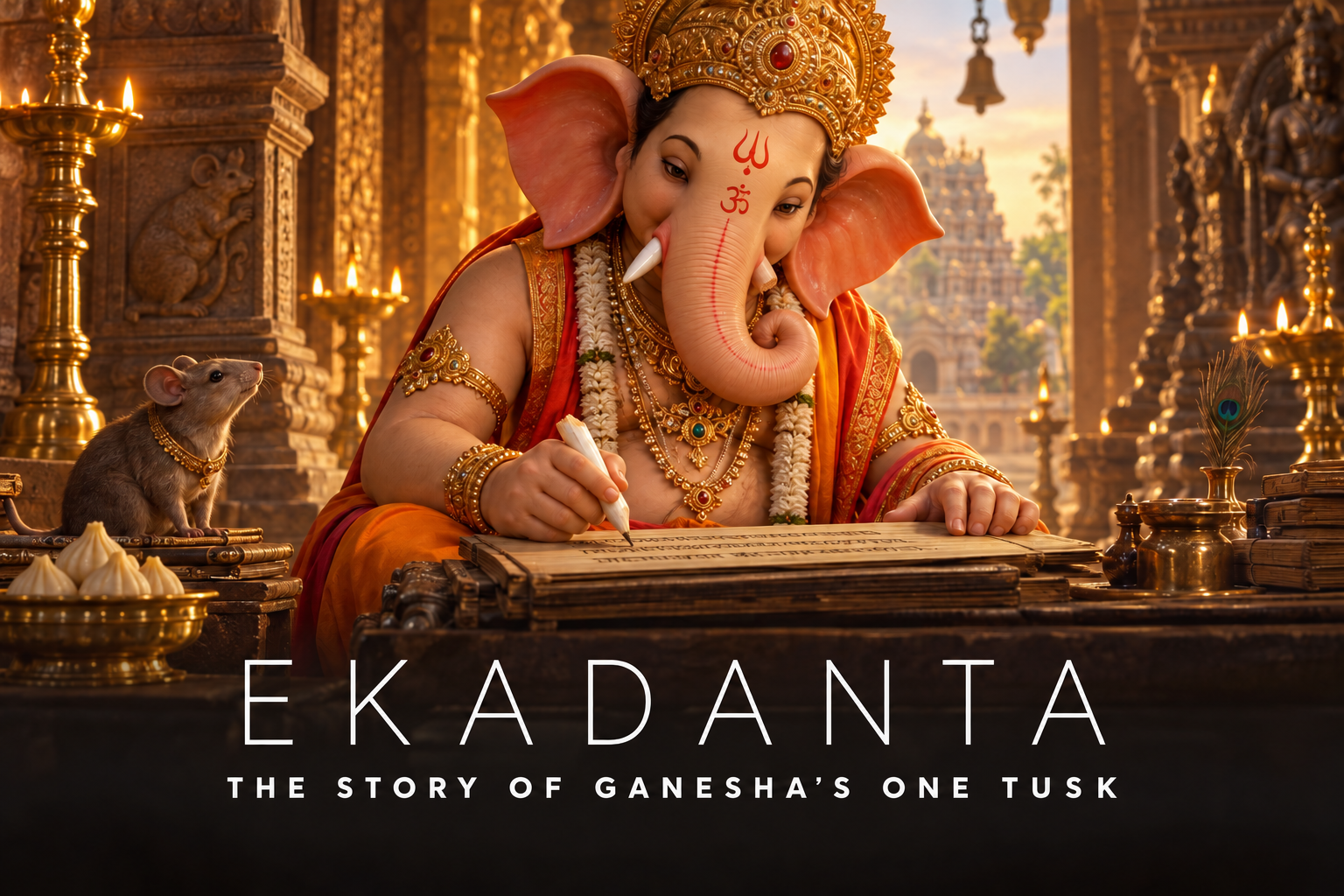
Among Ganesha’s many beloved names, Ekadanta draws our eyes to a small but striking detail: one whole tusk and one broken tusk. The name comes from eka, meaning “one,” and danta, meaning “tooth” or “tusk.” It is a description of his form, but devotees have long heard more in it. Why would the Lord of wisdom and new beginnings bear a visible mark of loss?
Hindu tradition does not offer just one answer. Different stories place the broken tusk in different settings, and each opens a different way to understand Ganesha. Here are the best-known accounts and the meaning they carry, with their differences kept intact.
What Does Ekadanta Mean?
Ekadanta means “the one-tusked one.” In paintings and images, Ganesha often holds the broken piece in his hand as well as wearing the remaining tusk. The detail turns an apparent imperfection into part of his identity. His name does not hide what is missing; it honours the wisdom revealed through it.
It helps to distinguish the name from any single explanation of how the tusk broke. A divine epithet can gather more than one narrative over centuries of devotional storytelling. The stories below need not be forced into a single timeline to have meaning.
Ganesha and Vyasa: The Tusk as a Writing Tool
One cherished tradition begins with Sage Vyasa, who sought a scribe for the immense Mahabharata. Ganesha agreed to write as Vyasa dictated. In a widely told later version, the writing instrument broke during the work. Rather than interrupt the epic, Ganesha broke off one of his own tusks and continued writing with it.
Here the tusk becomes a sign of dedication to knowledge. The story asks us to look beyond the lost ivory: Ganesha gives up something of himself so the work can continue. It also presents wisdom as active and disciplined, requiring effort rather than merely possessing an extraordinary mind.
There is an important textual distinction. The Adi Parva account of Vyasa and Ganesha names Ganesha as the scribe, but does not say that a pen broke or that he used his tusk. That familiar detail belongs to later storytelling around the epic. Calling it a tradition, rather than quoting it as a verse of the Mahabharata, lets us appreciate it accurately.
The Parashurama Account of the Broken Tusk
Another account places Ganesha at the entrance to Shiva’s dwelling. Parashurama, the warrior-sage, wished to enter, but Ganesha stood guard. Their encounter became a conflict. In the Brahmanda Purana narrative of Parashurama, Ganesha receives the force of Parashurama’s axe with a tusk, and the tusk is broken.
This is a very different setting from Vyasa’s writing. Ganesha is a guardian here, steadfast in a duty entrusted to him. The account is also more than a tale of strength meeting strength: his broken tusk becomes a reminder that even an encounter between revered beings may involve tension, restraint, and consequence. We do not need to erase that complexity to find devotion in the story.
Ekadanta and Madasura: The Victory over Pride
The Mudgala Purana’s Ekadanta section gives the name another dimension. It describes Ekadanta as a form of Ganesha who confronts Madasura. Mada can mean intoxication or arrogance: the blindness that comes when power makes a person forget humility. As Madasura’s dominance disturbs the worlds, the deities turn to Ekadanta.
When the encounter comes, Ekadanta overcomes Madasura, who recognizes his error and surrenders. The story’s ending matters: the answer to pride is not simply a stronger display of pride. Madasura is allowed to turn away from his hostility. In this telling, Ekadanta represents the wisdom that can interrupt arrogance and make change possible.
This Puranic narrative explains the spiritual significance of Ekadanta as a distinct divine form. It is not the same episode as the broken pen or the meeting with Parashurama. Holding the stories alongside one another gives a fuller picture than treating one as the only “real” account.
What Does Ganesha’s Single Tusk Symbolize?
Many devotees see the single tusk as a reminder that wisdom does not depend on outward perfection. In the Vyasa tradition, it evokes willingness to sacrifice for learning. In the guardian story, it speaks of resolve amid conflict. In the Madasura narrative, it points toward mastery over pride. These are interpretations of the stories, not claims that every image of Ganesha must carry only one fixed meaning.
The contrast between one whole tusk and one broken tusk can also invite a personal question: what should we hold firmly, and what can we let go? We can hold to truth and care while letting go of vanity, impatience, or the need to appear flawless. Ekadanta’s form makes that reflection memorable without turning a sacred image into a simple slogan.
Why This Name Still Speaks to Devotees
Ganesha is loved as the remover of obstacles, yet Ekadanta does not appear untouched by difficulty. His form suggests that an obstacle can be met with intelligence, courage, and humility. The mark on his face is not presented as a diminishment. It becomes the very name by which devotees remember him.
When we say “Ekadanta,” we remember a Lord whose wisdom serves a purpose: preserving a great story, honouring a duty, and guiding pride toward surrender. The different accounts do not weaken that devotion. They show how generations have found fresh meaning in one unmistakable feature of Ganesha’s form.
Explore thoughtfully chosen essentials that help make moments of remembrance feel personal.
Frequently Asked Questions
What does Ekadanta mean?
It means “the one-tusked one,” from the Sanskrit words eka (one) and danta (tusk or tooth).
Did Ganesha write the Mahabharata with his tusk?
That is a beloved later tradition. The Adi Parva names Ganesha as Vyasa’s scribe, but does not describe a broken pen or tusk used for writing.
Is there only one story of Ganesha’s broken tusk?
No. Stories connected to Vyasa and Parashurama differ, while the Mudgala Purana tells of Ekadanta’s victory over Madasura, the embodiment of pride.