

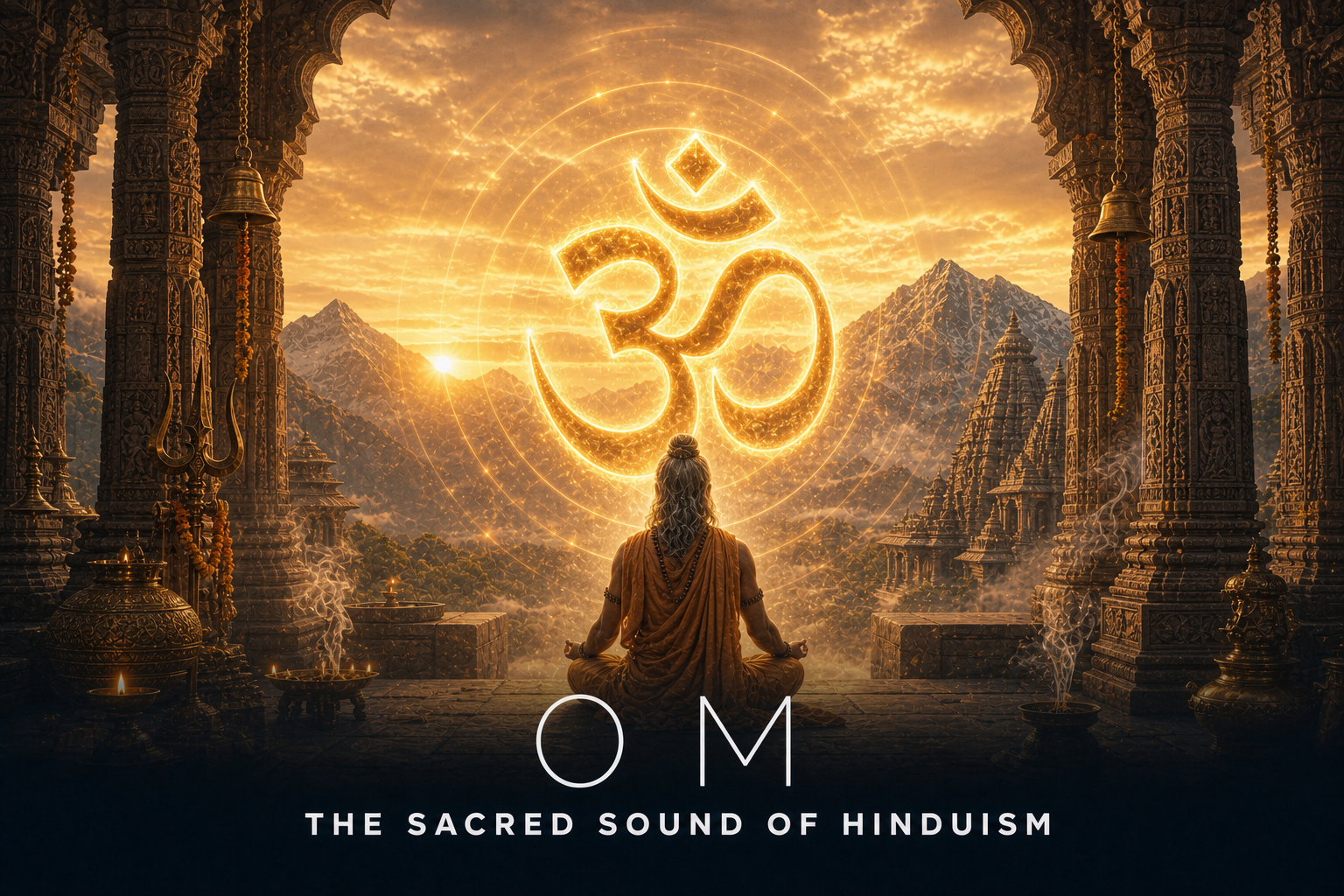
Before there was light, before there was sound as we know it, Hindu sages say there was one syllable: Om. Chant it before the Gayatri Mantra, before the Hanuman Chalisa, before Vedic hymns and daily puja — it always comes first. But why? What does this single sound actually mean, and why has it been called the “sound of the universe” for thousands of years?
Om as the First Sound of Creation
In Hindu cosmology, sound comes before form. Long before the world took shape, there was only vibration — and that first vibration was Om. The Chandogya Upanishad calls Om the udgitha, the sound through which all creation began, while the Rigveda already treats it as sacred utterance woven into the earliest hymns. It isn’t worshipped as a separate deity; it is understood as the essence contained within every deity, every mantra, and every prayer. When a priest opens a ritual with “Om,” he is not adding decoration — he is invoking the root sound from which everything else is said to have emerged.
What the Mandukya Upanishad Teaches About Om
The clearest explanation of Om comes from the Mandukya Upanishad, a short but profound text devoted entirely to this one syllable. It opens with a striking declaration: “Om, this syllable, is this whole world.” The Upanishad goes on to describe Om as containing everything that has been, everything that is, and everything that is yet to come. It is treated not as a word with a dictionary meaning, but as a direct pointer to Brahman — the underlying reality behind all appearances.
The Three Sounds of A-U-M — and the Silence That Follows
Written in Sanskrit, Om is really three sounds joined together: A, U, and M. The Mandukya Upanishad maps each one onto a state of consciousness we all pass through every single day:
A represents jagrat, the waking state, where we experience the world through the senses.
U represents swapna, the dreaming state, where the mind creates its own inner world.
M represents sushupti, deep, dreamless sleep, where even the sense of a separate self dissolves.
After the “M” fades, there is a pause — a brief silence before the next breath or the next chant. That silence is called turiya, the fourth state, said to be pure awareness beyond waking, dreaming, and sleep. This is why Om is chanted slowly and allowed to trail into stillness: the silence at the end is considered as much a part of the mantra as the sound itself.
The Symbol of Om: More Than a Sanskrit Letter
The familiar Om symbol seen on temple walls, malas, and doorways is not just decorative script. Traditionally, its curves represent the same three states — waking, dreaming, and deep sleep — the crescent above represents the veil of maya, or illusion, and the dot above that represents turiya, the transcendent state beyond it. Seen this way, the symbol is a small map of the entire spiritual journey: from ordinary waking life, through the layers of mind, past illusion, toward pure consciousness.
Why Every Mantra Begins With Om
Walk into any temple and you will hear it: Om Namah Shivaya, Om Namo Bhagavate Vasudevaya, Om Gan Ganapataye Namah. Nearly every major mantra in Sanatana Dharma opens with Om, and this is intentional. Chanting Om first is thought to align the reciter with the root vibration of the universe before addressing a specific form of the divine — Shiva, Vishnu, Ganesha, or Devi. It is a way of remembering that behind every name and form honoured in worship lies the same formless, boundless reality. In this sense, Om is not one mantra among many; it is considered the seed from which all mantras grow.
Om in Everyday Devotion
You don’t need a temple or a special occasion to encounter Om. It appears at the start of letters and speeches in traditional settings, on the walls of homes, etched into jewelry, and stitched into shawls used for meditation. Many households begin the day with a few rounds of Om chanted softly, using it the way one might take a breath before beginning anything important. Across centuries and regions, that single sound has remained a quiet constant — a reminder that whatever the day holds, it begins and ends in the same unbroken presence.
If chanting Om or any mantra is part of your daily practice, this combo pairs an authentic 5 Mukhi Rudraksha mala with a digital finger counter — so every round of japa is counted and every bead stays true to tradition.
Frequently Asked Questions
Is Om a Hindu word or just a sound?
Om is considered a sound-symbol rather than a word with a literal translation. Sanskrit tradition treats it as the root vibration behind all language and creation, which is why it is chanted rather than simply spoken.
Why do people chant Om before other mantras?
Chanting Om first is believed to align the mind and voice with the universal vibration before addressing a specific deity by name, connecting the personal form of worship to the formless reality behind it.
What is the difference between Om and Aum?
Om and Aum refer to the same syllable. “Aum” reflects the three Sanskrit sounds — A, U, and M — more precisely, while “Om” is the common transliteration used in everyday speech and writing.