
Every year, millions of devotees travel across India, Nepal, Bangladesh, Sri Lanka and Pakistan to visit temples known as Shakti Peethas — “seats of the Goddess.” There are traditionally said to be 51 of them. But few people stop to ask where this number comes from, or why these particular sites, scattered across such a vast and varied landscape, are considered sacred in the first place.
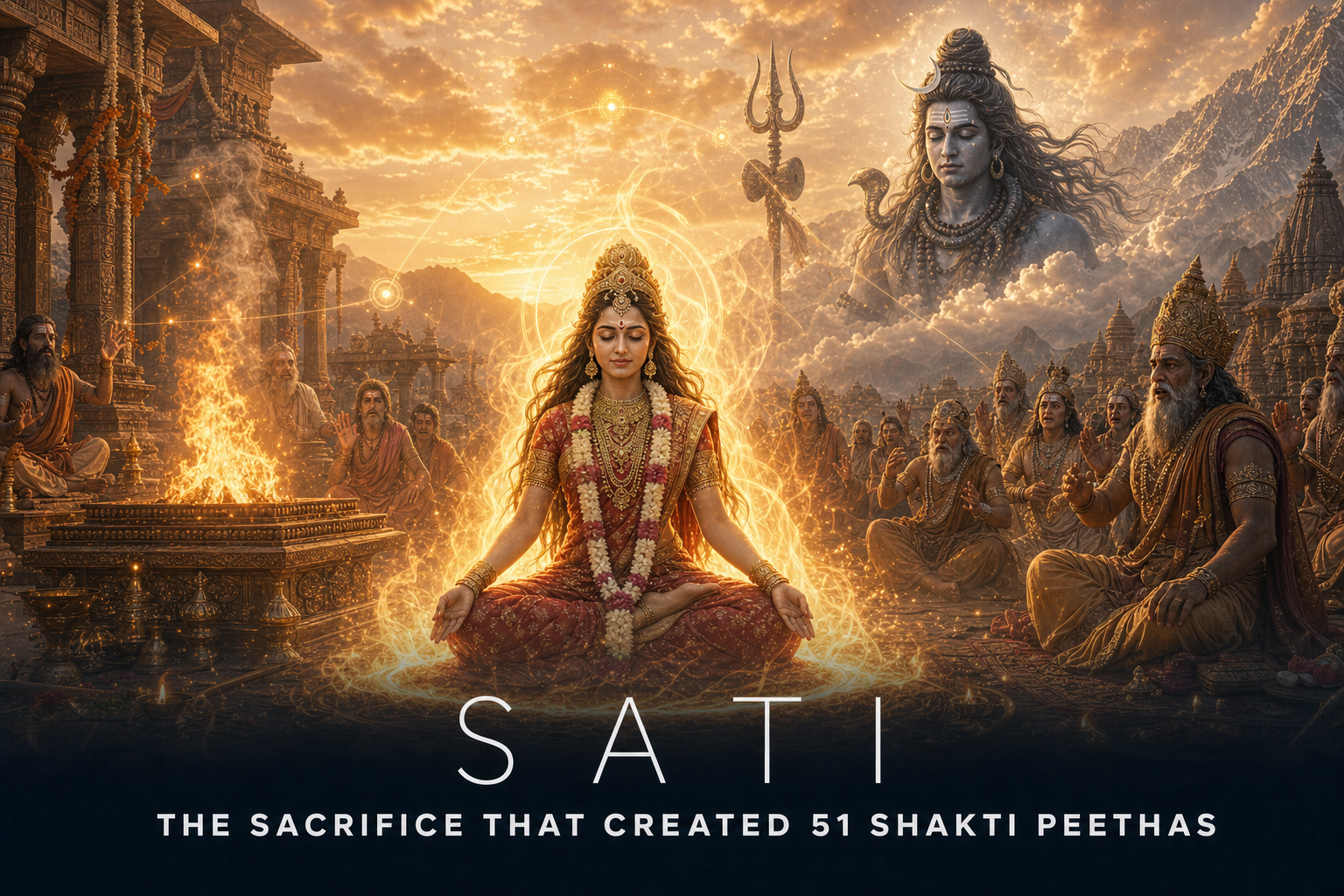
The answer lies in one of the most sorrowful stories in Hindu mythology — the story of Sati, Lord Shiva’s first consort, whose devotion and self-sacrifice at her father’s yagna set off a chain of events that reshaped the sacred geography of the subcontinent.
Who Was Sati?
Sati was the daughter of Prajapati Daksha, one of the mind-born sons of Lord Brahma and a powerful king among the Devas. From childhood, Sati was drawn to Lord Shiva, the ascetic god who lived apart from courtly life, meditating in the Himalayas. Despite her father’s disapproval, Sati chose Shiva as her husband, performing severe penance until he accepted her.
Daksha never fully reconciled himself to this match. In his eyes, Shiva was an unkempt wanderer — smeared in ash, garlanded with snakes, keeping company with ghosts and spirits at the cremation grounds — utterly unfit for a king’s daughter. This resentment simmered for years, and it finally erupted at a great yagna Daksha organised.
Daksha’s Yagna and the Insult to Shiva
According to the Shiva Purana and the Kalika Purana, Daksha planned a grand fire sacrifice and invited every deity of importance — every deity, that is, except Shiva. Sati learned of the yagna and, though uninvited and unwelcome, insisted on attending her father’s home. Shiva tried to dissuade her, sensing no good would come of it, but Sati’s love for her family made her go anyway.
At the yagna, Daksha ignored Sati entirely and then, in front of the assembled gods and sages, publicly insulted Shiva — mocking his appearance, his habits, and his worthiness to be called a god at all. Sati, who had defied her own father to marry Shiva out of conviction, could not bear to hear her husband humiliated in this way.
Sati’s Sacrifice and Shiva’s Grief
Unable to protest the insult through words, and equally unable to keep living in a body that traced its origin to a father who had dishonoured her husband, Sati invoked her yogic power and immolated herself in the very fire of the yagna. Some tellings describe this as an act of yogic self-annihilation rather than ordinary fire; others frame it simply as heartbroken sacrifice. Either way, the result was the same: Sati was gone.
When word reached Shiva, his grief turned instantly to a fury the scriptures describe as almost cosmic in scale. He tore a lock of his matted hair and struck it to the ground, from which sprang the fierce warrior Virabhadra, along with the goddess Bhadrakali. Shiva sent them to Daksha’s yagna to end it.
The Destruction of the Yagna
Virabhadra’s forces tore through Daksha’s sacrificial grounds, scattering the assembled gods and sages and destroying the ritual altar itself. Daksha was beheaded in the chaos. It was only after the other gods pleaded with Shiva to relent that Daksha was revived — in most versions, with the head of a goat, since his own could not be found or restored.
But Shiva’s sorrow did not end with the destruction of the yagna. Inconsolable, he lifted Sati’s body and began to wander the three worlds, locked in the Rudra Tandava, the cosmic dance of grief and destruction, unable to let go of what he had lost.
Vishnu’s Chakra and the Birth of the Shakti Peethas
Shiva’s endless mourning threatened the balance of creation itself, so the other gods turned to Lord Vishnu for help. Vishnu followed Shiva and, in an act meant to release him from his grief rather than to cause further harm, discharged his Sudarshan Chakra at Sati’s body as Shiva carried it. The discus cut through the body, and its pieces fell to earth at different points across the land, one by one.
Wherever a part of Sati’s body touched the ground, that place became a Shakti Peetha — a seat where the Goddess’s energy, or Shakti, is said to reside permanently, accompanied by a form of Shiva known as a Bhairava who guards the site. Traditional accounts count 51 such places, from Hinglaj in present-day Pakistan to Kamakhya in Assam, though various texts differ slightly on the exact count and locations, with some listing as few as 4 and others as many as 108.
If Sati’s story moved you, go deeper into the Goddess’s many forms. This complete guide covers all 9 Devis of Navratri, Ghatasthapana vidhi, katha, kanya pujan and aarti — in Hindi and English, ready for instant download.
What the Shakti Peethas Mean Today
Beyond the tragedy at their origin, the Shakti Peethas carry a deeper symbolic meaning. Each site represents a fragment of the divine feminine made permanently present in a specific place — a reminder that Shakti, the Goddess’s creative and protective energy, is not confined to one form or one location but is distributed across the land itself. Pilgrims who visit these sites, from Kalighat in Kolkata to Jwalamukhi in Himachal Pradesh, believe they are drawing close to a living, localized presence of the Goddess rather than merely a monument to a myth.
The story also carries a quieter lesson about respect within family and marriage: Daksha’s refusal to honour his son-in-law, and his public humiliation of him, is what set the tragedy in motion. In that sense, the Shakti Peethas stand not only as seats of divine energy but as an enduring reminder of what happens when pride overrides love.
Frequently Asked Questions
How many Shakti Peethas are there?
The most widely followed tradition counts 51 Shakti Peethas, corresponding to the 51 letters of the Sanskrit alphabet, though some older texts mention only 4 principal peethas and others list up to 108.
Why did Sati sacrifice herself at Daksha’s yagna?
Sati could not bear her father Daksha’s public insult of her husband, Lord Shiva, at the yagna. Unable to protest through words and unwilling to remain in a body connected to her father after the dishonour, she gave up her life through her yogic power.
What is a Bhairava in relation to a Shakti Peetha?
Each of the 51 Shakti Peethas is traditionally paired with a guardian form of Shiva called a Bhairava, said to watch over the site where a part of Sati’s body fell.