
Every year, on the day after Diwali, thousands of families in Braj build a small mountain out of cooked rice, sweets and vegetables, decorate it with flowers, and bow before it. They are not worshipping food. They are remembering a week when a seven-year-old boy held up a hill and quietly changed how Braj understood God.
The story of Krishna lifting Govardhan hill is one of the most loved episodes in the Bhagavata Purana. It is told to children as an adventure, painted in miniature after miniature, and sung in temples across Vrindavan. But underneath the drama of storm and stone sits a teaching that is surprisingly sharp: about fear, about ritual done out of habit, and about where divinity actually lives.
The Autumn Ritual That Started It All
Braj was cattle country. Its wealth was grass, milk and rain, and its people were cowherds who read the sky the way farmers still do. Each autumn, at the close of the monsoon, the elders of Gokul organised a grand yajna in honour of Indra, the deva of rain and thunder. Grain was gathered, offerings prepared, priests called. It was the biggest observance of their year.
Young Krishna watched the preparations and asked his father, Nanda, a simple question: why Indra? The answer he received was the answer most of us would give about our own inherited rituals – because it has always been done, and because Indra sends the rain, and because if he is displeased he may withhold it.
That last clause is the one Krishna refused to let pass. Worship offered out of fear of punishment, he suggested, is not devotion. It is a tax.
A Seven-Year-Old Redirects the Offering
Krishna made a different case to the elders of Braj. What actually sustains us here, he asked – what feeds the cows, holds the springs, gives shade, herbs and firewood? Govardhan, the hill at the heart of Braj. And who tends the cows and works the land? The Brajwasis themselves, and the brahmanas among them. Offer the puja there, he said. Honour what visibly nourishes you.
Remarkably, the elders agreed. The offering was carried to Govardhan instead. In the Bhagavata Purana, Krishna then does something extraordinary: he manifests a vast form upon the hill and declares that he himself is Govardhan, accepting the offering directly. It is the first hint that this leela is not about swapping one deity for another – it is about recognising the sacred in the ground under your feet.
Indra’s Storm and the Umbrella of Stone
Indra, watching his yajna cancelled, reacted exactly as Krishna had predicted a proud power would. He summoned the Samvartaka clouds – the clouds of dissolution – and unleashed a deluge on Braj. Rain fell in ropes. Hail struck the cattle. Rivers rose and the ground turned to slurry. The very people who had been told not to fear Indra now stood in the middle of his answer.
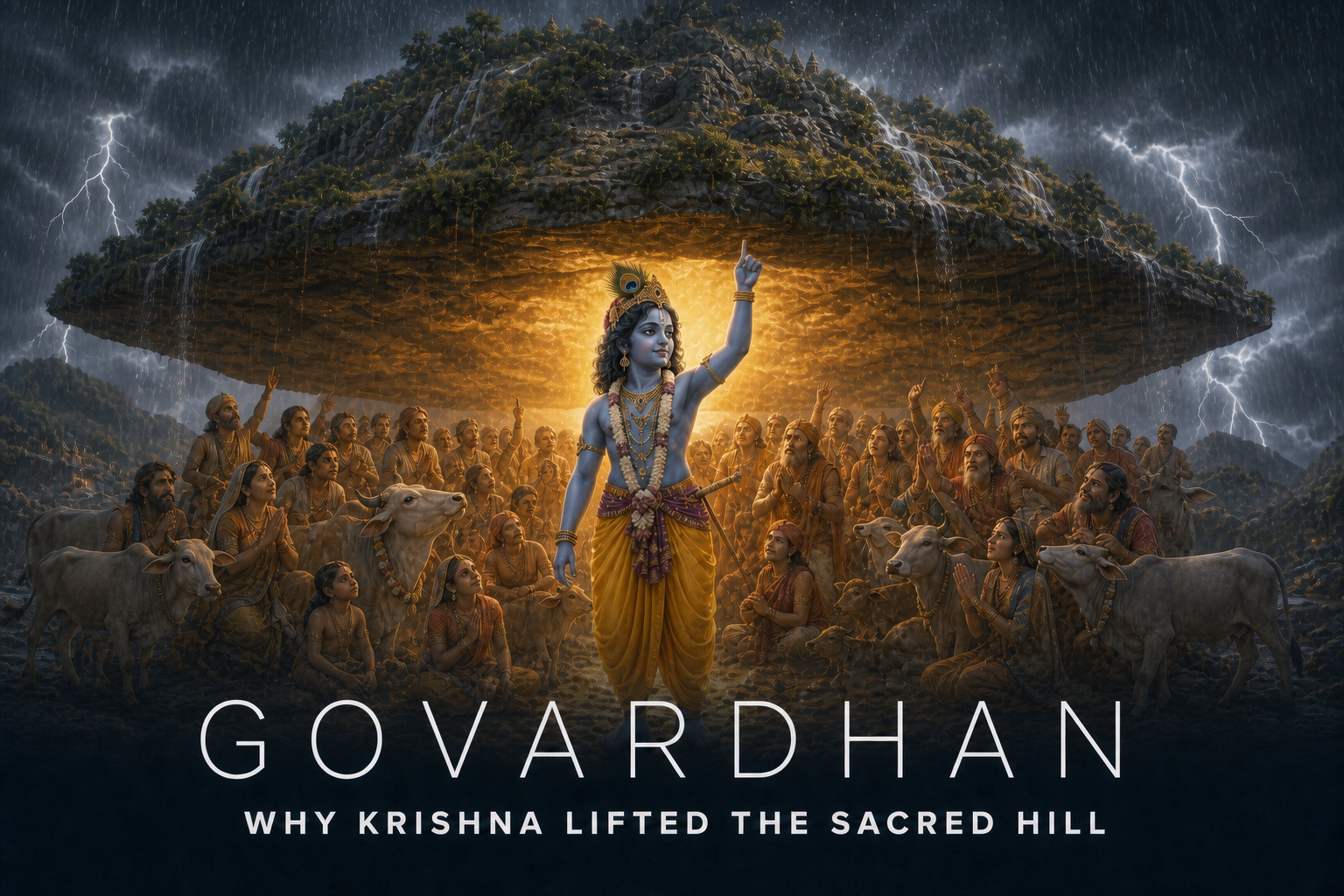
They ran to Krishna. And the boy walked to Govardhan, bent, lifted the entire hill, and balanced it on the little finger of his left hand like an umbrella of stone. Under it he gathered every man, woman, child, calf and cow of Braj.
The Purana says he held it for seven days and seven nights. Through all of it he did not eat, did not set the hill down, and did not falter – and the Brajwasis under the hill felt neither hunger nor thirst, so absorbed were they in looking at him. On the seventh day the clouds emptied themselves out and gave up. Indra, humbled, came down and bowed at Krishna’s feet, asking forgiveness for his pride.
Why the Hill Itself Is Worshipped as Giriraj
Because of those seven days, Govardhan is not treated as scenery in Braj. It is treated as a person. Devotees call it Giriraj – the king of mountains – and speak of it as Krishna’s own form. Pilgrims still walk the Govardhan parikrama, a circuit of about seven kos (roughly 21 kilometres) around the hill, many of them barefoot, some measuring the whole route with their body in dandavat pranam.
You will notice something in Braj that you see almost nowhere else: nobody climbs Govardhan. Walking on the hill is avoided out of reverence, because you do not stand on the body of the one you worship. Small stones from the hill, called Giriraj shilas, are carried home and given daily seva as living deities.
Annakut: The Mountain of Food
Once the storm passed, the Brajwasis wanted to thank the hill that had sheltered them. They cooked everything they had and heaped it before Govardhan – a mountain of food answering a mountain of stone. That offering became Annakut, literally “a hill of grain”, still celebrated the day after Diwali as Govardhan Puja.
In many temples the offering is the chhappan bhog, fifty-six preparations. The traditional explanation is quietly touching: Krishna normally ate eight times a day, and for seven days under the hill he ate nothing. Eight meals multiplied by seven days is fifty-six. The community was not just saying thank you – it was feeding a child it felt had gone hungry for its sake.
What the Govardhan Leela Actually Teaches
Read as theology rather than adventure, this leela carries three ideas that sit at the centre of bhakti.
Devotion is not protection money. Krishna does not object to worship. He objects to worship whose engine is fear. A relationship maintained only to avoid punishment is not a relationship, and Sanatana Dharma at its best asks for love, not appeasement.
The sacred is near, not distant. Indra sat in the heavens; Govardhan sat at the end of the village path. By moving the offering from one to the other, Krishna moved reverence from the abstract to the immediate – the hill, the cows, the trees, the people who feed you. This is why Braj still worships rivers, stones and tulsi plants without embarrassment.
Shelter comes to those who take shelter. Krishna lifts the hill, but the Brajwasis must walk under it. Grace in this story is not passive rescue; it is offered, and it has to be entered. The Sanskrit word for that step is sharanagati – taking refuge – and the image of a whole village standing under one raised hand is perhaps its most beautiful illustration in all of Hindu literature.
There is a smaller detail worth keeping. Krishna lifts the hill with the little finger of his left hand – the weakest finger of the non-dominant hand. The Puranas are making a point. For the one who holds the universe, holding a hill is not a feat of strength. What looks like a miracle from below is effortless from above.
If this leela draws you to Krishna, the Janmashtami Vrat Guide eBook walks you through the midnight vrat of his birth — muhurat, Nishita puja vidhi, the janma katha and aarti, in Hindi and English. Instant download on your phone.
Frequently Asked Questions
How old was Krishna when he lifted Govardhan hill?
The Bhagavata Purana describes Krishna as seven years old during the Govardhan leela. The detail is deliberate — the smallness of the child is what makes the lifting of a hill a statement about divinity rather than about strength.
Why did Krishna stop the worship of Indra?
Not out of rivalry with Indra, but to correct the motive behind the ritual. The Brajwasis were worshipping out of fear that rain would be withheld. Krishna redirected the offering to Govardhan hill, the cows and the brahmanas — what visibly sustained them — to teach that devotion should flow from gratitude, not dread.
Where is Govardhan hill and can it be climbed?
Govardhan is a low sandstone hill near Mathura in the Braj region of Uttar Pradesh, about 22 km from Vrindavan. Devotees do not climb it: because the hill is revered as Krishna’s own form, worship takes the shape of the parikrama, a walking circuit of roughly 21 km around its base.