

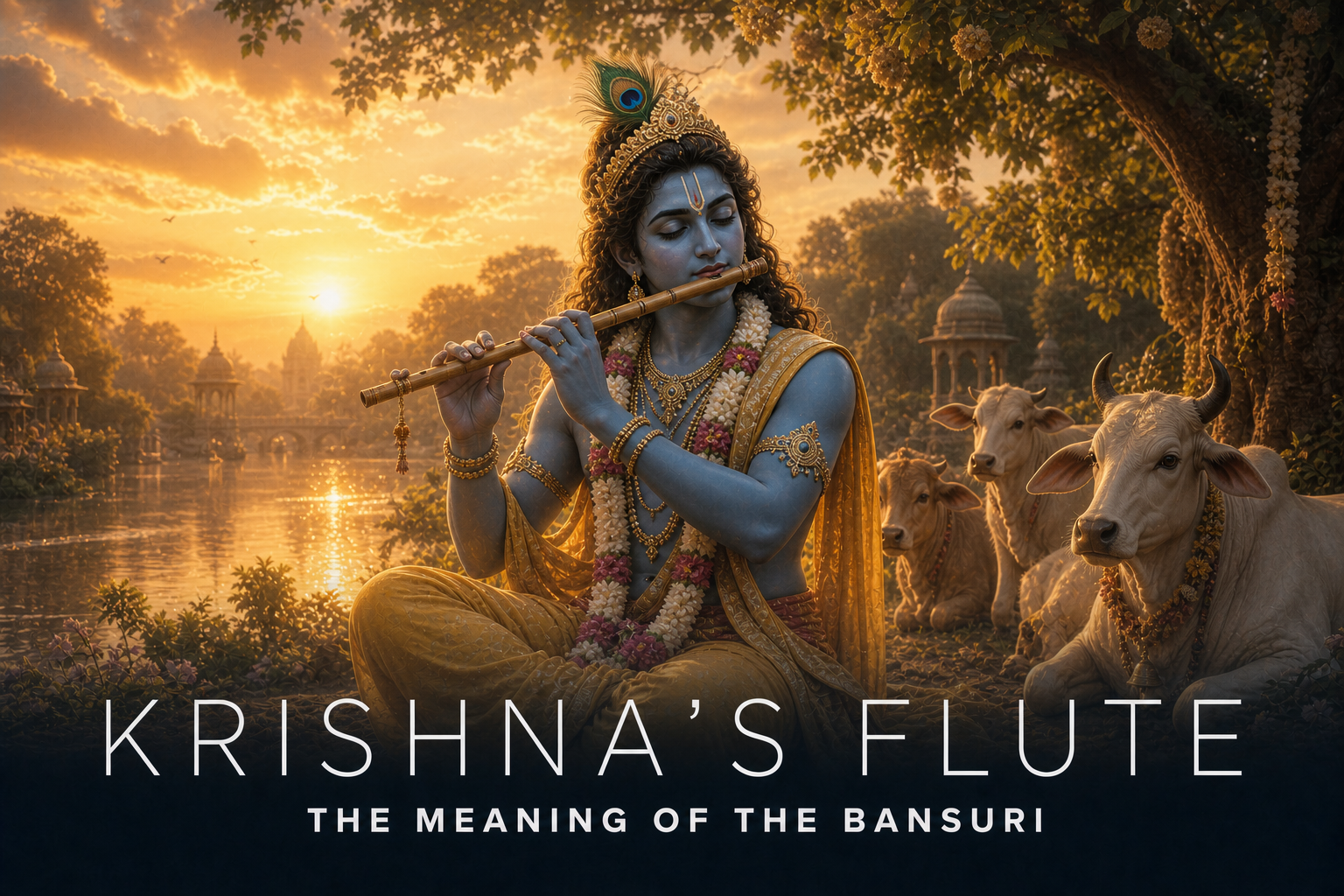
Almost every image of Shri Krishna carries the same detail. The peacock feather, the yellow pitambara, the slight bend of the body — and a simple length of bamboo held to his lips. He is Vishnu incarnate, the one who lifted Govardhan and spoke the Bhagavad Gita on the battlefield. Yet the object he is remembered holding is not a weapon or a crown. It is a flute.
So why does Krishna play the flute? The answer sits somewhere between story and philosophy — and once you hear it, the bansuri stops being an ornament and becomes the whole teaching.
The Flute Has Three Names, and Each Tells a Story
In Sanskrit scripture the instrument is called venu. In devotional poetry and bhajans it becomes murali — a name popularised in Bengal through the sixteenth-century Chaitanya Charitamrita, which is why Krishna is sung of as Murlidhar, “the one who holds the murali.” In North Indian music it is the bansuri, from bans, the Hindi word for bamboo.
The Brahma Samhita tradition goes further and describes Krishna as owning several flutes rather than one: the venu, the murali and the vamshi, each of a different length and number of holes, each drawing a different mood out of Vrindavan. Devotees read this not as trivia but as a hint — the divine call does not arrive in one voice. It meets each listener in the register they can hear.
Where Did the Flute Come From?
The texts do not agree, and that disagreement is itself revealing.
The Srimad Bhagavatam presents the simplest version: Krishna, a cowherd boy in the forests of Vraja, cut the bamboo himself and taught himself to play. No guru, no ceremony. The flute is what a village boy would naturally have in his hands while grazing cattle — and that ordinariness is the point. The Lord chose the humblest instrument available to him.
Other traditions, drawing on the Brahma Samhita, tell of the flute being given to Krishna by Shiva and Saraswati — Shiva, the great ascetic and master of sound, placing the instrument in the hands of the boy who would use it for love rather than for tapasya. Read together, the two accounts say the same thing from opposite directions: whether the flute came from the forest floor or from Kailash, it was never about the object. It was about who was breathing through it.
The Venu Gita: When the Gopis Described the Sound
The most beautiful account of Krishna’s flute in all of scripture is not a description of Krishna at all. It is a description of what happened to everyone else when he played.
In the twenty-first chapter of the Tenth Canto of the Srimad Bhagavatam sits a passage of about twenty verses known as the Venu Gita — the Song of the Flute. Autumn has arrived in Vrindavan. Krishna walks into the forest with his cowherd friends to graze the cattle, and he begins to play. The gopis, still in their homes, hear the sound drifting across the pastures, and they begin to speak to one another about it.
What they describe is not music. It is disruption. The rivers slow. The peacocks dance. The cows stand still with grass half-chewed in their mouths. And the gopis themselves lose the thread of ordinary life — milk boils over on the stove, questions from elders receive senseless answers, women stand motionless in open courtyards. Sri Chaitanya later compared the flute-song to a bird that flies into the ear and builds a nest there, after which no other sound can get in.
That is the theological claim hidden inside a pastoral scene: when the divine calls, everything you were carefully holding together simply stops mattering.
The Janmashtami Vrat Guide eBook carries the Janma Katha, the Nishita puja vidhi, mantras and aarti in Hindi and English together — so the midnight vrat is kept the way it was meant to be kept.
Why Bamboo? The Meaning of the Hollow Reed
Here is where the symbolism becomes unmistakable. A bansuri is nothing but a piece of bamboo that has been emptied out and pierced. It has no strings to tune, no reed to vibrate, no mechanism at all. Its entire capacity to make music comes from the fact that there is nothing inside it.
Saints have read this as the clearest available picture of the human soul. The bamboo had to be cut from its roots, hollowed of its pith, and bored through with holes before it could sing. Only then could another’s breath pass through it and become music. The flute contributes no sound of its own — it contributes emptiness, and offers that emptiness completely.
This is why Krishna’s flute is understood as a teaching on ego. So long as a person is full of themselves, nothing can move through them. Empty the ego, and the same life that felt like being cut and pierced becomes the reason the music is possible at all. The devotee’s prayer, in this reading, is not “make me great” but “make me hollow.”
The Flute as the Call of Love
There is one more layer. Krishna’s flute is never played to command — it is played to invite. He does not order the gopis to come; he plays, and they come, leaving behind homes and duties and reputations. The flute is the sound of attraction rather than authority.
That distinction matters in a tradition that also knows Krishna as the wielder of the Sudarshan Chakra and the charioteer who counsels war. The same divinity that can compel chooses, in Vrindavan, not to. It picks up a hollow reed instead and waits to see who listens. Bhakti is described exactly this way: the soul is not dragged towards God, it is drawn.
So when you next see that familiar image — the boy, the bend, the bamboo at his lips — you are not looking at decoration. You are looking at the whole path in one object: become empty, let the breath of the divine pass through, and the music that follows will not be yours to claim.
Frequently Asked Questions
What is Krishna’s flute called?
It is called venu in Sanskrit scripture, murali in devotional poetry, and bansuri in North Indian music. The name Murlidhar — “holder of the murali” — comes from the same word.
What does the hollow bamboo flute symbolise?
Emptiness of ego. The bamboo can only make music because nothing remains inside it, which sages read as the condition of a soul ready to let divine breath flow through unobstructed.
Where in scripture is Krishna’s flute described?
Most famously in the Venu Gita, roughly twenty verses in Chapter 21 of the Tenth Canto of the Srimad Bhagavatam, where the gopis describe the effect of the flute-song on Vrindavan.