
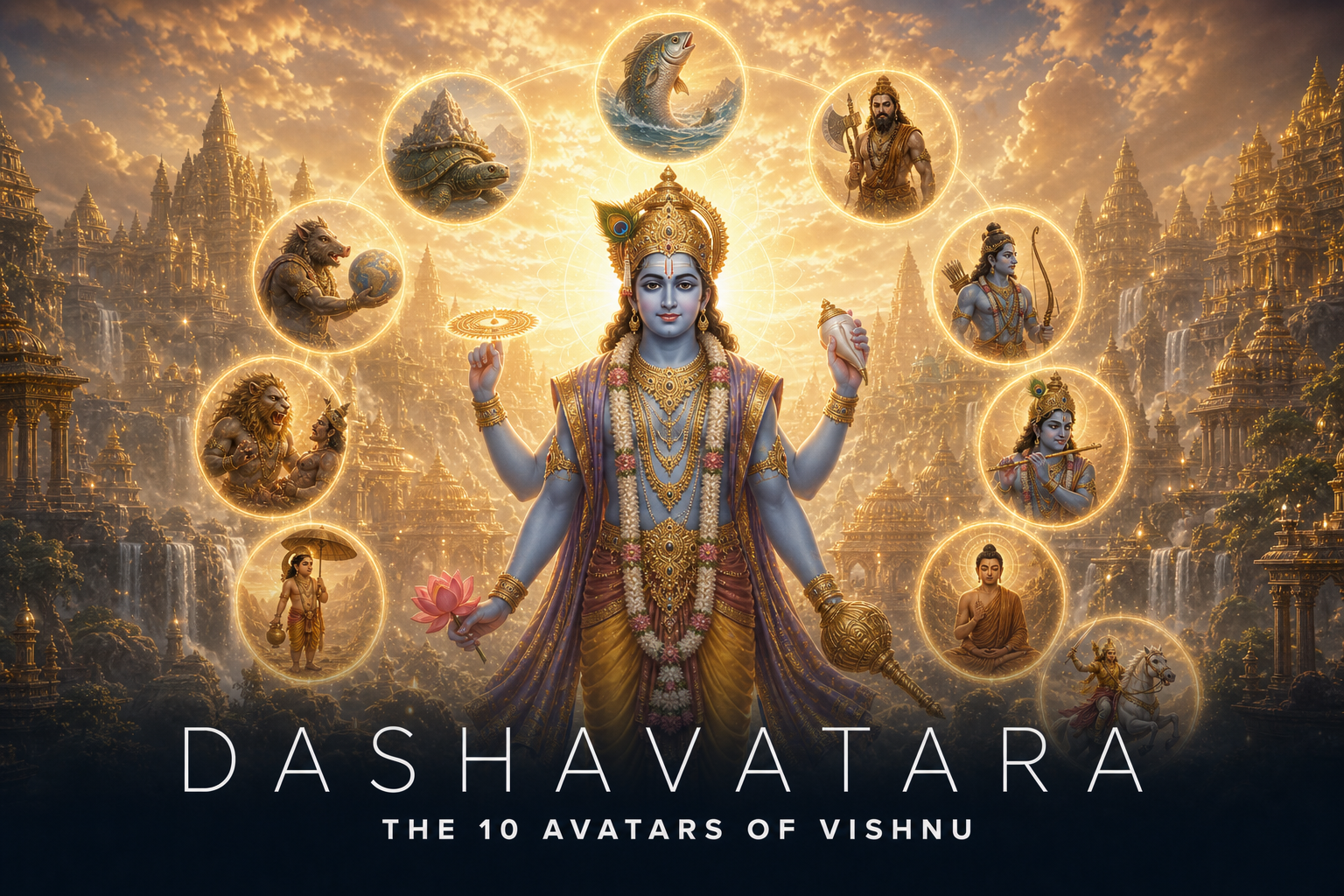
Long before the word “avatar” entered everyday English, Sanatana Dharma had already given it a precise meaning. Avatāra literally means a “descent” — the divine coming down into creation, taking a form that creation can hold. The Dashavatara is the most beloved list of these descents: ten forms in which Bhagwan Vishnu, the preserver, entered the world to restore dharma when it had tilted too far towards adharma.
What makes the Dashavatara so remarkable is not just the individual stories, but the shape of the sequence itself. Read in order, it moves from water to land, from beast to man, from the raw to the refined — a quiet map of how consciousness itself unfolds.
What Dashavatara Means and Why Ten
The word joins dasha (ten) with avatāra (descent). Hindu tradition does not claim Vishnu descended only ten times — the Bhagavata Purana speaks of innumerable incarnations, comparing them to countless streams flowing from an inexhaustible lake. The rishis simply selected ten as representative, the ones whose stories carry the fullest teaching.
The list appears in several texts, including the Bhagavata Purana (Canto 1, Chapter 3), the Garuda Purana and the Agni Purana, with small variations between them. The purpose of every descent is the same, and Krishna states it himself in the Bhagavad Gita: whenever dharma declines and adharma rises, the divine takes form again to protect the good, restrain the harmful, and re-establish righteousness.
The First Four: Avatars of Satya Yuga
Matsya, the fish. A great deluge was coming. Vishnu appeared as a small fish who grew impossibly large, and warned the righteous king Manu (Satyavrata) to build a boat carrying the seeds of life and the sages. Through the flood, Matsya towed that boat to safety. In several accounts, he also recovered the Vedas that had been stolen and hidden beneath the ocean. The first descent is a rescue of knowledge itself.
Kurma, the tortoise. When the devas and asuras churned the cosmic ocean for amrita, Mount Mandara — their churning rod — began sinking into the seabed. Vishnu became a vast tortoise and bore the mountain on his back so the churning could continue. Kurma is the avatar of patient, invisible support: the one who holds the weight while others do the visible work.
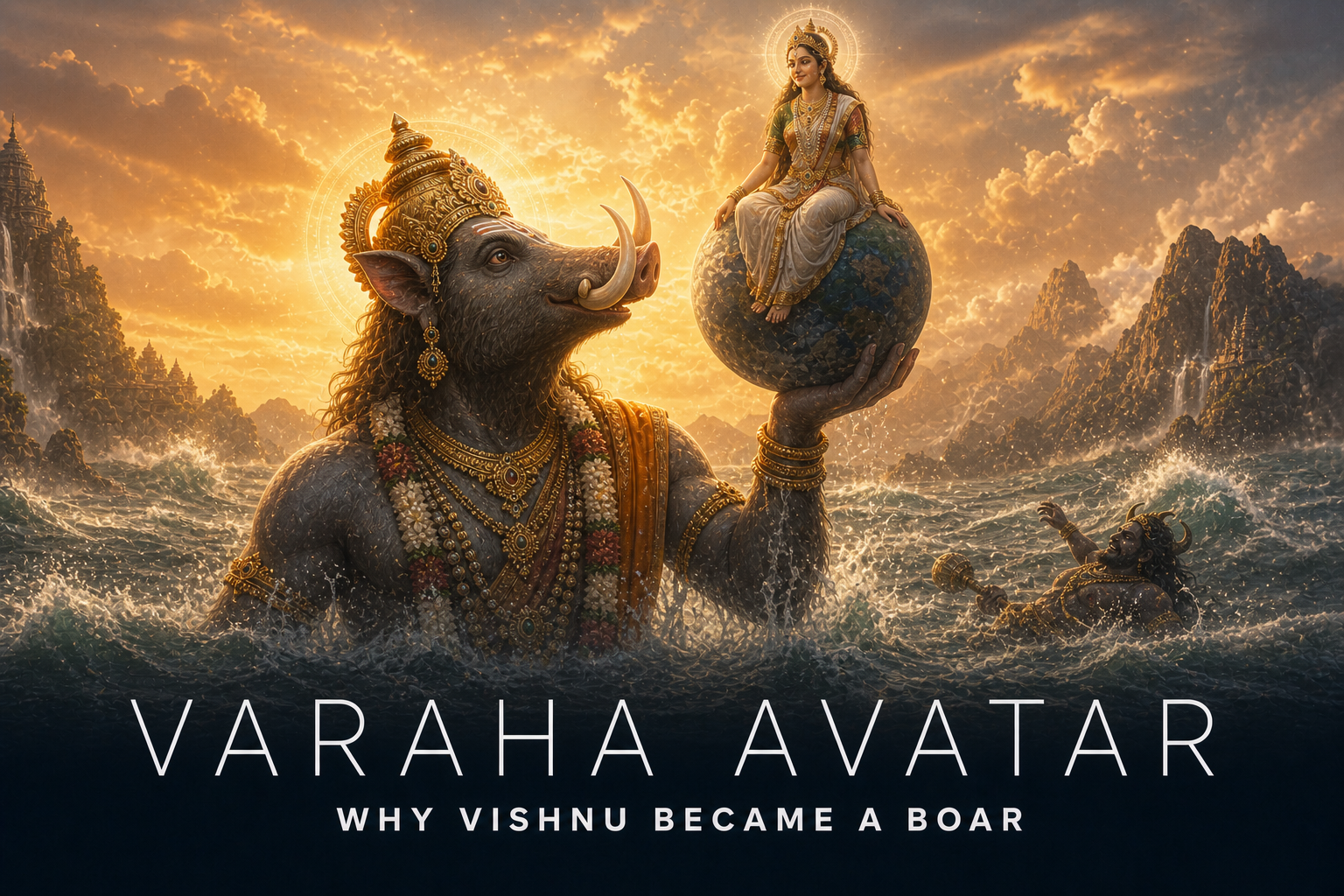
Varaha, the boar. The asura Hiranyaksha dragged the earth down into the cosmic waters. Vishnu took the form of a boar, dove into the depths, defeated him, and lifted Bhudevi — the earth — back on his tusks. Varaha is the guardian of the ground beneath our feet, the reminder that the earth is not property but a goddess to be raised, not sunk.
Narasimha, the man-lion. Hiranyakashipu had won a boon that he could not be killed by man or beast, indoors or outdoors, by day or night, on the ground or in the air, by any weapon. When he tormented his own son, the child-devotee Prahlad, Vishnu emerged from a pillar at dusk as a being neither man nor lion, placed the asura on his lap on a threshold, and tore him apart with his claws. Every clause of the boon was honoured and every clause was outmatched. Narasimha teaches that no clever arrangement can put anyone beyond dharma.
Treta Yuga: Vamana, Parashurama and Rama
Vamana, the dwarf. King Bali, generous but boundlessly ambitious, had taken the three worlds. Vishnu came as a short brahmachari and asked only for three paces of land. Bali laughed and agreed. Vamana then grew until two strides covered earth and heaven — and Bali, keeping his word, offered his own head for the third. Because his devotion was genuine, Vishnu granted him the netherworld of Sutala and the boon of returning each year to see his people, a homecoming still celebrated as Onam. This is the avatar of humility outweighing might.
Parashurama, the axe-bearer. Born to sage Jamadagni and Renuka in the Bhrigu lineage, he received his axe from Shiva himself. When the kshatriya rulers of the age turned arrogant and preyed upon the very people they were meant to protect, Parashurama humbled them. He is one of the chiranjivi — the immortals — and remains a bridge figure, appearing in both the Ramayana and the Mahabharata.
Rama, the ideal. Prince of Ayodhya, son of Dasharatha, husband of Sita, whose life Valmiki set down in the Ramayana. Rama does not defeat Ravana with divine trickery; he wins by never abandoning his word, his duty or his composure, even across fourteen years of exile. He is called Maryada Purushottam — the perfect man of boundaries — because he shows that divinity, once embodied, chooses to live inside human limits.
Dvapara Yuga: Krishna, the Complete Descent
Krishna is the avatar people love most, and the one hardest to summarise. He is the mischievous child of Gokul, the flute-player of Vrindavan, the statesman of Dwarka, and the charioteer who delivered the Bhagavad Gita on the field of Kurukshetra when Arjuna could not lift his bow.
Where Rama shows dharma as unbroken rule-keeping, Krishna shows dharma as living wisdom — the discernment to know what a moment actually demands. Many traditions call him purna avatara, the complete descent, because nothing of the divine was held back. Some lineages, especially in Sri Vaishnavism and much of South India, count his elder brother Balarama in the list of ten as well.
Kali Yuga: Buddha and Kalki
Buddha. The Bhagavata Purana (1.3.24) names Buddha among Vishnu’s descents. In the Puranic reading, he appeared to turn people away from ritual practised without compassion — particularly the animal sacrifice that had been reduced to a transaction for power. The inclusion is itself a teaching: dharma is capable of correcting its own excesses.
Kalki, the one still to come. The tenth avatar has not yet appeared. He is described as riding a white horse, Devadatta, bearing a blazing sword, born in a village called Shambhala at the close of Kali Yuga — ending the age and beginning a new Satya Yuga. Kalki is not really a prophecy of destruction. He is the assurance that no age of confusion is permanent.
The Hidden Logic of the Order
Place the ten side by side and a pattern appears. Matsya lives in water. Kurma moves between water and land. Varaha is fully terrestrial. Narasimha is half-animal, half-man. Vamana is human but incomplete in stature. Parashurama is a full human of raw force. Rama is the disciplined human. Krishna is the fully realised human. Buddha is the awakened one. Kalki is what comes after.
Water to land, animal to human, force to wisdom, wisdom to awakening. Whether one reads this as a spiritual ladder or simply as a beautifully ordered story, the Dashavatara says something steady and hopeful: creation is never abandoned, and every descent meets the world exactly where it stands.
Krishna’s descent is celebrated at midnight, and the Janmashtami Vrat Guide eBook carries the full janma katha, Nishita Kaal puja vidhi, vrat rules and aarti — in Hindi and English together. Instant download, read on any device.
Frequently Asked Questions
Are there only ten avatars of Vishnu?
No. The Bhagavata Purana describes innumerable incarnations and compares them to countless streams flowing from a lake that never empties. The ten of the Dashavatara were chosen by the rishis as the most representative, and other lists — such as the twenty-four avatars — also exist in the Puranas.
Why do some lists include Balarama instead of Buddha?
The ninth position varies by tradition. Most Puranic sources, including the Bhagavata Purana, name Buddha. Sri Vaishnava lineages and many South Indian temples place Balarama, Krishna’s elder brother, there instead. Both listings are considered valid within their own traditions.
Has the Kalki avatar already appeared?
No. Kalki is the only one of the ten still awaited. The Puranas place his appearance at the very end of Kali Yuga, after which Satya Yuga begins again. Traditional reckoning puts that far in the future, so Kalki remains a teaching about hope rather than an event to date.