
Long before clocks and calendars, the sages of Bharat measured time not in hours but in yugas — vast cosmic ages, each spanning hundreds of thousands of years. In the Sanatana vision, time is not a straight line marching forward but a great wheel that turns endlessly, rising and falling like the breath of the universe itself.
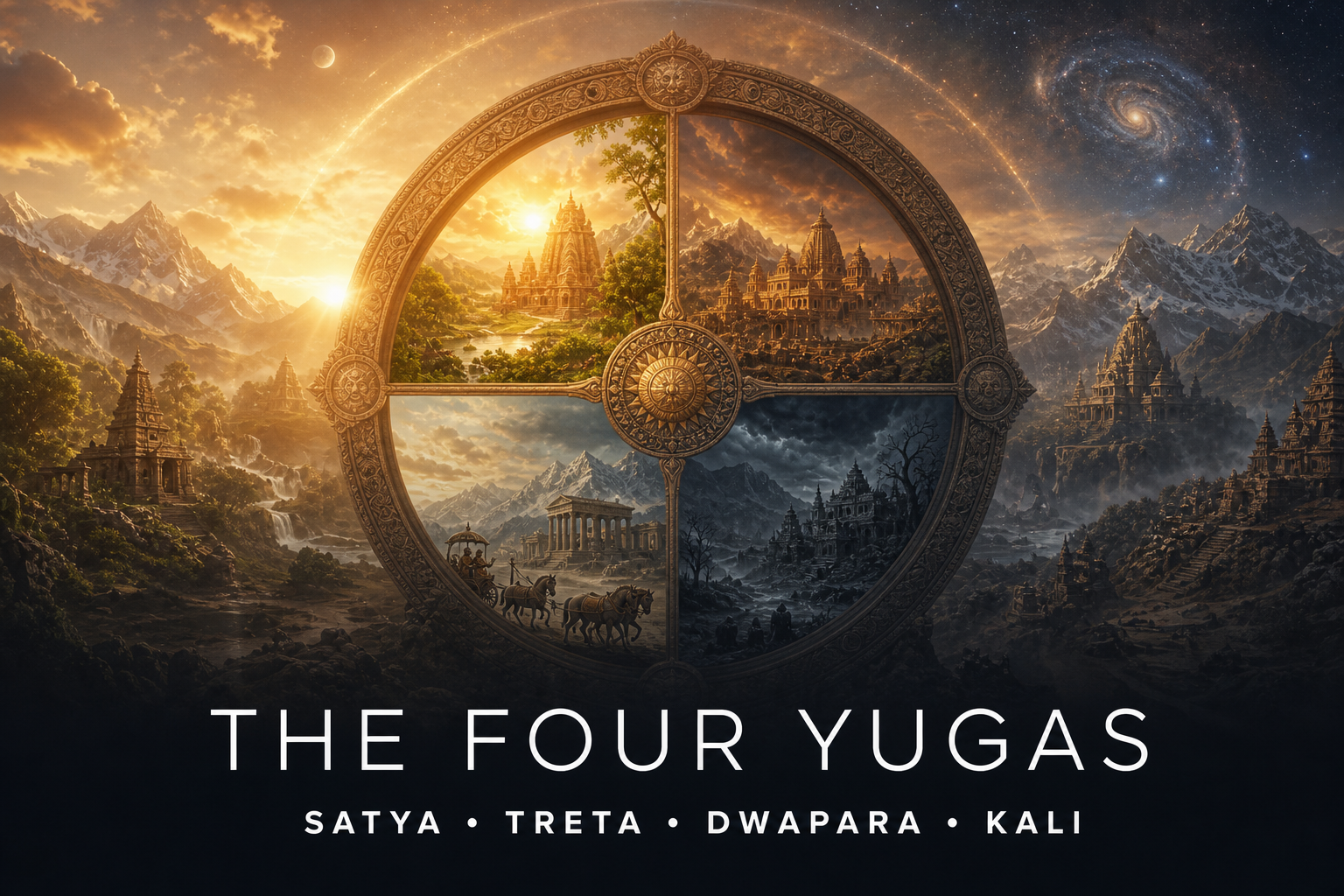
At the heart of this vision are the four Yugas: Satya, Treta, Dwapara and Kali. Together they tell a quiet, sobering story — the gradual dimming of truth and righteousness in the world, and the promise that the golden age will one day return. Understanding them is a way of understanding where we stand in the story of creation.
What Are the Four Yugas?
The word yuga means an age or epoch. The scriptures describe four of them, which together form one Mahayuga (great age) lasting 4,320,000 human years. Their durations fall in a striking 4:3:2:1 ratio, mirroring the steady decline of dharma from one age to the next:
- Satya Yuga — 1,728,000 years, the golden age of truth.
- Treta Yuga — 1,296,000 years, the silver age.
- Dwapara Yuga — 864,000 years, the bronze age.
- Kali Yuga — 432,000 years, the present age of iron.
Each yuga is shorter than the last, and in each, virtue, lifespan and spiritual clarity fade a little further. Yet the cycle never truly ends — when Kali Yuga closes, the wheel turns and Satya Yuga is reborn.
Satya Yuga: The Age of Truth
Satya Yuga, also called Krita Yuga, is the perfect first age — the “golden age” of Hindu cosmology. Here dharma stands complete and unbroken. People are said to have lived for thousands of years, free from disease, hunger and falsehood. There were no divisions born of pride, no need for temples or elaborate rituals, because the divine was directly perceived within the heart.
In this age, the path to self-realisation was pure meditation (dhyana). The mind was so clear and the soul so unclouded that simply turning inward was enough to know the truth. Righteousness required no enforcement; it was the natural state of every being.
Treta and Dwapara: The Slow Descent
With Treta Yuga, the silver age, the first shadow falls. Godly qualities diminish by a quarter, and truth is no longer effortless. This is the age of the great yajnas — the sacred fire sacrifices — through which people sustained their connection with the divine. It is also the age of Lord Rama, whose life became the eternal model of duty, honour and sacrifice.
Dwapara Yuga, the bronze age, brings a further decline. Now dharma stands on only half its foundation. Doubt, disease and desire grow stronger, and human lifespans shrink. The recommended practice shifts to the worship of the deities within temples. This is the age that closes with the Mahabharata and the earthly life of Lord Krishna, whose teachings in the Bhagavad Gita were given precisely as the world was about to slip into the darkest age of all.
Kali Yuga: The Age We Live In
Kali Yuga — the age of iron, of quarrel and strife — is the fourth and final yuga, and the one we are living in now. It is said to have begun around 3102 BCE, after Krishna departed from the earth. In this age, only a quarter of dharma remains. Truth is scarce, attention is short, greed is common, and the span of human life is brief.
And yet the scriptures offer a striking comfort. Because life in Kali Yuga is so difficult and so short, the path to the divine is made the simplest of all. Where earlier ages demanded years of meditation, grand sacrifices or elaborate temple worship, this age asks only for sincere devotion and the chanting of the holy names of God (nama-sankirtana). A single heartfelt prayer here is said to carry the weight of long austerity in the golden age.
The Bull of Dharma: A Living Symbol
The Puranas capture this whole descent in one unforgettable image: dharma as a great bull. In Satya Yuga the bull stands firm on all four legs — the four pillars of righteousness: truthfulness, compassion, austerity and charity. As each age passes, the bull loses one leg. In Treta it stands on three, in Dwapara on two, and in our own Kali Yuga it balances precariously on a single leg — truthfulness alone.
The image is not meant to frighten but to awaken. It reminds us that righteousness in this age is fragile and must be consciously protected. Every act of honesty, kindness, self-discipline and generosity is, quite literally, a way of holding up the last leg of dharma.
In Kali Yuga, the simplest path is sincere daily devotion. Explore puja essentials, sacred books and spiritual guides at The Divine Store — thoughtfully curated to keep your practice steady and heartfelt.
Why the Yuga Cycle Still Matters
It would be easy to read the yugas as a tale of despair — a world sliding endlessly downhill. But the deeper teaching is one of hope and perspective. The wheel always turns. Kali Yuga is not the end but a passage, and beyond it lies the return of the golden age. Nothing in the cosmos is permanently lost; light always follows darkness.
For the seeker, the yugas offer a gentle instruction: do not measure your worth by the age you were born into, but by how faithfully you uphold dharma within it. To live simply, speak truthfully and love sincerely in Kali Yuga is worth more than the same acts would be in an easier age. In that sense, this difficult age is also the most generous one of all.
Frequently Asked Questions
Which yuga are we currently living in?
We are living in Kali Yuga, the fourth and final age of the cycle, believed to have begun around 3102 BCE after Lord Krishna left the earth. It is the shortest yuga, lasting 432,000 years in total.
How long does one complete cycle of the four yugas last?
One full cycle of all four yugas — a Mahayuga — spans 4,320,000 human years. The four ages follow a 4:3:2:1 ratio in length, from the long Satya Yuga down to the comparatively brief Kali Yuga.
What is the easiest spiritual practice for Kali Yuga?
The scriptures teach that in Kali Yuga the simplest and most effective path is nama-sankirtana — the sincere chanting and remembrance of the holy names of God — along with genuine devotion, honesty and compassion in everyday life.