
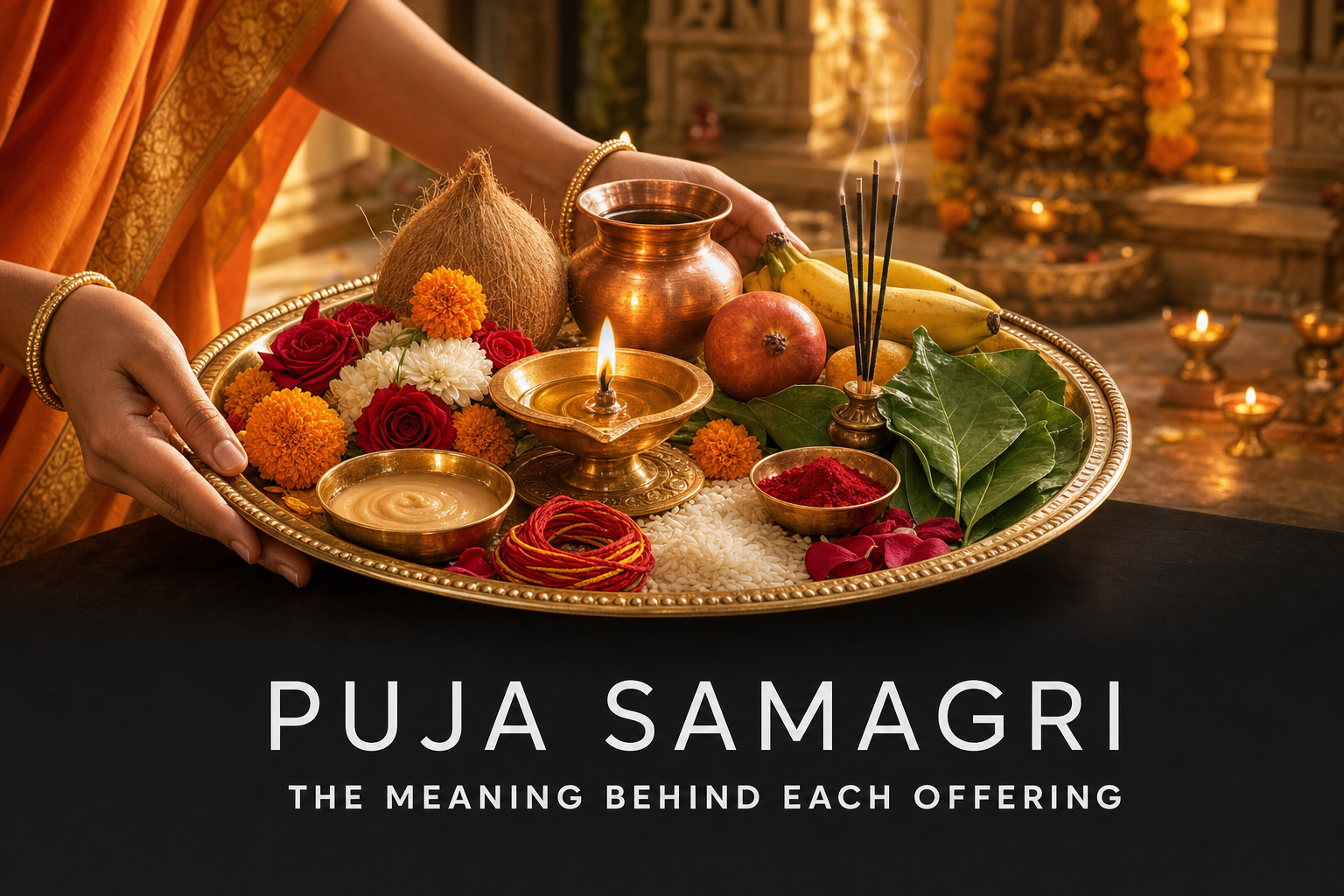
Stand in front of a home mandir during an aarti and you will see a very particular set of things: a lamp burning clarified butter, a few grains of unbroken rice, a smear of sandalwood, a thread of red cotton, water in a small vessel. Every tradition has its ritual objects, but Sanatana Dharma is unusually specific about hers. Nothing in that arrangement is decorative, and nothing is arbitrary.
We rarely stop to ask why. Most of us learned these offerings by watching a mother or grandmother, absorbing the what without ever being told the why. And so a question surfaces sooner or later, usually from a child: does it actually matter if we use one thing instead of another?
It does — and the reason is more interesting than mere rule-following.
An Offering Is a Language, Not a Transaction
The first thing to understand is that puja is not a payment. The deity does not require ghee. What the offering does is give a formless devotion something to move through — it turns an inward feeling into an outward act, which is precisely how the mind learns to hold an intention steady.
Each item in a puja carries meaning the way a word carries meaning. Substitute a word at random and the sentence still makes sounds, but it stops saying what you meant. That is roughly what happens when samagri is swapped carelessly. The ritual still looks like a ritual. It simply stops articulating what it was designed to say.
What the Common Offerings Represent
Consider the items that appear in nearly every puja, and what tradition understands them to mean:
- The ghee lamp (diya). Flame is knowledge dispelling ignorance. Ghee, drawn from milk through patient refinement, represents the mind purified through effort. A wick burns itself away entirely to give light — the image of the ego consumed in devotion.
- Akshat, unbroken rice. The word akshat means “unbroken” or “whole”. The grains are deliberately not split, because what we offer the divine should be complete and unfragmented, as our attention ought to be.
- Water. The simplest offering and the oldest. Water purifies, takes the shape of whatever holds it, and asks nothing. In a tradition where the poorest devotee must be able to worship fully, water ensures no one is excluded.
- Chandan, sandalwood. Sandalwood cools, and it gives fragrance even to the blade that cuts it. It marks the space between the brows, and stands for a mind that stays cool and returns sweetness for injury.
- Flowers. Beautiful, fragrant and brief. A flower offered at its peak is an acknowledgement that we give our best knowing it will not last — which is the whole shape of a human life.
- Mauli, the red thread. Tied at the wrist, it makes a vow physical. Long after the puja ends, the thread is still there, quietly reminding the wearer of a resolve they made.
Read together, the arrangement on a puja thali is a compressed teaching: come whole, come purified, give your best, stay cool-headed, remember what you promised.
Why Some Offerings Are Forbidden
The prohibitions puzzle people more than the prescriptions. Why is tulsi, beloved to Vishnu, kept away from Shiva? Why is durva grass essential to Ganesha but avoided for Durga?
The answers live in the stories. Each restriction traces back to a specific episode in the Puranas — a curse, a promise, a moment of divine displeasure — and the tradition preserves these not as arbitrary taboos but as remembered history between a deity and a plant, a flower, a substance. To observe them is to show that you know the story. It is a form of attentiveness.
There is also a quieter logic underneath. The prohibitions force the worshipper to know which deity they are approaching and how that deity is approached. They prevent worship from collapsing into a generic gesture aimed at nothing in particular. Specificity is what makes a relationship personal.
Purity Means Fitness, Not Expense
Here the tradition is often misread, sometimes deliberately. Shuddhata — purity — is regularly presented as a matter of cost, as though a more expensive offering carries more weight. It does not.
Purity in this context means an item is genuinely what it claims to be and fit for the purpose it is being used for. Ghee that is actually ghee. Rice that is actually unbroken. Water that is clean. A humble offering that is authentic is more correct, in shastric terms, than a lavish one that is adulterated.
The Bhagavad Gita settles this argument directly. Krishna says that a leaf, a flower, a fruit or water, offered with devotion, is what he accepts. The list is deliberately modest. The condition is not the value of the object but the sincerity behind it.
Why Correctness Still Matters, Then
If devotion is what counts, does correctness matter at all? Yes — for a reason that has nothing to do with pleasing a deity and everything to do with the worshipper.
Ritual works on the mind through repetition and precision. When you prepare the right items, in the right order, with attention to what each one means, the preparation itself becomes part of the worship. Your mind arrives at the puja already gathered. When you improvise carelessly, the ritual becomes a performance you are watching yourself give, and the mind stays outside it.
Correctness, in other words, is not a test set by the divine. It is a discipline offered to the devotee, and its benefit lands squarely on the one who observes it.
Authentic puja samagri, idols and diyas, online pooja booking, kundli and muhurat consultations, and bilingual vrat guides — curated to what the vidhi actually asks for.
Frequently Asked Questions
Does it matter which items I use in a puja?
Yes, though not because the divine demands luxury. Each offering carries a specific meaning, and certain items are traditionally forbidden for particular deities. Using the correct samagri keeps the ritual coherent and keeps the worshipper attentive.
What if I cannot obtain a particular item?
The tradition is accommodating. Water alone, offered sincerely, is a complete offering — the Bhagavad Gita says as much. Absence of an item is not a barrier; carelessness about what is available is a different matter.
Why is tulsi not offered to Lord Shiva?
The prohibition traces to the Puranic account of Tulsi, wife of the asura Jalandhara, whom Shiva slew. Tulsi is therefore central to Vishnu worship and kept away from Shiva — one of several restrictions rooted in remembered story rather than arbitrary rule.