
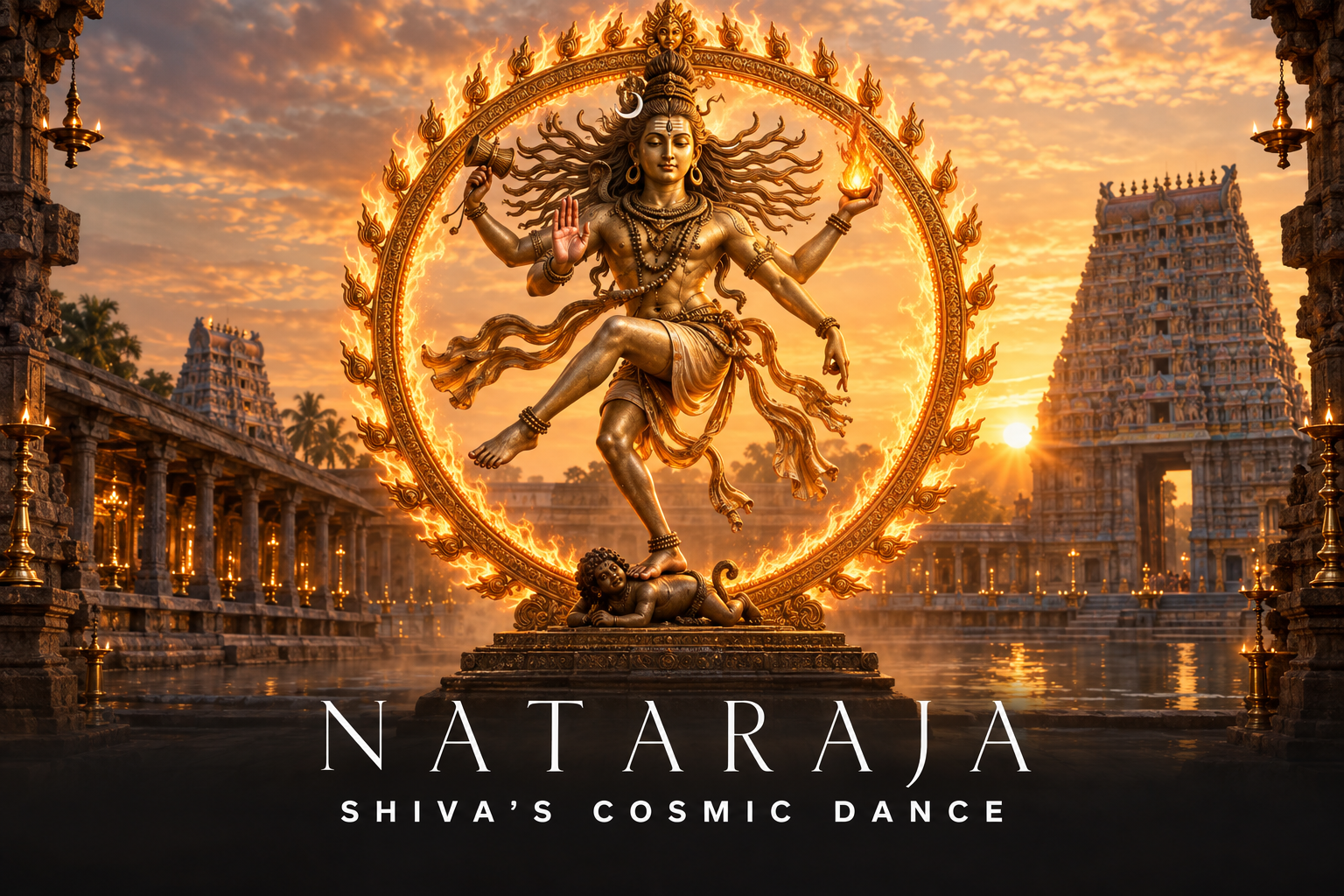
Of all the forms in which Shiva is worshipped, none is quieter in its face and louder in its meaning than Nataraja. A ring of fire. One foot lifted mid-air. Four arms caught in a gesture that looks like it has been held for ten thousand years. And in the middle of all that motion, a face that is perfectly, impossibly calm.
This is the story of Nataraja and the meaning of Shiva’s cosmic dance — where the form came from, which sages first saw it, and why every element of the image was placed there deliberately.
Who Is Nataraja? The King of Dance
The name breaks into two simple words: nata, meaning dance or the art of the dancer, and raja, meaning king. Nataraja is Shiva as the Lord of Dance — not a god who happens to dance, but a god whose dance is the act of holding the universe together.
In Sanatana thought the cosmos is not a finished object but an ongoing event — made, held, unmade and made again at every scale from a galaxy to a breath. Nataraja is that ceaselessness given a body, and his dance, the Tandava, is the rhythm by which creation happens at all.
What makes the form so striking is the contradiction it holds without strain. The limbs are in motion, the hair has flown loose, fire rings the figure — and the face registers none of it. That stillness at the centre of the storm is the entire teaching. The dance is what the world does. The stillness is what Shiva is.
The Legend of the Thillai Forest
The best-known story behind the Nataraja form is set in the Thillai forest of the far south, at the place known today as Chidambaram in Tamil Nadu. Two great sages had come there, each by his own long road. The first was Vyaghrapada. He wished to offer Shiva only the freshest flowers — blossoms gathered before dawn, before a bee had touched them, before any human hand had brushed the petals. To reach them he needed to climb in darkness, on bark, without slipping or bruising a single bloom. Tradition holds that Shiva granted him the claws and feet of a tiger so that he might do it. The name itself carries the story: vyaghra is tiger, pada is foot.
The second was Patanjali, the sage whose name the tradition of yoga carries, drawn to Thillai by the same pull.
For the devotion of these two, and in the presence of the gods and his own consort Shivakamasundari, Shiva performed the Ananda Tandava — the Dance of Bliss. That word ananda is worth pausing on. It is not pleasure and it is not excitement. It is closer to fullness: the state of a thing that lacks nothing at all. Shiva did not dance because he was delighted. He danced because that is what completeness looks like when it moves.
The Dance Contest and the Urdhva Tandava
A second strand of the Thillai tradition tells of a contest. Kali, whose power had long presided over that forest, is said to have challenged Shiva to a dance — a test of who would hold sway there.
Step for step she matched him; in force and in skill they were equal. Then Shiva lifted one leg straight up toward the sky — the posture remembered as the Urdhva Tandava. Kali would not follow. Some tellings say she could not; the gentler readings say she chose not to, out of the modesty proper to the Mother of the world.
Either way, the point of the story is not a defeat. It is a direction. Every other movement of the dance happens across the earth, in the plane of the world. The raised leg alone points away from it. It is the one step that is not about the world at all, and that is exactly why it settles the matter.
Reading the Nataraja Form: What Every Symbol Means
Almost nothing in the Nataraja image is decorative. Each element is a word in a sentence, and once you can read them the figure resolves into a single statement.
- The damaru in the upper right hand. The hourglass drum is the sound of creation — the first vibration, the beat that begins time.
- The agni in the upper left hand. Opposite the drum, a tongue of flame: the fire in which everything made is finally unmade. Creation in one hand, dissolution in the other — balanced, neither winning.
- The lower right hand in abhaya mudra. The open palm of fearlessness. Amid fire and cosmic change, the message to the devotee is simply: do not be afraid.
- The lower left hand pointing to the raised foot. The hand sweeps across the body toward the lifted left foot — the one thing in the image not touching the ground of the world, and so the promise of liberation.
- The figure beneath the right foot. A small being called Apasmara or Muyalaka lies pinned under Shiva’s planted foot — forgetfulness, ego and heedlessness, the fog that keeps a person from seeing.
- The ring of fire. The prabha mandala is the cosmos itself, burning and renewing at its edge while the dancer at its centre remains unchanged.
One detail deserves more attention than it usually gets: Shiva does not kill Apasmara. He does not destroy ignorance — he stands on it. If forgetfulness were wiped out entirely, knowledge would have no meaning, because nothing would ever have to be realised. Ignorance is not the enemy to be annihilated; it is the ground to be kept underfoot.
Tandava and Lasya: Two Halves of One Rhythm
Tandava is usually translated as the fierce dance and its counterpart Lasya, associated with Parvati, as the gentle one. It is tempting to read them as opposites — destruction against creation. They are better read as one motion seen from two sides.
Nothing new can occupy a space that is already full. A seed sprouts only because the seed coat breaks. What Tandava dissolves is not the world but the form the world had been holding — and in that clearing, the next form becomes possible. It is not a demolition followed by a rebuild. It is one continuous turning.
Chidambaram and the Space That Holds Nothing
The great temple at Chidambaram keeps a striking secret at its heart. Behind the golden hall of the dancing Shiva is a shrine many pilgrims come specifically to see — and what it enshrines is empty space.
It is called the Chidambara Rahasya, and the emptiness is the point. Shiva is worshipped there as akasha, the element of space itself. Every other element can be held, poured, lit or breathed; space can only be recognised. It allows everything else to exist and is itself never touched by any of it.
Which brings the whole image back to that calm face. The dance is the world. The dancer is what the world is happening in.
The Nataraja teaches steadiness inside movement — and a small daily practice is how that steadiness is built. Our Shiv Sadhna Combo pairs a black stone Shivling for abhishek with an original 5 Mukhi Rudraksha mala for japa, so your sadhana has both a seat and a rhythm.
Frequently Asked Questions
What does Nataraja mean?
Nataraja means King of Dance, from nata (dance) and raja (king). It is the form of Shiva as the cosmic dancer whose Tandava creates, sustains and dissolves the universe.
Who is the figure under Nataraja’s foot?
He is Apasmara, also called Muyalaka — the personification of ignorance, ego and forgetfulness. Shiva subdues him rather than destroying him, because knowledge only has meaning where forgetting is still possible.
Why is Nataraja associated with Chidambaram?
Tradition holds that Shiva performed the Ananda Tandava, the Dance of Bliss, in the Thillai forest at Chidambaram before the sages Patanjali and Vyaghrapada. The temple there worships Shiva as akasha, the element of space.