

Some prayers stay with us because their rhythm feels familiar long before their meaning becomes clear. Purnamadah is one of them. We may hear its repeated sound of purnam at the beginning of a teaching or its gentle closing appeal for peace, and wonder what kind of fullness it describes.
The meaning of Purnamadah centres on wholeness: a reality that remains complete even as the world appears from it. Its few lines open a large question about Brahman, the universe and our sense of belonging. Approached patiently, this Upanishadic invocation invites both careful thought and quiet devotion.
1. The prayer and its Upanishadic setting
The familiar invocation is:
ॐ पूर्णमदः पूर्णमिदं पूर्णात्पूर्णमुदच्यते ।
पूर्णस्य पूर्णमादाय पूर्णमेवावशिष्यते ॥
ॐ शान्तिः शान्तिः शान्तिः ॥
Its central verse occurs in the Brihadaranyaka Upanishad at 5.1.1. It is also traditionally used as an invocation with the Isha, or Isavasya, Upanishad. These two contexts explain why readers encounter the prayer alongside different Upanishadic texts.
A brief paraphrase is that the fullness indicated as “That” is also present as “this”; what comes forth from fullness is full, and fullness remains. The closing words ask for peace.
This is a prayer worth allowing to remain a question as well as a declaration. Its language asks us to reconsider assumptions that usually feel obvious: that producing something must diminish its source, and that the reality before us must be separate from the reality we seek.
2. What the words Purnam, Adah and Idam mean
Purnam means full or complete. In the Vedantic explanations considered here, it points towards the limitless completeness of Brahman. It carries a larger meaning than a container filled to its rim.
Adah means “that,” while idam means “this.” Swami Krishnananda explains these terms in relation to the source beyond ordinary sense perception and the manifested world we encounter. The verse applies fullness to both.
The words describing what comes forth and what remains complete the movement of the prayer. We hear the same central idea again and again, as though language were gently turning our attention around one difficult insight.
For a reader beginning to explore Vedanta, keeping these meanings close is enough to make the verse less distant. “That” and “this” stop being empty pointers. They bring the unseen source and our experienced world into a shared contemplation of completeness.
3. How can the whole remain after the whole?
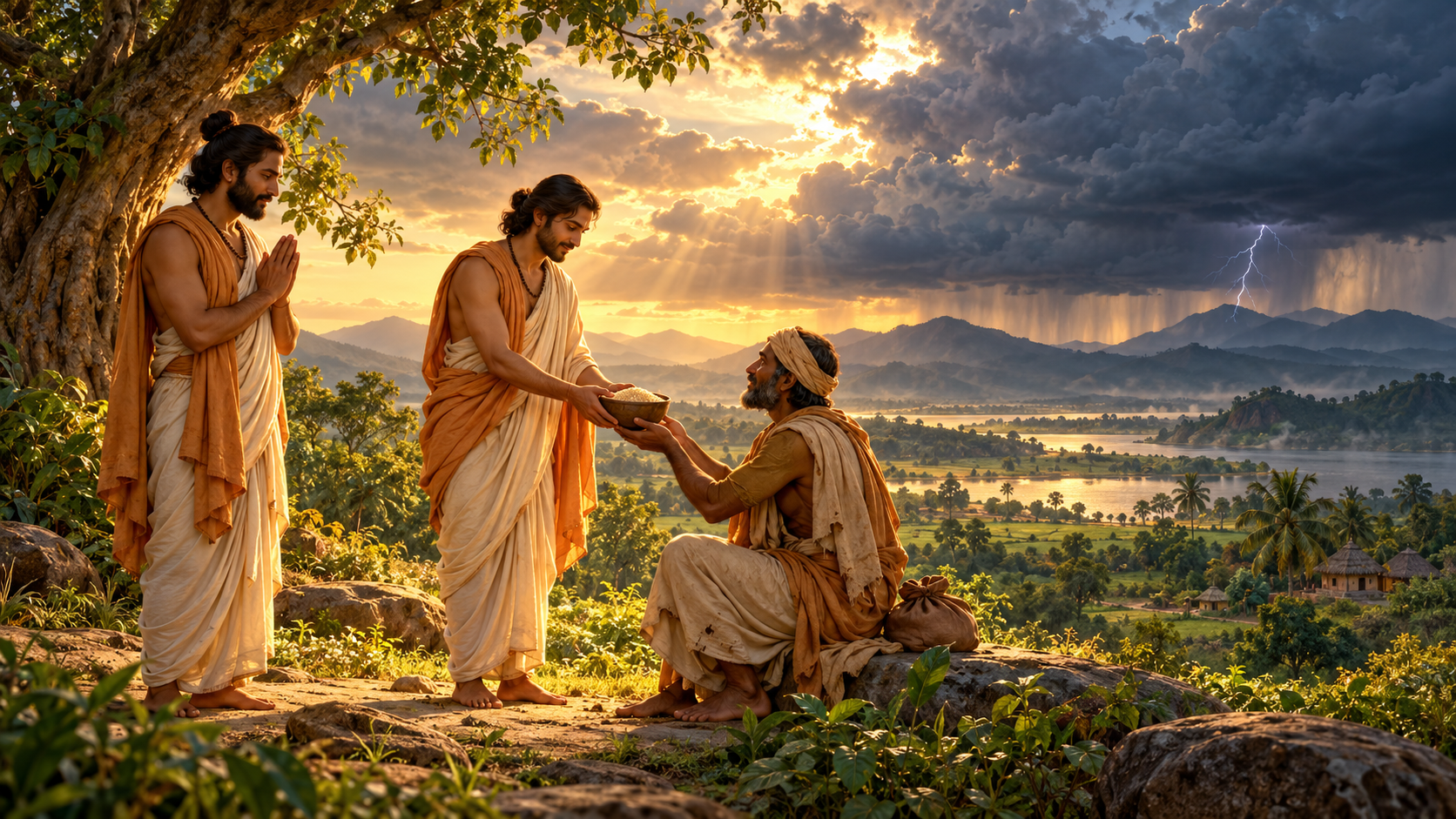
Ordinary things are measurable. If we pour water out of a vessel, less water remains in it. If we give away all the rice in a bowl, the bowl becomes empty. We naturally bring that understanding to a verse that speaks of something coming from something else.
Swami Krishnananda’s explanation distinguishes the Infinite from such finite quantities. Brahman is not a limited store from which creation removes a portion. The prayer’s language points to a fullness whose nature is undiminished.
This belongs to philosophical and spiritual inquiry. The verse is not offering a new rule for calculating material quantities. Reading it in its Upanishadic setting keeps its paradox meaningful.
We can also notice what the paradox does to attention. For a moment, the mind cannot rely on its usual picture of separate pieces. It has to become receptive to another way of understanding reality. That pause can be valuable even while our study continues and our understanding remains incomplete.
4. Why the invocation ends with peace
The prayer concludes with Om shantih, shantih, shantih. Shantih means peace. The repeated appeal gives the invocation a quiet landing after its expansive thought about fullness.
In a setting of sacred study, such an ending can help us recognise the spirit in which understanding is sought. We come with questions, habits and concerns. A prayer for peace expresses the wish to meet the teaching with greater openness.
As devotional reflection, we may hear this peace as an invitation to listen without haste. A verse need not yield all its meaning in one reading. It can accompany us while a question ripens, while an explanation becomes clearer, or while we notice how deeply we depend on familiar ways of thinking.
There is tenderness in that pace. Study can ask much of us and still be approached with patience. The invocation’s closing sound makes room for both aspiration and gentleness.
5. Wholeness as a reflection for everyday life
A teaching about Brahman reaches beyond an encouraging thought about ourselves. Even so, we can draw careful devotional applications from the prayer without mistaking them for its entire philosophical meaning.
For example, the habit of measuring our worth only through comparison can make life feel relentlessly unfinished. Remembering the word purnam may prompt a different question: what deserves gratitude and attention here, before the next achievement arrives?
Gratitude can coexist with effort. We can value what has been given, recognise a mistake, and work to repair it. We can honour another person’s dignity while acknowledging that a relationship needs care. Such reflections keep the idea of wholeness connected with responsibility.
The ocean and sunrise in this article’s illustration offer an atmosphere for contemplation; they are artistic symbols rather than a scene described in the verse. The teaching itself rests in the words of the invocation and the traditions that explain them.
Purnamadah leaves us with a generous subject for study: a fullness that is never used up. Returning to it, we may bring a little more attentiveness to the world before us and a little more reverence to the mystery it holds.
Make space for mindful devotion
Explore thoughtfully chosen devotional essentials for a peaceful sacred space at home.
Frequently Asked Questions
What is the meaning of Purnamadah?
It expresses the fullness of “That” and “this,” and a wholeness that remains undiminished. Vedantic explanations connect it with Brahman and the universe.
Which Upanishad contains Purnamadah?
The central verse occurs at Brihadaranyaka Upanishad 5.1.1 and is traditionally used as an invocation with the Isha Upanishad.
What does Shantih mean?
Shantih means peace. The familiar invocation closes with Om and a threefold repetition of this appeal.
Sources: Brihadaranyaka Upanishad 5.1.1; Swami Krishnananda’s Isavasya invocation commentary, The Fullness of the Infinite and Brahman the Inexhaustible. Sanskrit and word meanings cross-checked with Shlokam. Everyday applications are offered as devotional reflection.