

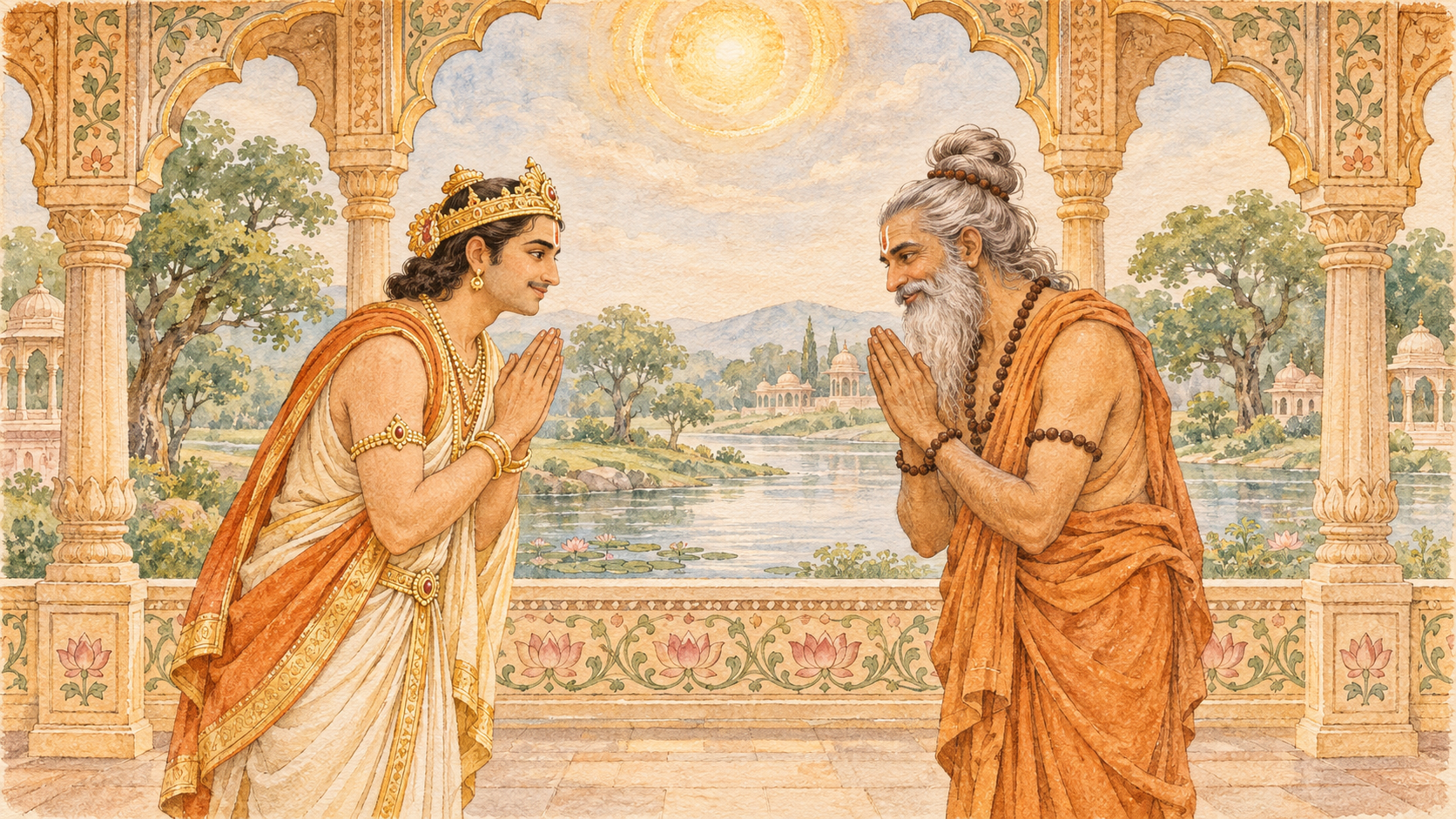
Some sacred stories reach their deepest moment when anger gives way to care. In the story of Ambarisha and Durvasa, a powerful sage threatens a devoted king. Yet the king’s most memorable act comes later, when he prays for the very person who tried to harm him.
Told in the ninth book of the Bhagavata Purana, this encounter explores devotion through a demanding human question: what happens to our kindness when we feel misunderstood? Its unfolding draws together divine protection, the danger of wounded pride and the quiet strength of a heart willing to forgive.
Ambarisha: A King Whose Life Turned Toward Hari
The Bhagavata presents Ambarisha as a prosperous ruler whose deepest attachment is to the Lord. His royal position does not keep devotion at the edge of life. Remembrance and service give direction to his everyday faculties.
Verses 9.4.18–20 describe this beautifully through the senses: his mind rests on Krishna, his speech celebrates the Lord, his hands serve in the temple and his ears attend to sacred accounts. The portrait is one of a whole person becoming attentive to a single beloved purpose.
For a reader, the appeal lies in that sense of integration. Prayer is capable of influencing how we speak, listen and work. The story begins with a king, but its invitation reaches any home where people hope to make daily activity an offering.
This also prepares us to understand his later response. Ambarisha’s composure grows out of an established devotional disposition. His gentleness has roots deeper than the immediate conflict.
A Guest Arrives at a Difficult Moment
During an observance connected with Ekadashi and Dwadashi, Durvasa arrives as Ambarisha’s guest. The king welcomes him and invites him to eat. The sage accepts, then goes to the Yamuna for his religious observances.
As the time for concluding the fast approaches, Ambarisha faces a dilemma. He wishes to honour his guest while also fulfilling his vow. After consulting learned brahmanas, he takes a little water and waits for Durvasa’s return. Bhagavata Purana 9.4.39–40 explains the reasoning within this particular situation: water could be regarded as both eating and not eating.
The detail matters because Ambarisha is trying to reconcile duties with care. He seeks counsel rather than treating his own preference as sufficient. His concern includes both devotion and hospitality.
When Durvasa returns, however, he interprets the act as an insult. The same small action is now understood through two very different dispositions. A contemporary reader may recognise how quickly a presumed slight can become a certainty when there is no room left for patient inquiry.
Anger Meets the Sudarshana Chakra
Durvasa’s anger erupts into a supernatural attack. Pulling hair from his head, he creates a fiery being to punish the king. Ambarisha remains steady. The Sudarshana Chakra, acting under the Lord’s protection of his devotee, destroys the attacking being and then pursues the sage.
The Bhagavata’s dramatic imagery places a severe limit on power used in anger. The king does not direct an attack in return. Divine protection intervenes while he remains absorbed in the Lord.
Durvasa seeks refuge with Brahma and Shiva, and ultimately approaches Narayana. His journey moves from attempts to escape danger toward the need to acknowledge its cause.
Read devotionally, this is a warning about the misuse of spiritual attainment. Learning, austerity and extraordinary ability do not make an angry judgment harmless. The encounter asks us to consider the purpose for which our influence is used, especially when pride has been hurt.
Narayana Sends Durvasa Back to the King
Narayana’s reply reveals the intimacy between the Lord and his devotees. In 9.4.63, the Lord describes himself as bound by their loving devotion. The passage expresses bhakti through the language of a relationship so dear that divine majesty freely honours love.
This is not a formula for controlling God through an outward act. The verse concerns devotees whose hearts are free from selfish demands. Its emphasis is the depth of their surrender and the Lord’s affection.
Narayana directs Durvasa to return to Ambarisha. Verse 9.4.69 links the danger to the sage’s offence and points him back toward the person he has wronged.
There is an enduring insight here about reconciliation. Seeking relief somewhere else cannot replace the difficult act of approaching someone we have hurt. An apology becomes meaningful when it recognises another person’s dignity. The movement back to Ambarisha is therefore the turning point of the story.
Forgiveness Becomes an Act of Compassion
Durvasa returns and takes shelter at the king’s feet. Ambarisha responds with distress at the sage’s suffering, then prays to Sudarshana for his safety. The chakra becomes peaceful, and Durvasa is spared.
In 9.5.14, the sage recognises what has happened: despite his offence, Ambarisha has wished him well. The king’s devotion becomes visible in compassion toward a frightened guest.
The account then returns to hospitality. Ambarisha feeds Durvasa before taking his own meal. Bhagavata Purana 9.5.24 adds a final detail: the king attributes the outcome to the Lord’s grace and takes no personal credit.
This ending gives the narrative its warmth. Ambarisha has no need to turn another person’s remorse into a public triumph. Care resumes in a concrete form: a guest is fed, danger has passed and gratitude replaces self-congratulation.
For us, the story can become an occasion to reflect on how conflict changes our intentions. Can we welcome sincere accountability without continuing to nourish resentment? Can a truthful response also leave room for another person to grow?
The story of Ambarisha and Durvasa holds together devotion and conduct. The king’s remembrance of Hari flowers in patience, humility and a generous wish for another’s welfare. That is the image the narrative leaves with the heart.
Make space for everyday remembrance
Discover devotional essentials chosen for your home and quiet moments of reflection.
Frequently Asked Questions
Where is the story of Ambarisha and Durvasa told?
The account appears in Bhagavata Purana, Book 9, chapters 4 and 5. These chapters describe the conflict, Narayana’s teaching and the reconciliation.
Why did Durvasa return to Ambarisha?
Narayana directed him back to the devotee he had offended. Ambarisha then prayed for the sage’s safety, and the Sudarshana Chakra became peaceful.
What is the story’s main spiritual meaning?
It celebrates devotion expressed through humility and compassion, while showing the harm caused by anger and the importance of acknowledging a wrong.
Sources: Bhagavata Purana 9.4 and 9.5, especially 9.4.18–20, 9.4.63 and 9.5.14. This retelling follows that account; present-day reflections are interpretation, not scripture quotations.