

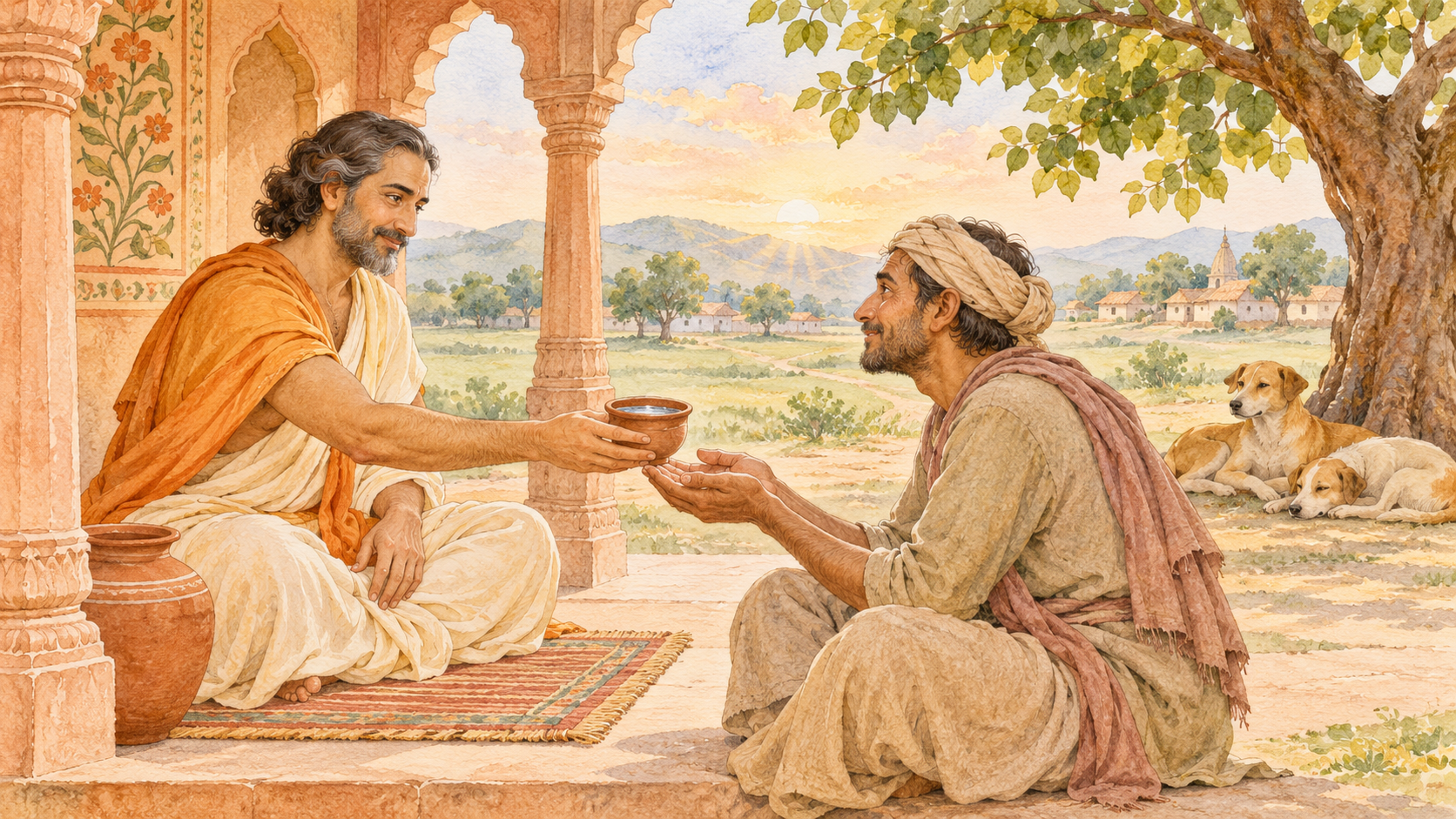
A small cup of water can hold a great spiritual meaning. In the story of Rantideva, a hungry and thirsty king receives a succession of visitors. With each arrival, his attention turns toward another being’s need, until even the water he has kept for himself becomes a gift.
The Bhagavata Purana tells this episode in Book 9, chapter 21. Its deepest concern is the heart from which generosity arises. Rantideva’s compassion grows from devotion: he sees those before him in relationship with Hari, and their suffering matters to him.
Rantideva’s Story Begins with Want
The chapter places Rantideva in the lineage of Sankriti and remembers him for an extraordinary generosity. His household is enduring severe deprivation. The account describes forty-eight days without food and water before nourishment finally arrives.
These are the extraordinary conditions of a sacred narrative. The devotional meaning rests in compassionate attention, and the episode should be understood as a story of exceptional self-giving rather than a pattern of deprivation to reproduce.
Food prepared with milk and ghee, together with water, is at last available. Rantideva and his family are about to eat when a brahmana guest appears. The long-awaited moment of relief becomes a moment of welcome.
There is a particular tenderness in this opening. Generosity is often pictured through abundance: a full storehouse, a rich feast, a king distributing wealth. Here the narrative draws our attention to someone who knows hunger himself. His own need has not closed his awareness of another’s.
The Guests Who Receive His Food
Rantideva honours the first visitor and shares the meal. Bhagavata Purana 9.21.6 explains his disposition: he perceives Hari’s presence everywhere. Respect accompanies the food; the visitor is welcomed as a person worthy of care.
A second guest, described in the text as a shudra, arrives as Rantideva prepares to eat what remains. He too receives a share. Then a man accompanied by dogs asks for food for himself and the animals. Rantideva gives them the remainder, again with honour.
The presence of the dogs widens the scene. The king’s attention includes beings that could easily be overlooked while people compete for a scarce meal. The text specifically describes his respectful treatment of both the man and his companions.
For today’s reader, this sequence invites reflection on the manner of giving. A gift can be offered with warmth, or it can make its recipient feel small. Rantideva’s example joins material help with regard for those receiving it. The gesture carries an acknowledgement: your hunger is real, and your presence deserves attention.
The Last Water and the Prayer for Others
Only drinking water remains, sufficient for one person. As Rantideva is about to drink, another exhausted visitor asks for it. The account describes this man as a chandala, a person placed outside the privileged social order of the time.
The narrative records that social description, but Rantideva responds to the visitor’s thirst. He is moved by the man’s distress and gives him the water. The final gift is small in volume and immense in the meaning the story gives it.
Before the gift, Rantideva voices his central aspiration in 9.21.12. In paraphrase, he seeks neither extraordinary yogic powers nor release from rebirth for himself; he wishes to bear the suffering of living beings so that they may be free of distress.
The prayer reveals the direction of his devotion. His longing reaches outward toward the welfare of others. It is this inward movement that makes the episode more than an account of endurance.
We may hear in it a searching question for our own prayers: alongside what we ask for ourselves, how much room is there for another person’s relief? Compassion allows their need to enter the circle of our concern.
The Divine Revelation Behind the Visitors
After these acts of generosity, the visitors’ divine identities are revealed. The Vedabase rendering of 9.21.15 names deities such as Brahma and Shiva among those who had appeared in the different forms.
This retelling follows that passage without assigning a particular deity to each visitor. The narrative’s emphasis falls on Rantideva’s response before the revelation: he offers care while the guests still appear as ordinary beings in need.
He then bows respectfully, but seeks no material reward from them. Verse 9.21.16 describes his mind as remaining devoted to Vasudeva, Vishnu. His generosity has not been a bargain made in expectation of a prize.
That ending gives the story its devotional clarity. The discovery of divine visitors confirms the depth of a compassion already present. Rantideva did not wait for a sign of holiness before treating the thirsty person with dignity.
Seeing with Compassion in Everyday Life
The story of Rantideva brings bhakti into the meeting between giver and receiver. Remembering Hari influences the way a hungry stranger is seen, the regard shown to an animal and the intention behind an offering.
Its imagery can accompany ordinary acts of service: making someone feel welcome at a meal, noticing a tired visitor, or supporting a community effort that feeds people. Such reflections translate the story’s compassion into familiar circumstances without claiming to repeat its extraordinary events.
It also asks something of our attention. Often we see a category before we see a person. Rantideva’s welcome encourages us to notice the living being whose need stands before us, and to let that recognition soften indifference.
The remembered cup of water therefore holds more than a lesson about possessions. It holds an image of concern freely offered, without a demand for prestige or repayment. In devotional reading, the heart becomes generous because it has learned to care beyond itself.
Rantideva remains memorable through this union of prayer and conduct. His wish for others’ welfare takes the form of food shared, guests honoured and water given with compassion.
Welcome devotion into everyday moments
Explore devotional essentials for your home and quiet occasions of remembrance.
Frequently Asked Questions
Where is the story of Rantideva found?
This account appears in Bhagavata Purana 9.21, especially verses 2–18. It describes his generosity, his prayer and the revelation of the visitors’ identities.
Why did Rantideva give away his last water?
He was moved by an exhausted visitor’s thirst. His gift expresses the compassion voiced in his prayer for living beings to be freed from suffering.
What does Rantideva’s story teach about devotion?
It presents devotion through respect, generosity and concern for others. Rantideva remains attached to Vasudeva while seeking no material reward for his gifts.
Sources: Bhagavata Purana 9.21, especially 9.21.6, 9.21.12, 9.21.15 and 9.21.16. Narrative and prayer are paraphrased; present-day reflections are interpretation, not scripture quotations.