
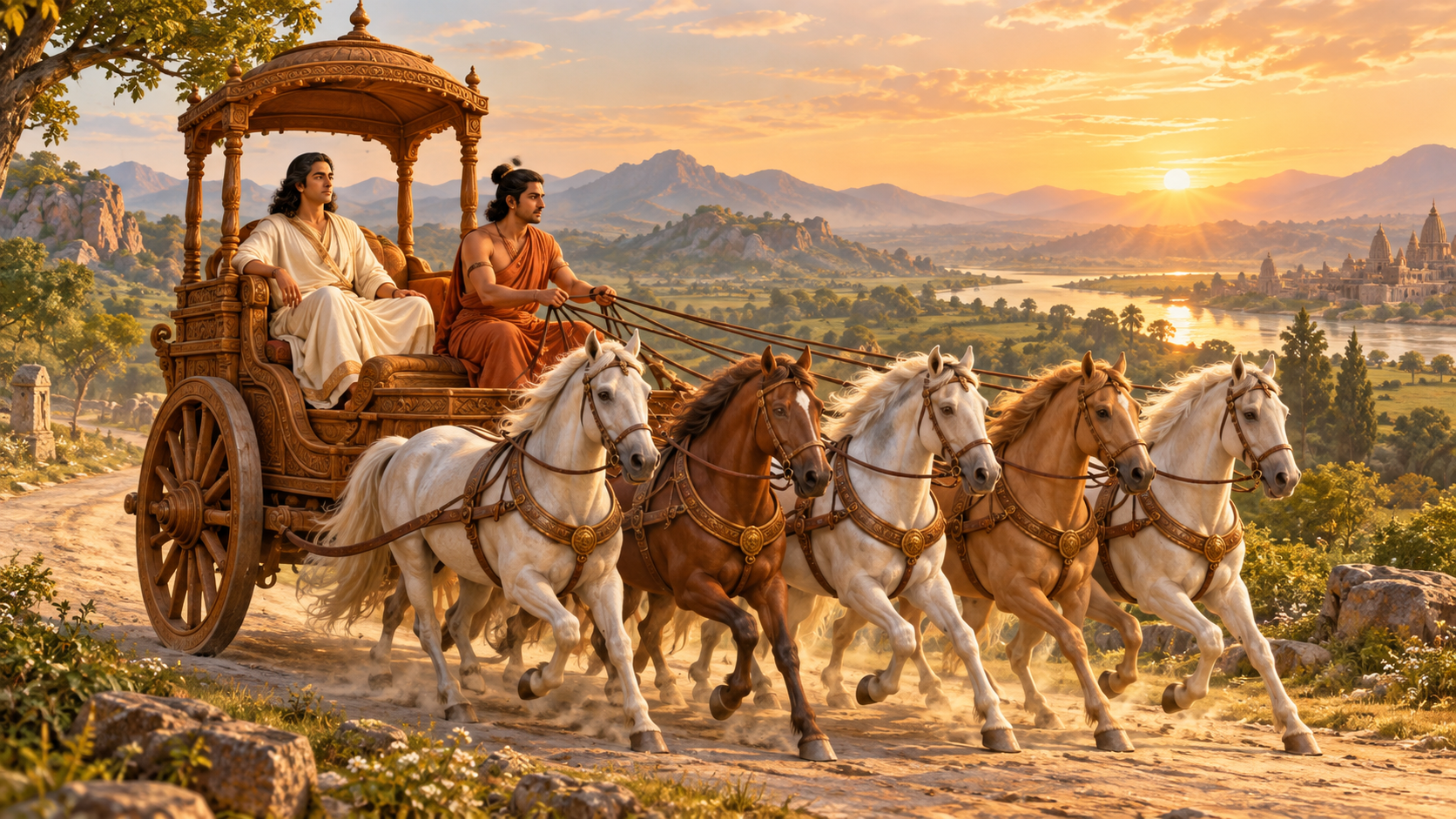
A moment of anger can carry us further than we intended. So can a beautiful sound, a sudden desire or a thought we keep feeding. The chariot allegory in the Katha Upanishad gives these familiar experiences a memorable form: a traveller, a vehicle, a driver, reins, horses and a road.
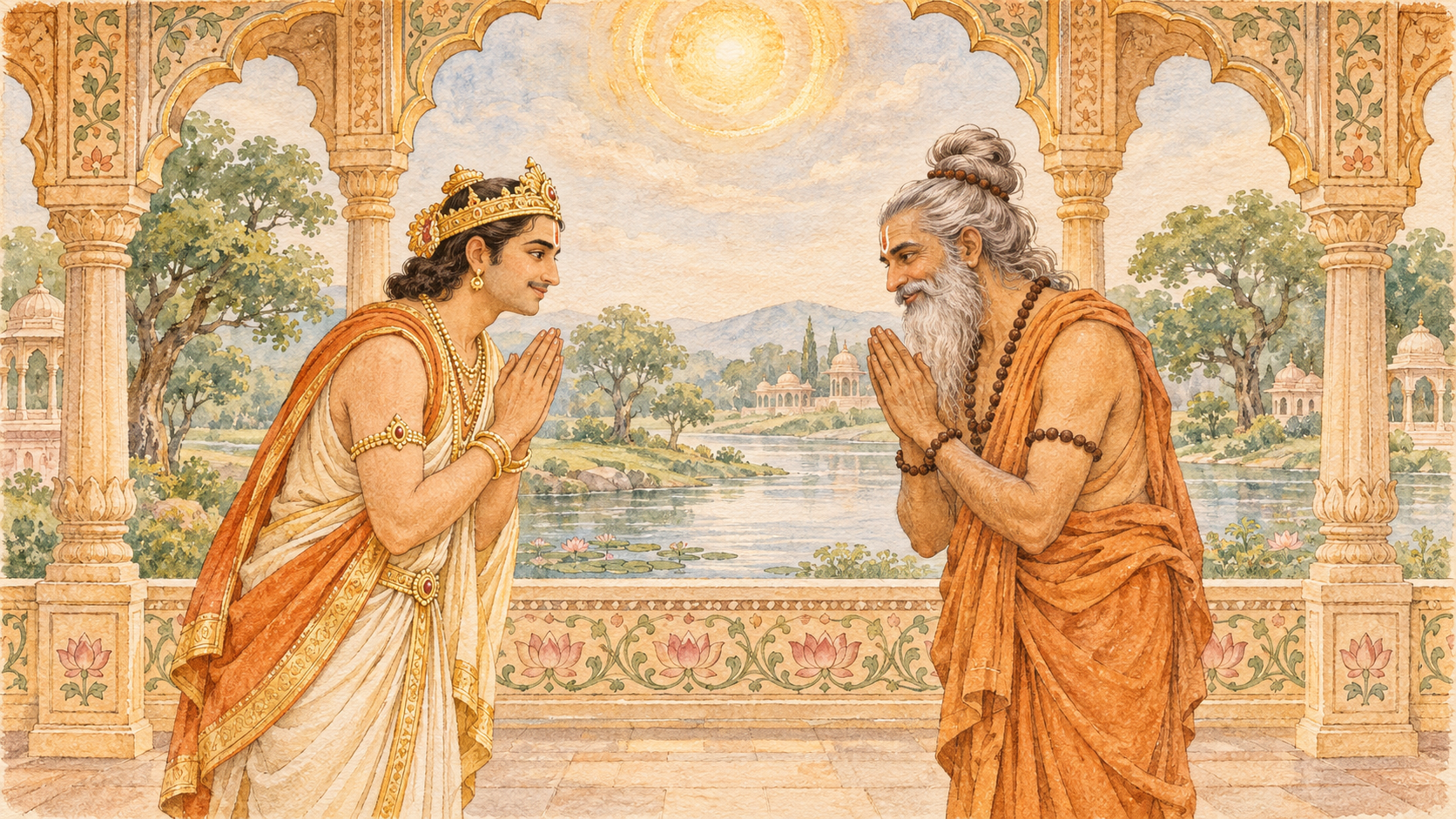
Yama offers this image within his teaching to Nachiketa. In verses 1.3.3–1.3.9, the parts of a chariot help explain the relationship between the Self and the faculties through which we experience life. Read with care, the passage invites a steadier relationship with attention, judgment and the purpose of our journey.
1. The traveller and the chariot
Verse 1.3.3 places the atman, the Self, in the position of the chariot’s master or rider. The body is the chariot. The image asks us to distinguish the traveller from the vehicle through which the journey takes place.
The following verse describes the Self associated with body, senses and mind as the experiencer. Vedantic explanations carefully discuss this embodied condition. The metaphor opens a question about identity: how do we understand ourselves amid the body’s activities and the mind’s changing experiences?
For a devotional reader, this question can soften the habit of defining a whole life by one passing condition. A difficult morning, a restless thought or an unwelcome feeling deserves attention, while our search for meaning can reach deeper than that moment.
The vehicle also has a place of honour in the image. It carries the journey. Caring for the body and treating it with dignity can become part of the gratitude with which we receive life.
2. Why the intellect is the charioteer
The charioteer represents buddhi, the intellect or faculty of understanding and discernment. It has the task of guiding. A journey depends on more than the horses’ strength: direction matters, and someone must attend to it.
In this setting, discernment concerns our spiritual orientation. We can understand an immediate attraction and still ask what it will lead towards. We can feel strongly and still consider whether an action is fair, truthful or helpful.
A useful everyday reflection is the difference between noticing an impulse and handing it the whole decision. Suppose a conversation has become heated. The first sharp reply may come readily; understanding can remember the relationship, the facts and the consequences of speaking.
This example is an application of the image. The Upanishad’s larger concern is knowledge and liberation. Yet the ordinary occasions on which judgment becomes clear help us appreciate why its charioteer must be attentive.
3. The mind as reins, the senses as horses
Manas, the mind, is compared to the reins. The senses are the horses, and their objects form the roads or fields over which they move. The relationships are precise: the intellect guides through the mind, which is connected with the senses.
Verses 1.3.5–1.3.6 contrast an uncomposed mind and an understanding without discrimination with a mind under guidance and an understanding that discerns. The horses become difficult or manageable accordingly.
Swami Krishnananda’s discussion emphasises the cooperation of the parts. The road, senses, mind, intellect and traveller belong within one journey. Seeing a flower, hearing music or tasting food gives the metaphor its living context: experience reaches us through these faculties.
We may therefore reflect on guidance as a relationship that needs care. Attention can be scattered by competing invitations, then gathered around something worthy. A sacred story heard patiently or a kind word received fully offers an everyday glimpse of that gathering.
4. What is the journey’s destination?
The passage’s destination is spiritual freedom. Verses 1.3.7–1.3.8 connect lack of discernment and an ungoverned mind with continued worldly existence, and contrast this with reaching the goal from which rebirth does not follow.
Verse 1.3.9 speaks of the journey’s end as the highest abode or supreme state of Vishnu. Vedantic teachers explain this language in relation to the supreme, all-pervading reality. The destination gives the chariot image its depth.
Such a goal changes how we hear the metaphor. A well-directed life includes practical responsibilities, but the Upanishad also asks what ultimately satisfies the seeker. Greater speed alone cannot answer that question.
In a devotional reading, remembering a sacred purpose can bring tenderness to discipline. We turn towards truth because it is worth loving. A small act of restraint may express respect for another person; a moment of attentive study may express reverence for the wisdom we hope to understand.
5. Carrying the image into daily life
The chariot offers a language for reflection. When we feel pulled in several directions, we can notice which attraction has taken hold of attention. When a decision becomes clearer, we can recognise the value of understanding that has had time to consider.
These are modern applications of Yama’s image. They help us return to the text with lived questions: What am I allowing to guide me? What purpose gives my choices direction? How can attention serve that purpose with greater steadiness?
The teaching also encourages humility. An intelligent person can still be distracted. A sincere intention can still need patient support. Learning involves the whole person, and clarity grows through repeated opportunities to listen, reflect and respond.
Let the image remain spacious enough to hold devotion as well as effort. The traveller’s journey has meaning; the faculties that serve it can be honoured and guided. With that remembrance, even an ordinary choice may become an occasion to turn towards what we hold sacred.
Make space for mindful devotion
Explore thoughtfully chosen devotional essentials for a peaceful sacred space at home.
Frequently Asked Questions
Where does the chariot allegory appear?
Its central explanation appears in Katha Upanishad 1.3.3–1.3.9, within Yama’s teaching to Nachiketa.
What do the driver and reins represent?
The driver represents buddhi, the intellect or discerning understanding. The reins represent manas, the mind; the horses represent the senses.
What is the allegory’s spiritual lesson?
It connects discernment and a guided mind with the journey towards liberation. Reflections about daily attention are applications of that larger teaching.
Sources: Katha Upanishad 1.3.3–1.3.9 in Swami Nikhilananda’s translation; Swami Krishnananda, Discourse 4; A. K. Aruna’s text and translation with Shankara’s commentary; and Chinmaya Mission study reflections. Everyday examples are devotional applications.