
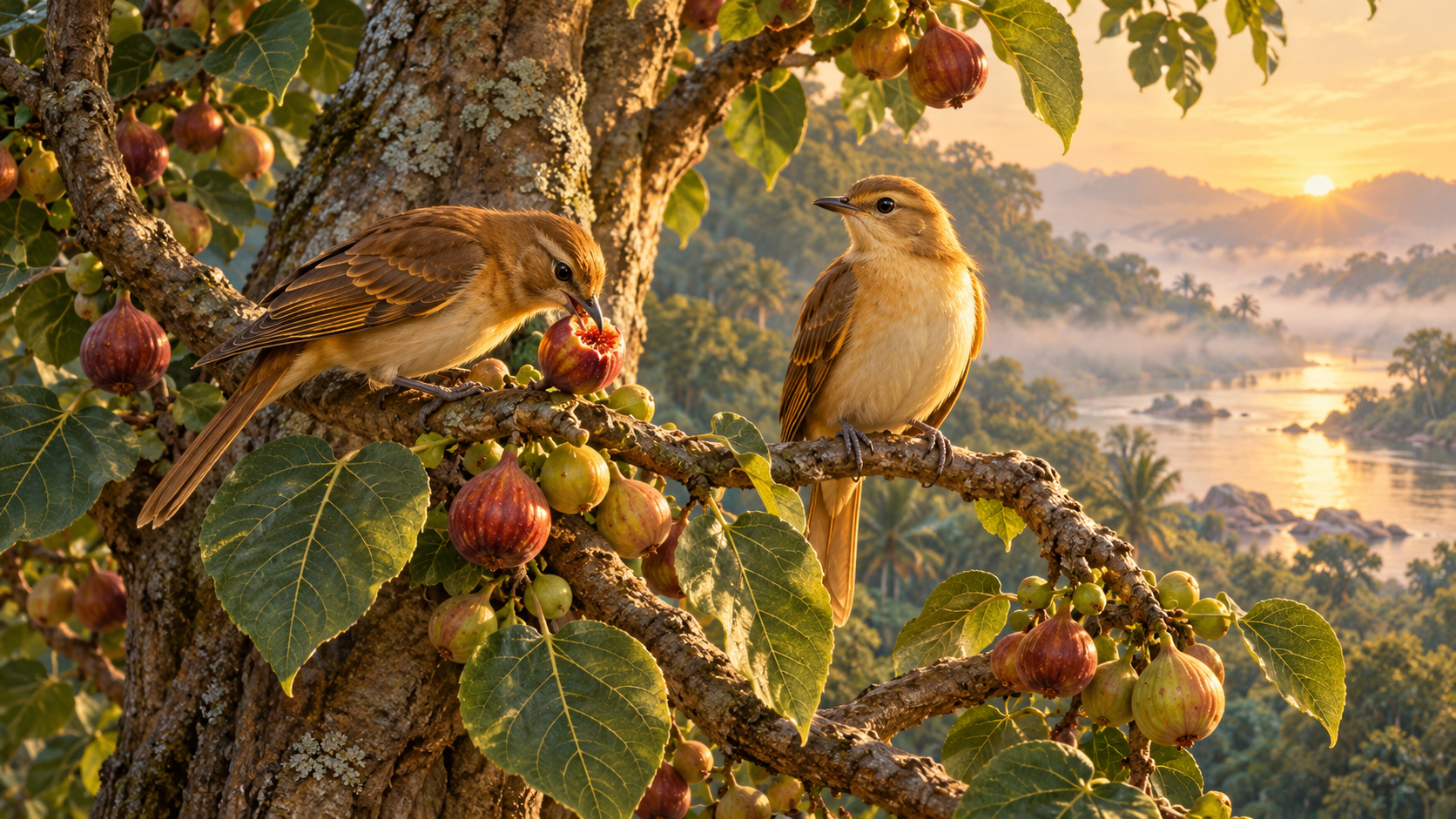
The two birds in the Mundaka Upanishad form one of sacred literature’s most memorable images. Two close companions share a tree. One eats its fruit; the other looks on without eating. In a few lines, the passage opens a question about experience, attachment and the presence of the divine.
The scene is simple enough to picture, yet its meaning invites patient reflection. We recognise the bird absorbed in tasting: our days, too, can become a succession of pleasures, disappointments and expectations. The watching companion introduces another possibility, a steadiness that is already near even when attention is elsewhere.
1. What the Upanishad Actually Says
In Mundaka Upanishad 3.1.1, the birds are described as intimate, inseparable companions on the same tree. One enjoys the sweet fruit, while the other watches without eating. The following verse turns explicitly toward the human condition: a person is immersed in grief and bewilderment, until seeing the other, the Lord, and recognising his greatness brings freedom from sorrow.
These two verses provide the centre of the image. We do not need to invent names for the birds or imagine a contest between them. The passage is a philosophical metaphor, rather than an account of two named animals in a particular forest.
Its companionship matters. The still bird is present throughout the first bird’s involvement with the fruit. A devotional reader may find consolation here: the divine presence need not be imagined as something created only after a moment of spiritual achievement.
2. The Tree and the Bird That Eats
In Shankara’s commentary on 3.1.1, the tree represents the body, and the fruits signify the results of karma, experienced as happiness and misery. The eating bird represents the individual experiencer, caught in the conditions of embodied life.
This symbolism helps explain why the image reaches beyond ordinary enjoyment. We undertake actions, hope for particular outcomes, and respond when the results arrive. A welcome outcome may delight us; an unwelcome one can dominate our thoughts. Soon the next desired result seems to hold the answer to our unease.
Think of the difference between completing useful work and allowing every response to that work to determine our sense of worth. The work may deserve our full care. Yet praise and criticism can become a restless cycle when each is treated as a final verdict on who we are.
That example is a contemporary reflection on the metaphor. It is not an additional episode from the Upanishad. Keeping that distinction clear lets the ancient image illuminate our experience without making scripture say more than it does.
3. The Watching Bird and the Witness
The same commentary identifies the other bird with Ishvara, the Lord, and describes his presence as that of a witness. Swami Krishnananda’s exposition of chapter 3, section 1 likewise explains the two birds through the individual soul and Ishvara, contrasting involvement in experience with unattached consciousness.
These are Vedantic interpretations of the image. They should be approached within that philosophical setting, with awareness that different traditions explain the relationship between the individual and the divine in different ways.
The witnessing image can also prompt a modest question for reflection: can we notice a reaction without immediately surrendering our whole attention to it? Anger, delight or worry may be present, while there is also the capacity to recognise what is happening.
Such recognition is a starting point for inquiry, not proof that we have realised the Self. It can nevertheless interrupt the habit of moving from every feeling straight into speech or action. A little space may allow a more thoughtful response.
4. Why Seeing the Companion Changes the Scene
Verse 3.1.2 places a change in understanding at the heart of freedom from grief. The immersed person sees the Lord and recognises his greatness. The passage does not describe the watching bird bringing a sweeter fruit to replace a disappointing one.
That difference is significant. The metaphor turns attention toward the ground of experience, rather than merely promising a more agreeable sequence of events. What changes is the way reality is known.
For a devotee, this may evoke the movement from feeling entirely alone with life’s uncertainties toward trust in the divine. For a student of Vedanta, it raises questions about identity and knowledge. Both responses call for care and continued study; neither needs to reduce the verse to a slogan.
The image also asks us to be gentle with others. Another person’s distress should never be dismissed with a demand to become detached. Compassion remains a fitting response when someone is struggling. Reflection becomes more meaningful when it deepens that compassion.
5. A Quiet Image for Ordinary Days
There is no need to turn the two birds into enemies. Their closeness is part of the teaching. The eating bird is a recognisable picture of our involvement in life, and the still companion invites us to question whether that involvement exhausts who we are.
A useful reflection is to notice what we are asking the next outcome to provide. Is it a practical result, or are we hoping that one more achievement will finally make us complete? The question can be asked without abandoning responsibilities or denying the value of ordinary joys.
We can return to the scene slowly: one tree, two companions, the taste of fruit, and a presence that watches. Its beauty lies in how much it holds without becoming complicated. The Upanishad leaves us with an image worth contemplating, and with a reason to look beyond the next fruit.
Explore puja essentials for the devotional moments you cherish at home, alongside time for reading and reflection.
Frequently Asked Questions
Where are the two birds described in the Mundaka Upanishad?
The image appears in 3.1.1. Verse 3.1.2 develops its meaning through grief, recognition of the Lord and freedom from sorrow.
What do the two birds represent?
In the Vedantic commentaries discussed here, the eating bird is the individual experiencer, while the watching bird is Ishvara, the Lord and witness.
Does the metaphor ask us to stop caring about life?
It invites inquiry into attachment and identity. It need not become an excuse to neglect responsibilities or another person’s needs.