
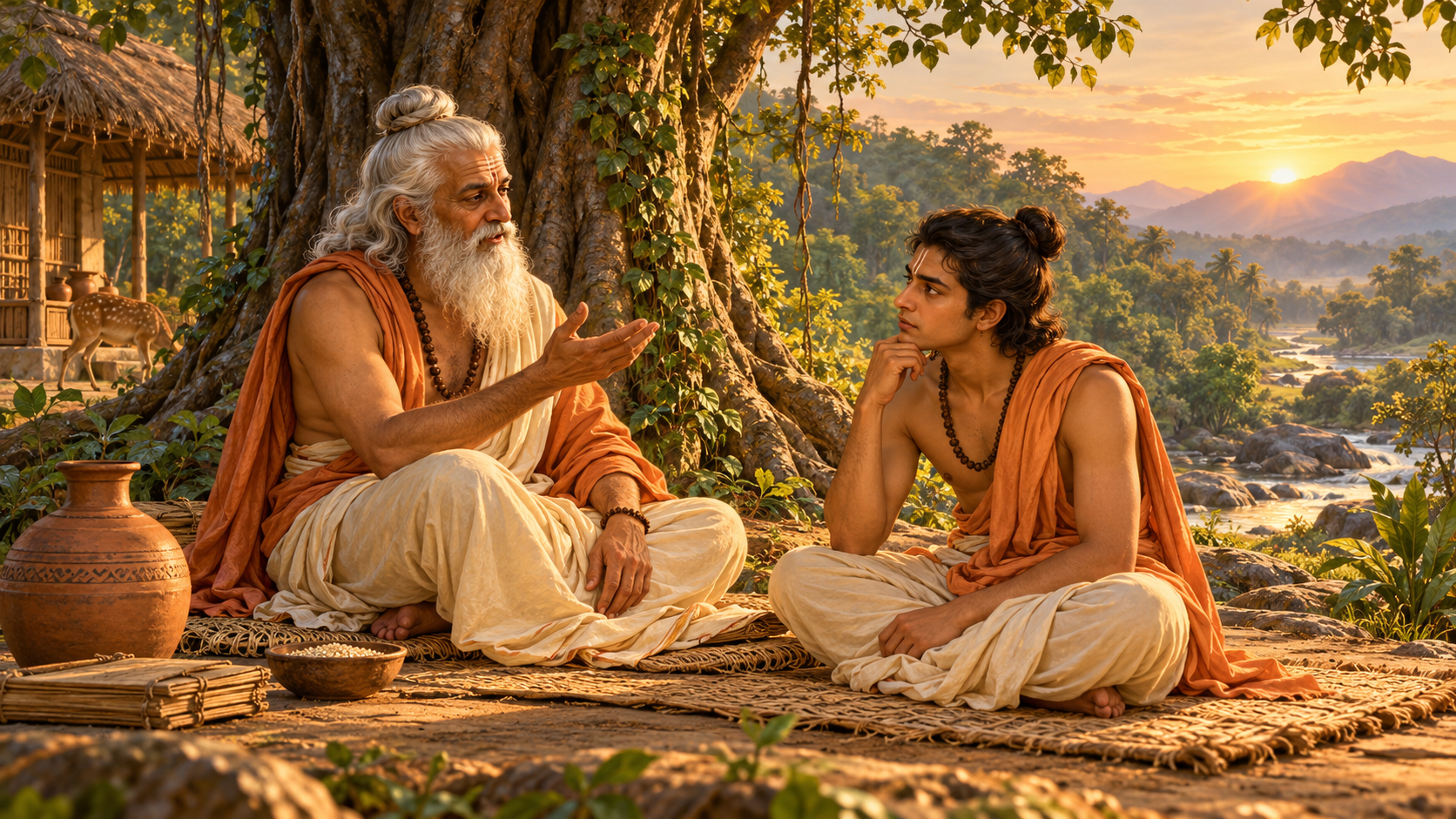
The story of Bhrigu and Varuna offers a quiet picture of spiritual learning: a son approaches his father, asks about Brahman, and receives a question that will deepen his whole understanding of life. There is no battle to win or treasure to recover. The adventure unfolds through inquiry, reflection and the courage to keep learning.
Preserved in the Bhrigu Valli, the third part of the Taittiriya Upanishad, this dialogue moves from food toward bliss. Its gentle rhythm is part of its wisdom. Bhrigu discovers something, returns to his teacher, and looks more deeply. For anyone who has struggled to understand a sacred teaching, his patience feels reassuring.
1. Bhrigu Asks His Father About Brahman
The opening identifies Bhrigu as Varuna’s son. He approaches his father with a request to learn about Brahman, the ultimate reality. Varuna points to familiar dimensions of experience, including food, vital breath, sight, hearing, mind and speech. He then directs Bhrigu toward that from which beings arise, by which they live, and into which they return.
This is the starting point of Taittiriya Upanishad 3.1. The teaching gives Bhrigu a direction for investigation. A definition heard from a teacher must become something he examines with his own attention.
Here, Brahman means ultimate reality; it should not be confused with Brahma, the creator deity. Nor does this passage require us to import episodes about Bhrigu from other texts. Following this particular dialogue on its own terms lets its distinctive teaching emerge.
2. Why the Search Begins With Food
In section 3.2, Bhrigu recognises food as Brahman: living beings arise through food, are sustained by it and return to it. Yet he returns to Varuna asking for further instruction. His first insight becomes the beginning of a deeper search.
The choice of food makes the story wonderfully grounded. Before we speak about subtle ideas, we encounter nourishment. A meal carries the labour of many hands, the gifts of soil and rain, and the dependence of the body on what it receives. Reflecting on this can soften the habit of treating ordinary life as spiritually unimportant.
Bhrigu’s return also offers a lesson in intellectual humility. Discovering something meaningful need not mean that the whole inquiry is finished. We can appreciate an insight without demanding that it answer every question. Spiritual seriousness can include both gratitude for what is understood and honesty about what remains unclear.
3. Breath, Mind and Understanding Deepen the Inquiry
The next sections move through prana, mind and vijnana: vital breath, the mental faculty, and understanding or discriminating intelligence. After each of these discoveries, Bhrigu again approaches his father. Varuna repeatedly directs him to seek Brahman through tapas.
Translations often render tapas as austerity or penance. In its discussion of this passage, Chinmaya International Foundation’s Bhrigu Valli study text explains the term here through concentrated reflection and inquiry. This helps us understand the dialogue as a sustained educational process, rather than imagining hardship for its own sake.
Notice the relationship between teacher and student. Varuna continues to guide; Bhrigu continues to engage. A thoughtful reader can see trust and effort working together. The teacher’s presence matters, and so does the student’s willingness to return to the subject with fresh attention.
That pattern is familiar in any deep learning. A sentence that once seemed obvious may reveal a difficulty on a second reading. Revisiting it can be a sign of growing understanding. Bhrigu’s repeated request gives dignity to that patient work.
4. Ananda: The Culmination in Bliss
In section 3.6, Bhrigu recognises ananda, or bliss, as Brahman. The text presents bliss as the source, support and destination of beings, and identifies this as the knowledge of Bhrigu and Varuna.
Within the Vedantic interpretation offered in the study text, this culmination concerns the fullness of Brahman. It reaches beyond the pleasure attached to a pleasant sensation or a favourable event. Those experiences change; the inquiry is seeking an ultimate foundation.
We should therefore approach the word bliss with care. It is easy to turn it into a demand that a spiritual person must always feel cheerful. The story invites a more serious engagement with what lasting fulfilment means. Its teaching deserves reflection without becoming a promise that one reading will remove every difficulty.
For devotional readers, there is beauty in the way the search widens. The everyday world first draws Bhrigu’s attention; continued inquiry leads him toward a deeper account of reality. His journey honours the possibility that understanding can mature.
5. Why the Dialogue Still Matters
The Bhrigu Valli continues after this discovery. Its later sections return to the importance of food and hospitality. Section 3.7 enjoins respect for food, while 3.10 includes a teaching about welcoming the guest. The movement toward the highest reality sits alongside concern for the life we share.
That pairing offers a meaningful reflection for today. Reverence can find expression in attention to what sustains us and consideration for another person. A profound conversation need not make the next ordinary act of care seem small.
The story of Bhrigu and Varuna also challenges our impatience. We often expect a quick explanation to settle a large question. Bhrigu stays with his inquiry. He allows learning to unfold through more than one encounter, and his teacher allows him the space to grow.
We can carry that spirit into reading sacred literature: an attentive mind, a willingness to seek guidance, and respect for the depth of the question. Bhrigu’s journey reminds us that returning to learn can itself be an act of devotion.
Explore puja essentials for the devotional moments you cherish at home, alongside time for reading and reflection.
Frequently Asked Questions
Where is the story of Bhrigu and Varuna found?
It appears in the Bhrigu Valli, the third part of the Taittiriya Upanishad. The central inquiry unfolds in sections 3.1–3.6.
Who is Varuna in this dialogue?
The passage identifies Varuna as Bhrigu’s father, who instructs him about Brahman and guides his inquiry.
What does Bhrigu discover?
His inquiry moves through food, vital breath, mind and understanding, culminating in the recognition of ananda, or bliss, as Brahman.