
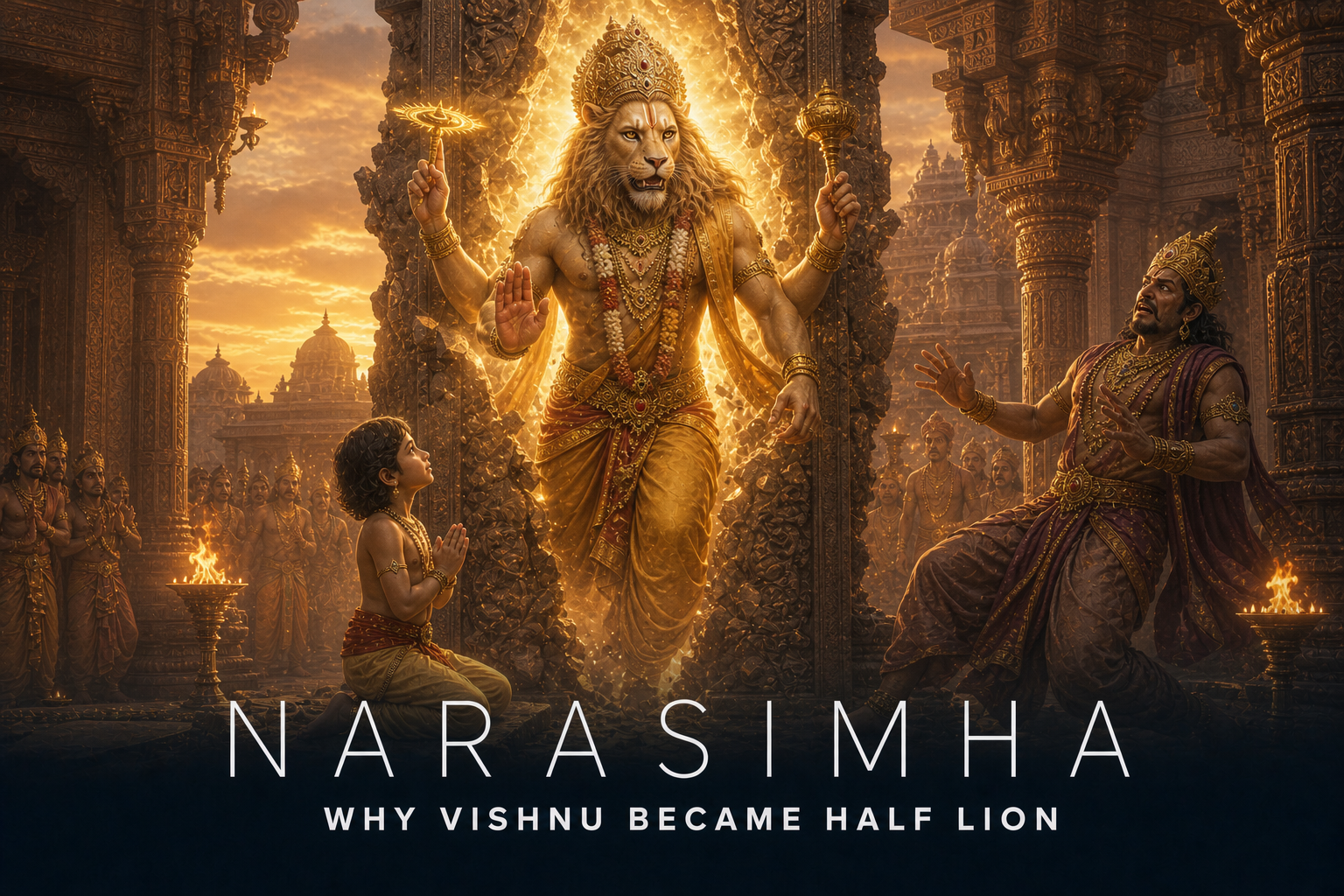
Of all the ten avatars of Vishnu, none is as startling as the fourth. Rama walks in as a prince. Krishna arrives as a child. But Narasimha does not arrive at all — he erupts, splitting a stone pillar in a palace hall, half man and half lion, at the exact moment a father raises his sword against his own son.
The story of Narasimha and Prahlad is told in the seventh canto of the Bhagavata Purana, and it is far more than a tale of a monster-slaying god. It is a carefully constructed riddle about what devotion is, what a loophole is, and what happens when a man tries to negotiate his way out of death itself.
Who Was Hiranyakashipu?
Hiranyakashipu was a daitya king, and his hatred of Vishnu was personal. His twin brother Hiranyaksha had dragged the earth into the cosmic waters, and Vishnu had descended as Varaha, the boar, to lift her back and to end Hiranyaksha in the process. Grief turned to vengeance. Hiranyakashipu resolved that he would place himself permanently beyond Vishnu’s reach.
He went into a tapasya so severe that the heat of it disturbed the worlds. Anthills rose over his motionless body. When Brahma finally appeared, Hiranyakashipu asked for immortality — and was refused. Brahma cannot grant what does not exist; everything born must end.
So the king did something cleverer. He asked instead to be killed by no man and no animal, by no deva and no asura, by no weapon, by nothing created by Brahma; not inside a house and not outside it; not by day and not by night; not on the ground and not in the sky. He built a fortress out of exceptions, and he believed it was airtight.
The Son Who Would Not Stop Chanting
The irony of the story is that Hiranyakashipu’s undoing was born in his own house. His son Prahlad, still a small boy, became an unshakeable devotee of Vishnu — the very name his father had outlawed across the three worlds.
The Purana describes Prahlad’s devotion as effortless rather than defiant. He was not rebelling; he simply could not stop seeing Vishnu everywhere. When his teachers taught him statecraft and the arts of power, he answered them with the nine forms of bhakti — listening, chanting, remembering, serving, worshipping, bowing, servitude, friendship, and complete surrender. It is one of the oldest and most quoted summaries of devotion in Hindu tradition, and it comes from the mouth of a child.
Hiranyakashipu tried everything a tyrant can try. Prahlad was thrown from cliffs, trampled by elephants, cast into water, and given poison. Each time he came back unharmed, still chanting. In the most famous of these episodes, his aunt Holika — who possessed a boon that fire could not burn her — carried him into a blazing pyre. Holika burned. Prahlad walked out. That night is still marked every year as Holika Dahan, the fire lit on the eve of Holi.
The Question at the Pillar
Finally the king confronted his son directly. Where is this Vishnu of yours, he demanded. Prahlad answered without hesitation: he is everywhere — in you, in me, in everything.
Hiranyakashipu pointed to a stone pillar in the hall and asked, mockingly, whether Vishnu was in that too. Prahlad said yes. The king struck the pillar with his mace.
The pillar cracked open with a sound like the end of the world, and out of it came a form that no one in that hall had a word for: a lion’s head on a man’s body, mane blazing, eyes like molten metal, claws like knives. Narasimha — nara, man; simha, lion. Neither one, and therefore outside the boon entirely.
How the Boon Was Undone
What follows is the most precisely engineered death in Hindu mythology. Every clause of Hiranyakashipu’s boon is honoured and dismantled in the same instant.
Narasimha seized him and carried him to the threshold of the doorway — neither inside the house nor outside it. He sat and placed him across his own lap — neither on the ground nor in the sky. It was dusk, that seam of time that belongs to neither day nor night. And he used no weapon at all, only the nails of his hands, which are not made and not given, but grow from the body itself. He was neither man nor animal, neither deva nor asura.
Not a single condition was broken. The boon simply ran out of places to hide. And that is the theological point the Purana is making: divine law is not cheated by cleverness, and no arrangement of words can wall a life off from consequence.
The Rage That Only a Child Could Calm
The story does not end with the killing, and the ending is the part most retellings rush past. Narasimha’s fury did not subside when Hiranyakashipu did. The devas gathered and could not approach him. Brahma could not. Lakshmi herself, in many tellings, would not.
It was Prahlad — the child, the reason the avatar had come at all — who walked up to that terrible form without fear and simply bowed and praised him. And the wrath drained away. Narasimha placed his hand on the boy’s head, offered him any boon he wished, and Prahlad asked not for a kingdom but that his father be forgiven and freed. He was made king anyway, and he ruled as a devotee rather than a conqueror.
This is why Narasimha is invoked as a protector rather than feared as a destroyer. His ferocity is not anger at the world; it is what love looks like when something threatens the one it loves. In temples across India, and especially in the South, he is worshipped in two moods — Ugra Narasimha, the fierce, and Lakshmi Narasimha, the one seated calmly with the goddess, already pacified.
What the Story Is Actually Saying
Read symbolically, the fourth avatar is about presence. Hiranyakashipu’s entire error was assuming that God occupies particular places and can therefore be excluded from the rest. Prahlad’s answer — that Vishnu is in the pillar too — is the whole of Vedantic thought compressed into one sentence a child could say.
The avatar takes an in-between form because the divine is not confined to categories. It arrives at a threshold, at dusk, in a shape with no name, precisely to demonstrate that the sacred does not live inside our definitions of it. And it comes not because a demon had grown too powerful, but because one small devotee kept calling.
Anant Chaturdashi is the day devoted entirely to Vishnu in his infinite, unending form — the same shelter Prahlad trusted. Our complete e-book carries the full vrat katha, puja vidhi and the 14-knot Anant sutra ritual, explained step by step for a home puja.
Watch: Why Vishnu Took the Narasimha Avatar
Frequently Asked Questions
Why did Vishnu take a half-man, half-lion form?
Because Hiranyakashipu’s boon protected him from being killed by any man or any animal. A form that was fully neither — and fully both — satisfied the letter of the boon while ending the life it was meant to guard.
Which avatar number is Narasimha?
Narasimha is the fourth of the ten principal avatars of Vishnu in the Dashavatara, following Matsya, Kurma and Varaha, and preceding Vamana.
Is Prahlad connected to Holi?
Yes. Holika, Hiranyakashipu’s sister, tried to burn Prahlad alive and perished in the fire while he was untouched. Holika Dahan, the bonfire lit the night before Holi, commemorates that escape.