
Few objects in Sanatana Dharma carry as much quiet reverence as the Rudraksha bead. Strung into malas, worn around the neck, or kept close during meditation, these wrinkled brown seeds are treated as something far more than jewelry — they are believed to be tears of the divine itself. But where does this belief come from, and what does the word “Rudraksha” actually mean? The answer lies in one of Shiva’s most tender legends, one that speaks of compassion so vast it took physical form on earth.
What Does the Word Rudraksha Mean?
The name comes from two Sanskrit words: Rudra, one of Lord Shiva’s fiercest and most ancient names, and aksha, meaning “eye” or “tear.” Put together, Rudraksha translates to “the tears of Rudra” or “the eyes of Shiva.” This etymology is not incidental — the entire mythology of the bead is built around the moment those tears are said to have fallen, and why they were shed in the first place.
The Story of Shiva’s Tears
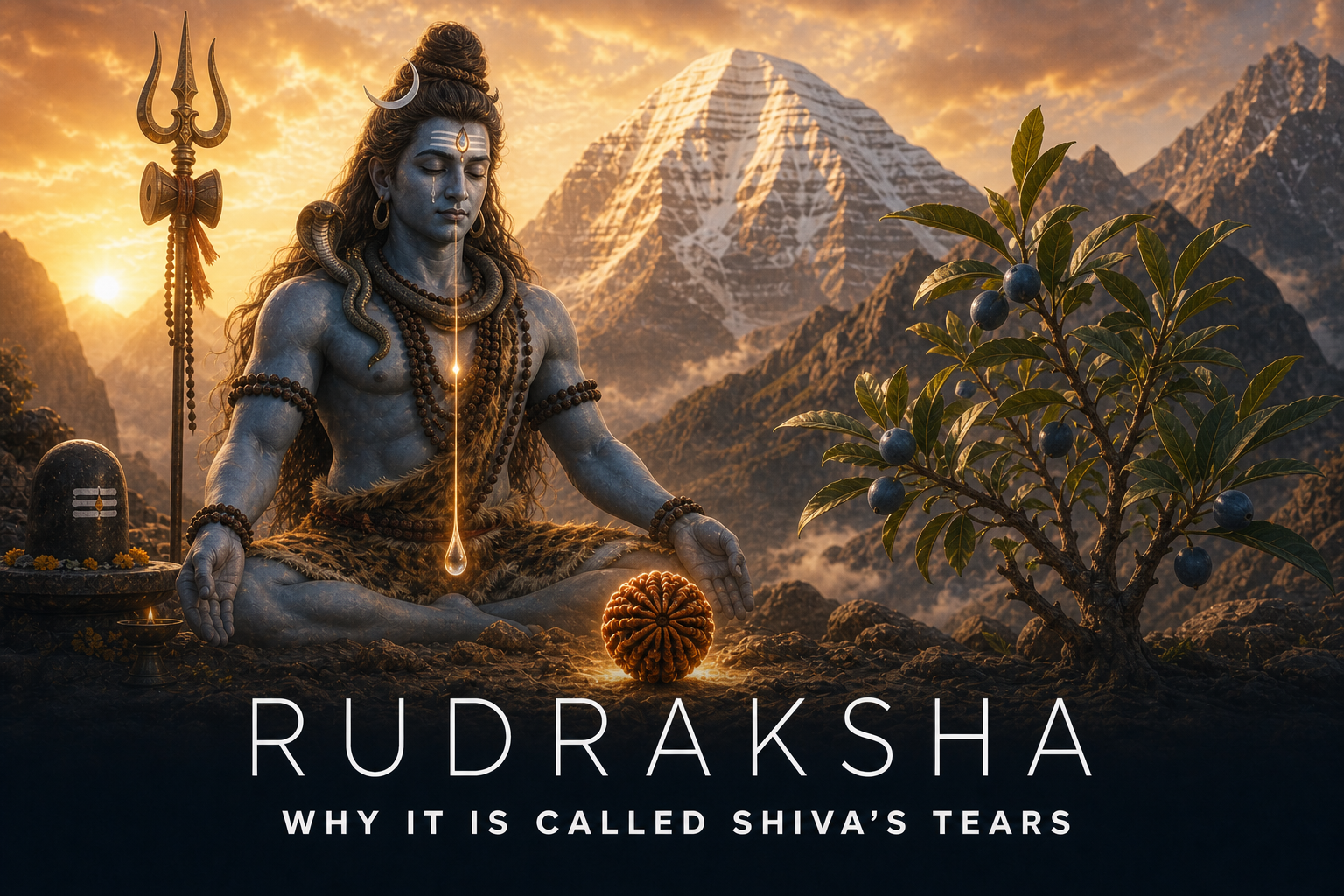
According to the Shiva Purana, Lord Shiva once sat in meditation for what is described as thousands of years, absorbed so deeply in tapasya that he was withdrawn from the world entirely. When he finally opened his eyes, he became aware — in that single instant — of the immense suffering carried by every living being across the universe: hunger, disease, grief, fear, and the endless cycle of birth and death.
Overwhelmed with compassion, tears rolled down his face and fell to the earth. Wherever they landed, it is said, Rudraksha trees sprang up. The bead was thus not born of anger or austerity, but of karuna — boundless compassion for humanity. To wear a Rudraksha, in this telling, is to carry a small piece of that compassion with you, a reminder that the divine grieves for suffering and offers protection in return.
Other Versions of the Legend
Like much of Puranic literature, the Rudraksha origin story exists in more than one form, each emphasizing a different quality of Shiva.
One version holds that during Shiva’s meditation on Mount Kailash, the sheer intensity of his tapasya caused drops of sweat to form on his brow; where these fell, Rudraksha trees took root. Another account ties the bead to a great war between the devas and the asuras — when the gods finally triumphed, Shiva is said to have wept tears of joy and relief, and these too became Rudraksha seeds. A third, more sorrowful telling connects the beads to Sati, Shiva’s first consort, whose death in the sacrificial fire is said to have broken him so completely that his tears of grief gave rise to the tree.
Whether born of compassion, exertion, joy, or grief, every version agrees on one point: the Rudraksha is Shiva’s own emotion made manifest in the physical world, which is precisely why it is treated as sacred rather than ornamental.
The Meaning Behind the Mukhis (Faces)
Every Rudraksha bead has natural vertical lines running along its surface, called mukhis, or faces. These are not decorative — each mukhi count is believed to carry its own presiding energy and deity, and this is why Rudraksha malas are chosen with such care.
A single-faced, or Ek Mukhi, Rudraksha is considered the rarest and is regarded as Shiva himself in bead form, symbolizing pure, undivided consciousness. A two-mukhi bead is linked to the union of Shiva and Parvati, representing balance and harmony between opposing forces. Three-faced beads are associated with Agni, the fire god, and the idea of purification, while four-faced beads are connected to Brihaspati, the guru of the devas, and the pursuit of knowledge. The most common and widely worn is the five-mukhi Rudraksha, representing Shiva’s Panchamukha (five-faced) form and believed to bring balance, calm, and general well-being — which is why it forms the base of most traditional 108-bead japa malas.
A certified, five-faced Rudraksha mala strung on 108 beads — ideal for daily japa, meditation, or simply keeping Shiva’s compassion close.
Why the Story Still Matters Today
It would be easy to reduce Rudraksha to a spiritual accessory, but the mythology behind it carries a philosophy worth sitting with. In every version of the legend, the bead exists because Shiva — the great ascetic, the destroyer, the lord of dissolution — was moved enough by the world’s pain to weep. That is a striking image: the most detached, meditative deity in the pantheon is also the one whose compassion literally grew trees.
For devotees, wearing or chanting on a Rudraksha isn’t about superstition; it’s about carrying that reminder physically. Each bead becomes a small anchor back to the idea that stillness and compassion are not opposites — that even the deepest meditation can, and perhaps should, end in tears for others.
Frequently Asked Questions
What does Rudraksha literally mean?
Rudraksha combines “Rudra” (a name of Shiva) and “aksha” (tear or eye), translating to “the tears of Rudra” or “the eyes of Shiva.”
Which Rudraksha origin story is the correct one?
The Shiva Purana’s account of Shiva weeping in compassion after opening his eyes from deep meditation is the most widely cited version, though regional and sectarian traditions also tell versions involving sweat, joy after a divine war, or grief over Sati.
Why do the number of mukhis (faces) matter?
Each mukhi count is believed to correspond to a different deity and energy, ranging from the rare Ek Mukhi (Shiva himself) to the widely worn five-mukhi bead associated with Shiva’s Panchamukha form.