
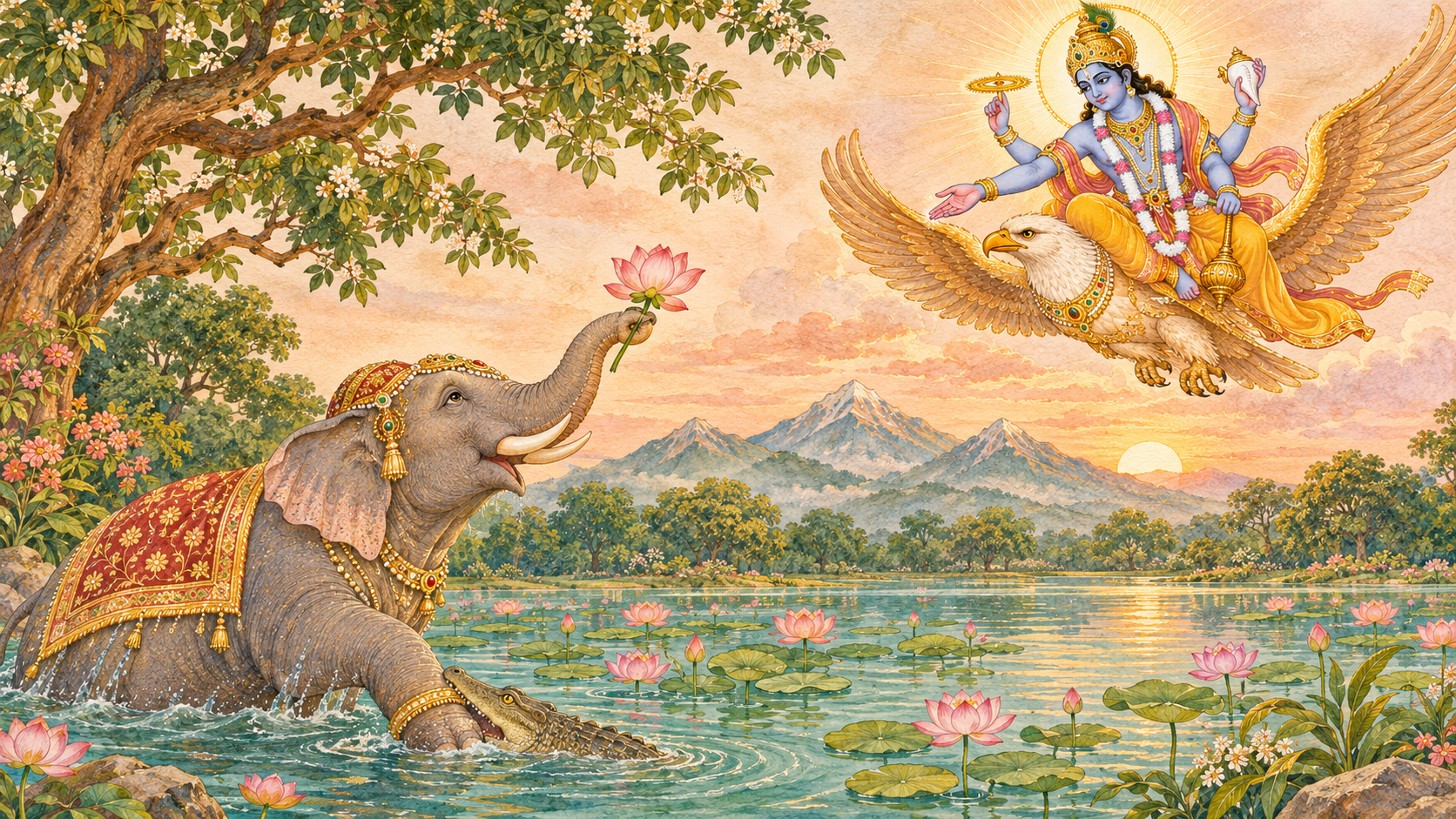
An elephant lifts a lotus above the water. His body is exhausted, yet the gesture carries a quiet dignity: he still has something to offer. The story of Gajendra is remembered through this tender image of devotion reaching toward Lord Vishnu in a moment of helplessness.
Known as Gajendra Moksha, the account appears in the eighth canto of the Bhagavata Purana, chapters 2–4. It moves from a struggle in a lake to prayer, rescue and liberation. Along the way, it asks a question that remains close to human experience: what sustains the heart when familiar sources of strength reach their limit?
This retelling follows the Bhagavata’s narrative. The reflections that follow draw devotional meaning from its imagery, while keeping the events and their interpretation distinct.
The Elephant King in the Lotus Lake
The setting is Trikuta, a mountain in the Purana’s sacred cosmology. Near it lies a beautiful lake surrounded by abundant life. Gajendra, the leader of a herd of elephants, enters the water with his companions and young ones, seeking relief from thirst and heat.
A crocodile catches his leg. Gajendra struggles to escape, and the other elephants attempt to pull him free. Their efforts cannot break the grip. The text describes the contest as lasting a thousand years, presenting an extraordinary Puranic scale rather than an ordinary wildlife scene.
The struggle gradually favours the creature at home in water. The crocodile grows stronger while Gajendra’s strength diminishes. At last, the elephant recognises the limits of his own power and of the help his companions can give.
His predicament invites a familiar reflection. A person may be capable, respected and surrounded by affection, yet encounter a difficulty that those advantages cannot fully resolve. The scene gives devotional expression to that vulnerable recognition.
A Prayer Remembered in Distress
Bhagavata Purana 8.3.1 says that Gajendra gathers his attention inward and remembers a sacred prayer learned in a previous birth. His turning toward the Divine has a history. Something cultivated earlier becomes available when outward strength is failing.
There is a gentle assurance in this detail. Quiet acts of remembrance may leave a deeper impression than we can measure at the time. A verse heard with love, a moment of sincere attention or a habit of gratitude can become part of the heart’s resources.
Gajendra’s prayer turns toward the Supreme as the deepest refuge. Within the story, his appeal reaches beyond the immediate contest between two bodies. Devotion opens a larger horizon than the urgent wish to escape pain.
For a present-day reader, this inward movement can be understood as an invitation to honesty. Prayer need not conceal fear or exhaustion. A person can acknowledge the need for support while continuing to seek help and care from others. The elephant’s surrender grows from a truthful recognition of his situation.
Vishnu Arrives, and the Lotus Is Raised
The narrative’s best-known image comes in 8.3.32. Gajendra sees Narayana approaching on Garuda, bearing his disc. With great difficulty, the elephant raises his trunk with a lotus and offers reverence to the Lord.
The order matters: in this verse, the lotus is lifted when Gajendra sees the Lord arriving. Retellings and paintings often gather the prayer, flower and rescue into one scene. Returning to the verse lets us appreciate its particular moment of recognition.
Vishnu responds with compassion. In 8.3.33, he descends from Garuda, draws Gajendra and the crocodile out of the lake, and uses his disc to free the elephant from the crocodile’s hold. The rescue is an act of divine mercy.
The smallness of the flower beside the immensity of the crisis gives the scene its emotional force. Gajendra cannot command the outcome. He can still turn toward the Lord with reverence. As a devotional reflection, the lotus suggests an offering whose worth lies in the heart that gives it.
The Lives Behind the Elephant and Crocodile
Chapter 8.4 reveals earlier histories. Gajendra was formerly Indradyumna, a king devoted to Vishnu. While absorbed in silent worship, he failed to welcome the visiting sage Agastya, who cursed him to take an elephant’s form.
The crocodile also has a past. He was Huhu, a Gandharva who had been cursed by the sage Devala. After Vishnu’s intervention, Huhu regains his celestial form and offers reverence before departing. The story therefore carries release for both beings caught in the encounter.
Gajendra’s deliverance is described in 8.4.6 as freedom from ignorance and bondage. He receives a divine form resembling the Lord’s, with four arms and yellow garments. The associated term is sarupya-mukti, liberation involving likeness of form.
Here the word moksha takes the account beyond survival. Gajendra’s journey includes a transformation of his condition and relationship with the Divine. The ending asks us to look more deeply than the visible struggle with which the story began.
What Gajendra’s Surrender Can Mean
In devotional reflection, surrender means entrusting oneself to the Divine with sincerity. Gajendra’s story gives this idea a living shape: effort is made, help is offered, limitation is recognised, and the heart turns toward a refuge greater than its own strength.
His companions deserve a compassionate reading too. They try to help. Their inability to rescue him does not make their affection meaningless. A thoughtful reading can honour both the value of human support and the spiritual longing that remains when support has limits.
The lake and crocodile may also be read symbolically as images of entanglement, fear or circumstances that overpower us. Such readings are interpretations of the narrative; the text does not require every detail to stand for one fixed psychological meaning.
The enduring comfort of the story lies in its vision of grace meeting vulnerability. Gajendra’s worth is not measured by how long he can appear invincible. Even with a weakened body and a faltering voice, he remains capable of devotion. The raised lotus gives that hope a form we can remember.
Make room for everyday remembrance
Explore devotional essentials for your home and quiet moments of reflection.
Frequently Asked Questions
Where is the story of Gajendra told?
The Bhagavata Purana recounts Gajendra’s crisis, prayers and liberation in its eighth canto, chapters 2–4.
Who was Gajendra in his previous birth?
Chapter 8.4 identifies him as King Indradyumna, a devotee of Vishnu who became an elephant following Agastya’s curse.
What does Gajendra Moksha mean?
It refers to Gajendra’s liberation. The account includes rescue from the crocodile and freedom from spiritual bondage through the Lord’s grace.
Sources: Bhagavata Purana 8.2, 8.3.1, 8.3.32, 8.3.33, 8.4 and 8.4.6. Narrative paraphrased; symbolic readings and present-day reflections are interpretations.