
Of all the great narratives in the Puranas, few are as vast and as layered as the Samudra Manthan — the churning of the cosmic ocean. It is a story of gods and demons working side by side, of a mountain used as a churning rod and the king of serpents as the rope, and of a poison so terrible that only Lord Shiva could hold it in his throat. During the sacred month of Sawan, when devotees pour Ganga water over the Shivling to cool the one who swallowed that poison, this ancient tale feels closer than ever.
What Is Samudra Manthan?
The story begins with loss. The sage Durvasa, angered by an act of carelessness, cursed the devas (gods) so that they were stripped of their strength, fortune and radiance. Weakened and defeated by the asuras (demons), the devas sought refuge with Lord Vishnu. He advised something surprising: to regain amrita, the nectar of immortality hidden in the depths of the Ksheer Sagar (the ocean of milk), the gods would have to churn the ocean — and to do so, they would need the help of their own rivals, the asuras. A fragile truce was struck, with the promise that the nectar would be shared.
The Churning Begins: Mandara and Vasuki
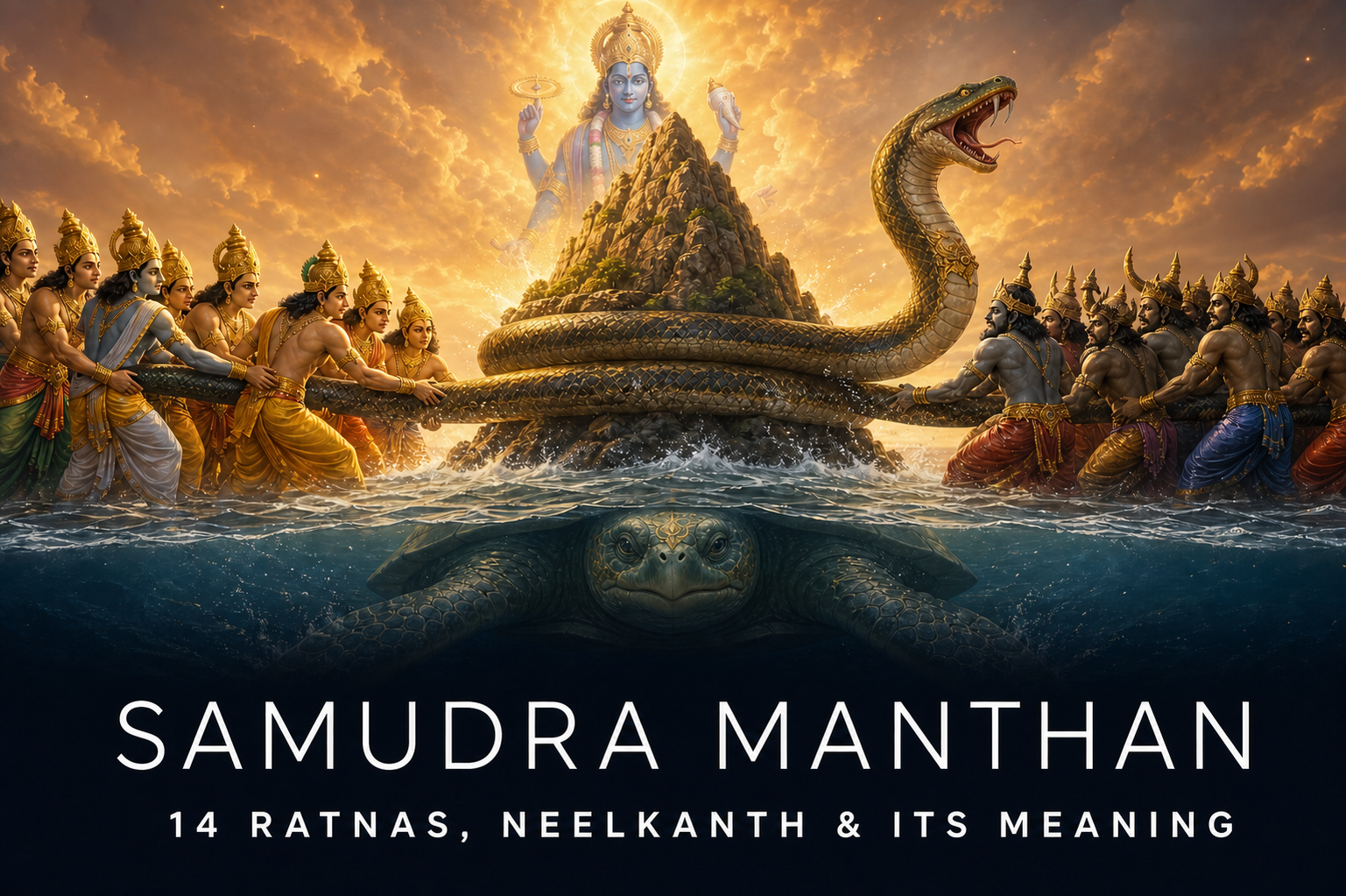
For a churning rod, the gods and demons uprooted the mighty Mount Mandara. For a rope, they called upon Vasuki, the great serpent king, who coiled himself around the mountain. The devas took hold of the tail while the asuras gripped the hood, and together they pulled back and forth, spinning the mountain to churn the sea.
But the mountain, having no base, began to sink into the ocean floor. At that moment Lord Vishnu descended as Kurma, the giant tortoise — his second avatar — and slipped beneath Mandara, holding it steady upon his back so the churning could continue. The ocean turned and turned, and slowly it began to yield its hidden treasures.
The Halahala Poison and the Birth of Neelkanth
The first thing to rise was not a treasure at all. It was Halahala (also called Kalakuta), a poison so deadly that its very fumes began to scorch the three worlds. Gods and demons alike fled in terror as creation itself trembled on the edge of destruction.
It was then that Lord Shiva stepped forward. In an act of supreme compassion, he gathered the burning poison and drank it to save all life. Goddess Parvati, fearing for him, pressed her hands to his throat so the poison could travel no further — and there it stayed, turning his throat a deep blue. From that moment Shiva became Neelkanth, “the blue-throated one” (neela = blue, kantha = throat). It is this sacrifice that the whole month of Sawan honours.
The Fourteen Ratnas That Rose from the Ocean
As the churning went on, fourteen divine gifts — the Chaturdasha Ratnas — emerged one by one from the waters:
- Halahala — the poison consumed by Shiva
- Kamadhenu — the wish-fulfilling cow
- Uchhaishravas — the seven-headed celestial horse
- Airavata — the white divine elephant
- Kaustubha Mani — the radiant gem worn by Vishnu
- Parijata — the eternally blossoming tree
- Apsaras — the celestial dancers
- Varuni — goddess of wine
- Chandra — the moon, which adorns Shiva’s head
- Sharanga — the mighty bow
- Shankha — the sacred conch
- Goddess Lakshmi — the deity of fortune, who chose Vishnu
- Dhanvantari — the divine physician, and
- Amrita — the nectar of immortality itself
Amrita, Mohini and the Eternal Test
When Dhanvantari finally rose bearing the pot of amrita, the fragile truce shattered. The asuras seized the nectar, and a struggle broke out. To restore balance, Lord Vishnu took the enchanting form of Mohini, who charmed the demons and skilfully served the nectar to the gods. The story reminds us that immortality is not simply seized by force — it is granted where there is grace, patience and righteousness.
The Hidden Meaning: A Churning of the Mind
Beyond the grand imagery, sages have long read the Samudra Manthan as a map of the inner spiritual journey. The ocean of milk is our own consciousness. Mount Mandara is the focused mind, and Vasuki the pull of desire that sets the churning in motion. The devas and asuras are the higher and lower impulses within every one of us, both needed to make progress.
When we begin any sincere sadhana, the first thing to surface is often not peace but our own halahala — buried fears, anger and restlessness. Only by learning to hold and transform that poison, as Shiva did, can the deeper treasures of clarity, devotion and finally amrita — the realisation of our own undying nature — rise to the surface. The churning, then, is not an event of the distant past. It is happening within us still.
Honour the one who drank the poison for the world. Explore our curated collection of Rudraksha, Shivling and Shiva puja essentials, chosen to make your Sawan worship complete.
Frequently Asked Questions
Why did Lord Shiva drink the Halahala poison?
When the deadly Halahala rose from the churning ocean, it threatened to destroy all creation. Out of compassion for every living being, Shiva drank it himself. Parvati held his throat so it would not spread, and the poison turned his throat blue — giving him the name Neelkanth.
What were the 14 ratnas of Samudra Manthan?
The fourteen treasures were Halahala, Kamadhenu, Uchhaishravas, Airavata, Kaustubha Mani, Parijata, the Apsaras, Varuni, Chandra, Sharanga, Shankha, Goddess Lakshmi, Dhanvantari and Amrita — the nectar of immortality.
How is Samudra Manthan connected to the month of Sawan?
It is believed the churning and Shiva’s drinking of the poison took place during Sawan. To soothe the heat of the poison in his throat, devotees offer water, milk and bel leaves to the Shivling throughout the month — the heart of Sawan worship.