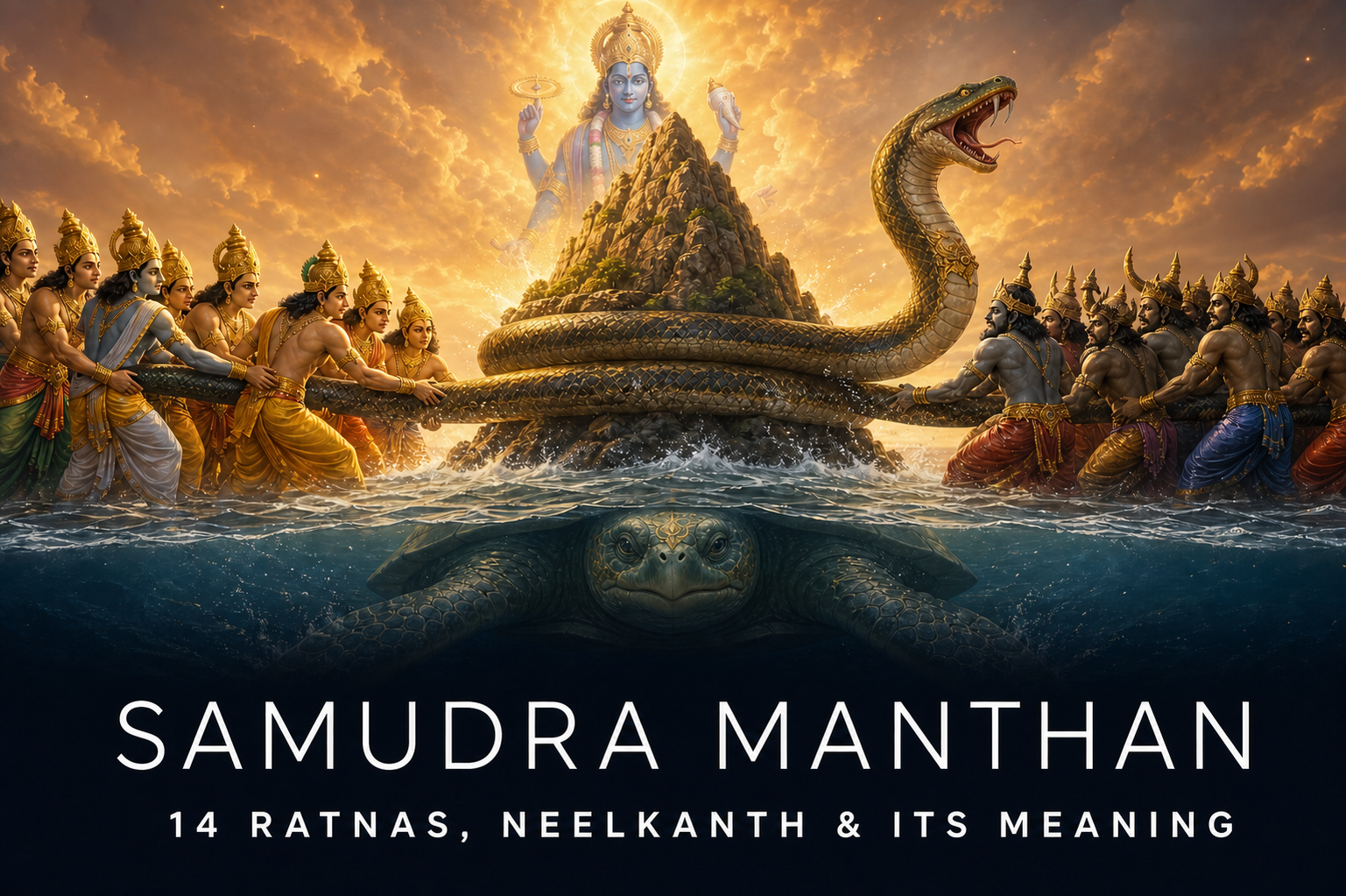

In sacred images of Lord Vishnu, each object held in his four hands speaks a language of its own. The discus expresses clear, decisive action; the mace conveys strength; the lotus points toward purity; and the conch, or shankha, carries the power of sound. Known as Panchajanya, Vishnu’s conch is more than an ornament or a battlefield trumpet. It announces the presence of dharma, awakens courage, and reminds the devotee that creation itself begins with vibration.
To understand why Vishnu holds a conch, we can look at his iconography, the story connected with Krishna, and the layers of meaning that devotees have heard in its call across generations.
The Shankha in Vishnu’s Sacred Form
Vishnu is the preserver of cosmic order, the divine presence who protects the world whenever harmony is threatened. Classical images usually show him with four arms holding the chakra, shankha, gada, and padma—the discus, conch, mace, and lotus. Museum collections and centuries of temple art identify the conch as one of his most enduring attributes.
A conch can be held quietly, yet it also contains a commanding voice. This makes it a fitting emblem for Vishnu. Preservation does not always mean stillness; sometimes order must be restored by a call that reaches everyone. The shankha represents that call. Its sound gathers attention, marks a sacred beginning, and declares that confusion does not have the final word.
Why Vishnu’s Conch Is Called Panchajanya
The name Panchajanya is closely associated with Krishna, an avatar of Vishnu. The Bhagavata Purana tells that after completing their education with Guru Sandipani, Krishna and Balarama offered to fulfil their teacher’s wish as guru dakshina. Sandipani asked for the return of his lost son. Their search led them to the ocean, where Krishna encountered the powerful being Panchajana, who moved through the water in the form of a conch.
Krishna defeated Panchajana and took the conch. He later sounded it before Yama while continuing the mission to restore his teacher’s son. The narrative joins the conch with devotion to the guru, courage in the face of death, and a promise faithfully completed.
The Bhagavad Gita names Panchajanya in its opening chapter. As the armies stand at Kurukshetra, Krishna blows Panchajanya, while Arjuna and the other warriors sound their own conches. The moment is solemn: the conch does not celebrate violence, but announces that a profound moral struggle is about to be faced.
The Sacred Sound That Awakens the Heart
A conch transforms breath into a far-reaching tone. For this reason, the shankha is often understood as a symbol of sacred sound—the movement from silence into expression. Hindu thought gives deep importance to sound as a carrier of prayer, memory, mantra, and knowledge. The conch’s resonant note invites the wandering mind to return to what is essential.
Its call also resembles an awakening. It asks the listener to rise above inertia and remember dharma. In a devotional sense, Vishnu’s conch is the compassionate summons of the Divine: return to steadiness, act with integrity, and do not let fear rule the heart. The same meaning can be felt whether the shankha appears in temple sculpture, ritual art, or the stories of Krishna.
Panchajanya and the Five Elements
The word pancha means “five,” and later symbolic traditions connect Panchajanya with the five great elements—earth, water, fire, air, and space. These elements form the field of embodied life. The conch, born from the ocean yet sounded through air, naturally brings several elemental images together.
This symbolism gives the shankha a cosmic dimension. Vishnu does not protect only one place or one community; he sustains the order within which all beings live. The five-element interpretation presents Panchajanya as a reminder that the world is sacred in its entirety. Matter, breath, sound, and consciousness are not isolated fragments. They participate in one ordered whole held by the preserving presence of Vishnu.
A Call to Dharma, Courage, and Protection
On a battlefield, a conch could signal readiness. In Vishnu’s hand, that power becomes moral rather than merely martial. Panchajanya proclaims that divine protection serves dharma. The Lord’s strength is directed toward restoring balance, shielding those who seek refuge, and opposing forces that reduce the world to fear or disorder.
For a devotee, the image offers a practical reflection. There are moments when conscience must speak clearly. There are promises that should be honoured even when the path becomes difficult. There are inner battles in which calm courage matters more than noise. Vishnu’s conch teaches that spiritual steadiness is not passive. It has a voice, and that voice calls us toward truth.
Explore thoughtfully selected devotional essentials that help create a peaceful place for prayer, remembrance, and everyday spiritual practice.
Frequently Asked Questions
What is the name of Vishnu’s conch?
Vishnu’s conch is commonly known as Panchajanya. The name is especially prominent in Krishna’s stories and in the opening chapter of the Bhagavad Gita.
What does Panchajanya symbolize?
It symbolizes sacred sound, the awakening of conscience, divine protection, and the call to uphold dharma. Some traditions also connect it with the five elements.
Why did Krishna blow the conch at Kurukshetra?
Krishna’s sounding of Panchajanya announced the solemn beginning of the conflict and framed it as a moral and spiritual crisis, not simply a contest for power.