
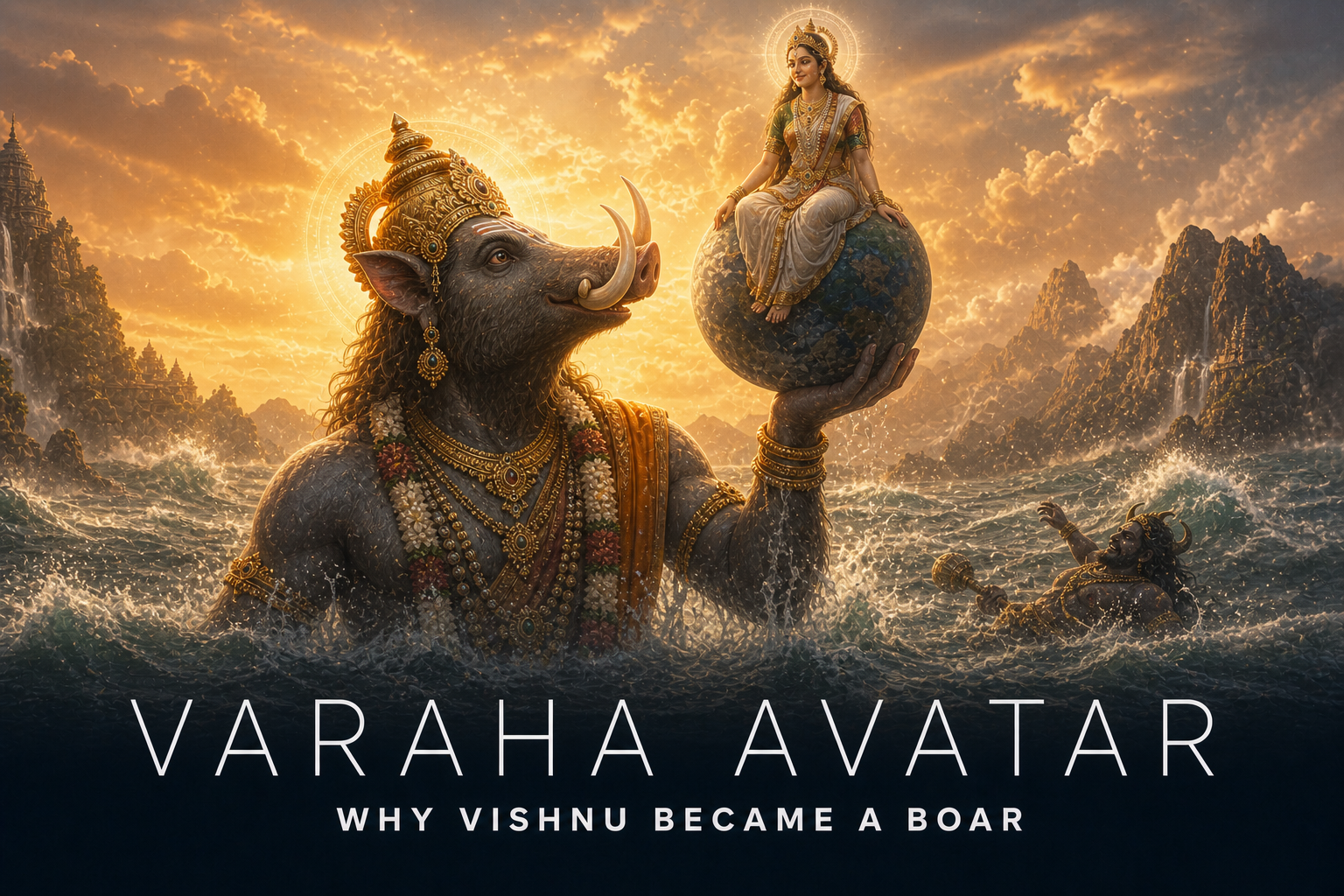
Of all the ten avatars of Vishnu, none is stranger to the modern eye than the third. The Lord of the universe — the one who reclines on Shesh Naag in an ocean of milk — takes the form of a wild boar, dives into black water, and comes up with the Earth balanced on the tip of a tusk. It is not an elegant image. It is a muddy, straining, physical one. And that is exactly the point.
The story of the Varaha avatar is the story of what happens when the world itself sinks — and of a God willing to go down into the mud to bring it back. Here is the legend as the Puranas tell it, and what the sages read into it.
Who Was Hiranyaksha, the Demon Who Stole the Earth?
Hiranyaksha was the son of the sage Kashyapa and Diti, and the elder brother of Hiranyakashipu — the demon later slain by Narasimha. Both brothers were born of a curse. In their earlier existence they were Jaya and Vijaya, the gatekeepers of Vaikuntha, cursed by the four Kumara sages for barring their entry to Vishnu’s abode. Given a choice between many lifetimes as devotees or a few as enemies, they chose enmity — because an enemy of Vishnu is slain by Vishnu himself, and that touch is liberation.
Born as an asura, Hiranyaksha performed terrible austerities and won from Brahma a boon of near-invulnerability: no god, no man, no beast named in his long list could kill him. He grew arrogant beyond measure. In the Bhagavata Purana he challenges the seas, torments the demigods, and finally seizes Bhudevi — the Earth herself, worshipped as a goddess — and drags her down into the cosmic waters, hiding her in the depths of Patala.
With the Earth submerged, creation stalled. There was nowhere to stand, nowhere to perform yajna, nowhere for the cycles of life to unfold. The universe had, quite literally, lost its ground.
How Vishnu Took the Form of a Boar
Brahma, unable to continue the work of creation, turned to Vishnu in prayer. The Bhagavata Purana gives the moment a curious tenderness: a tiny boar, no larger than a thumb-tip, emerged from Brahma’s nostril. As Brahma watched, it swelled — to the size of an elephant, then to a mountain, then to a form that filled the sky, its roar echoing through every world.
The choice of form is deliberate. A boar is the one creature that roots comfortably in mud and water, that can plunge into marshland and come up unbothered. To retrieve something lost in the primordial slush, the divine did not take a beautiful shape. It took a functional one. Hindu thought returns to this again and again — that the form of God is chosen by the need of the moment, not by the dignity of the form.
Note also the boon’s loophole. Hiranyaksha had listed every being he could imagine when asking for immunity — but a boar was too lowly to be worth naming. His arrogance wrote the terms of his own death, exactly as his brother’s would later do.
The Battle in the Cosmic Ocean
Varaha dived. Down through the layers of water he went, past the reach of light, tracking the Earth by scent as a boar tracks in the dark — a detail the Puranas dwell on lovingly. He found Bhudevi in Patala and lifted her onto his tusks.
Hiranyaksha met him there. The fight, the texts say, lasted a thousand years and shook the foundations of the worlds. The demon mocked the boar as a mere beast; the boar bore the insult and the Earth together, refusing to set her down. At last, on the surface of the waters, Varaha struck Hiranyaksha down with his mace and ended him — and the sages watching from above saw not a beast killing a demon, but the same Lord the gatekeeper had once served, granting him at last the release he had chosen lifetimes ago.
Varaha then set Bhudevi gently upon the waters, where she floats still. In temple sculpture across India — at Udayagiri, at Khajuraho, at Ellora — this is the moment carved again and again: the boar-headed god, one foot raised, the goddess small and safe in the crook of his tusk.
Every Vishnu avatar story ends the same way — with devotion answered. Our Vishnuji Puja Combo brings together the essentials for Vishnu worship at home, gathered and packed with care so your Ekadashi, Anant Chaturdashi and daily aarti are always ready.
What the Varaha Avatar Really Means
Read symbolically, the Varaha story is about the recovery of what has been lost to the depths. Bhudevi is not merely soil; she is dharma, stability, the ground on which righteous life is possible. When greed — Hiranyaksha’s name means “golden-eyed”, the one who sees only gold — drags the Earth under, it is the moral order that goes down with her.
Three ideas sit inside the image:
- The divine descends to the lowest place. Varaha does not summon the Earth back with a word. He goes down himself, into water and darkness, and carries her up on his own body. Grace, in this telling, is not remote.
- No form is beneath God. The avatar sequence moves fish, tortoise, boar, man-lion, dwarf, man — a deliberate ascent through the humblest shapes before reaching human form. Divinity is not embarrassed by the animal.
- Arrogance authors its own defeat. Hiranyaksha’s boon failed precisely where his pride refused to look. The Puranas make this point with almost mathematical repetition across the avatars.
Varaha in the Dashavatara Sequence
Varaha is the third of the ten avatars, following Matsya the fish and Kurma the tortoise, and preceding Narasimha. Some readers have long noted that the sequence traces a path from water-dweller to amphibian to land mammal to half-man to man — a progression that reads, to modern eyes, remarkably like an ascent of forms.
Traditionally, however, the sequence is read differently: each avatar meets a crisis the previous form could not. Matsya saves scripture from the deluge. Kurma steadies the churning of the ocean. Varaha restores the Earth herself. The pattern is one of widening rescue — knowledge, then the churning, then the ground beneath everything.
In temple worship Varaha appears in two forms: Bhu-Varaha, the boar-headed man lifting Bhudevi, and Yajna-Varaha, in which every part of his body is identified with an element of the fire sacrifice — his tusks the sacrificial stakes, his tongue the flame. The second reading makes him the embodiment of yajna itself, the ritual by which the world is sustained.
Where Varaha Is Worshipped Today
Varaha has fewer dedicated temples than Rama or Krishna, but the ones that exist are ancient and striking. The Varaha Cave Temple at Mahabalipuram in Tamil Nadu, carved in the seventh century, holds one of the finest early panels of the rescue. The Udayagiri caves in Madhya Pradesh contain a monumental Gupta-era Varaha relief roughly sixteen centuries old. In Tirumala, the Sri Varahaswami temple is by tradition older than the famous Venkateswara shrine beside it — and pilgrims are told to offer worship to Varaha first.
In parts of Andhra Pradesh and Karnataka, Varaha Jayanti is observed on the Shukla Paksha Tritiya of Bhadrapada month, with Vishnu puja, fasting and recitation of the Varaha Purana.
Frequently Asked Questions
Which avatar number is Varaha in the Dashavatara?
Varaha is the third avatar of Vishnu, coming after Matsya (the fish) and Kurma (the tortoise), and before Narasimha (the man-lion).
Who did Varaha kill and why?
Varaha slew the demon Hiranyaksha, who had dragged the Earth goddess Bhudevi into the cosmic waters and hidden her in Patala. Hiranyaksha’s boon of invulnerability did not name a boar, which is why Vishnu chose that form.
Are Hiranyaksha and Hiranyakashipu related?
Yes. They were brothers, both sons of Kashyapa and Diti, and both were incarnations of Jaya and Vijaya, Vishnu’s cursed gatekeepers. Hiranyaksha was slain by Varaha; Hiranyakashipu by Narasimha.