
Nine times, the tradition says, Vishnu has already come. A fish that towed a boat through the deluge. A tortoise that held up a mountain. A boar, a man-lion, a dwarf, an axe-bearing sage, a prince of Ayodhya, a cowherd of Vrindavan. Each descent answered a crisis that had already arrived.
The tenth is different. Kalki has not come yet. He is the only avatar of Vishnu who lives entirely in the future tense — a promise rather than a memory. And because he stands at the far end of our own age, the story of Kalki is really a story about time, about how bad things are allowed to get, and about why Sanatana Dharma refuses to end in despair.
What the Name Kalki Actually Means
The name is usually traced to the Sanskrit kalka — filth, sediment, the residue that settles at the bottom of still water. Kalki, then, is the one who removes the filth: the destroyer of accumulated impurity, both moral and spiritual.
That single word tells you what kind of avatar this is. Rama came to restore a kingdom. Krishna came to guide a war. Kalki does not come to reform the age — he comes to end it, the way a monsoon ends a drought, without negotiation.
Where the Prophecy Comes From
Kalki is not a folk legend. He appears in some of the most widely read Puranic literature. The Bhagavata Purana (Canto 12, Chapter 2) gives the most quoted account, naming both the village and the father. The Vishnu Purana carries a parallel prophecy, and the later Kalki Purana — a text largely woven from those two earlier sources — expands the sketch into a full narrative with a childhood, a teacher, a marriage and a campaign.
It matters that the older sources are brief. The Bhagavata gives a few verses; the elaboration came centuries later. Much of what people repeat about Kalki today — the exact colour of the horse, the name of the sword — belongs to that later layer rather than to the earliest scripture.
The Story: A Birth in Shambhala
The prophecy is unusually specific about origins. Kalki will be born in a village called Shambhala — a Sanskrit name that carries the sense of “place of peace” — in the house of a brahmana named Vishnuyasha, described as the most eminent man of that village. His mother is named Sumati.
There is a quiet beauty in that detail. The final avatar is not born in a palace or a temple city. He is born in an ordinary village, to a devout household, at the moment when the world has almost entirely forgotten what devout households are for. Peace survives in one small place, and the future comes out of it.
The Kalki Purana takes the story further: the boy studies the scriptures, learns dharma, artha and jnana, and receives his training in arms from Parashurama — the sixth avatar of Vishnu, the sage who by tradition still walks the earth. It is a striking image. One incarnation of Vishnu teaches another. The chain of descents closes on itself.
The Horse, the Sword and What They Stand For
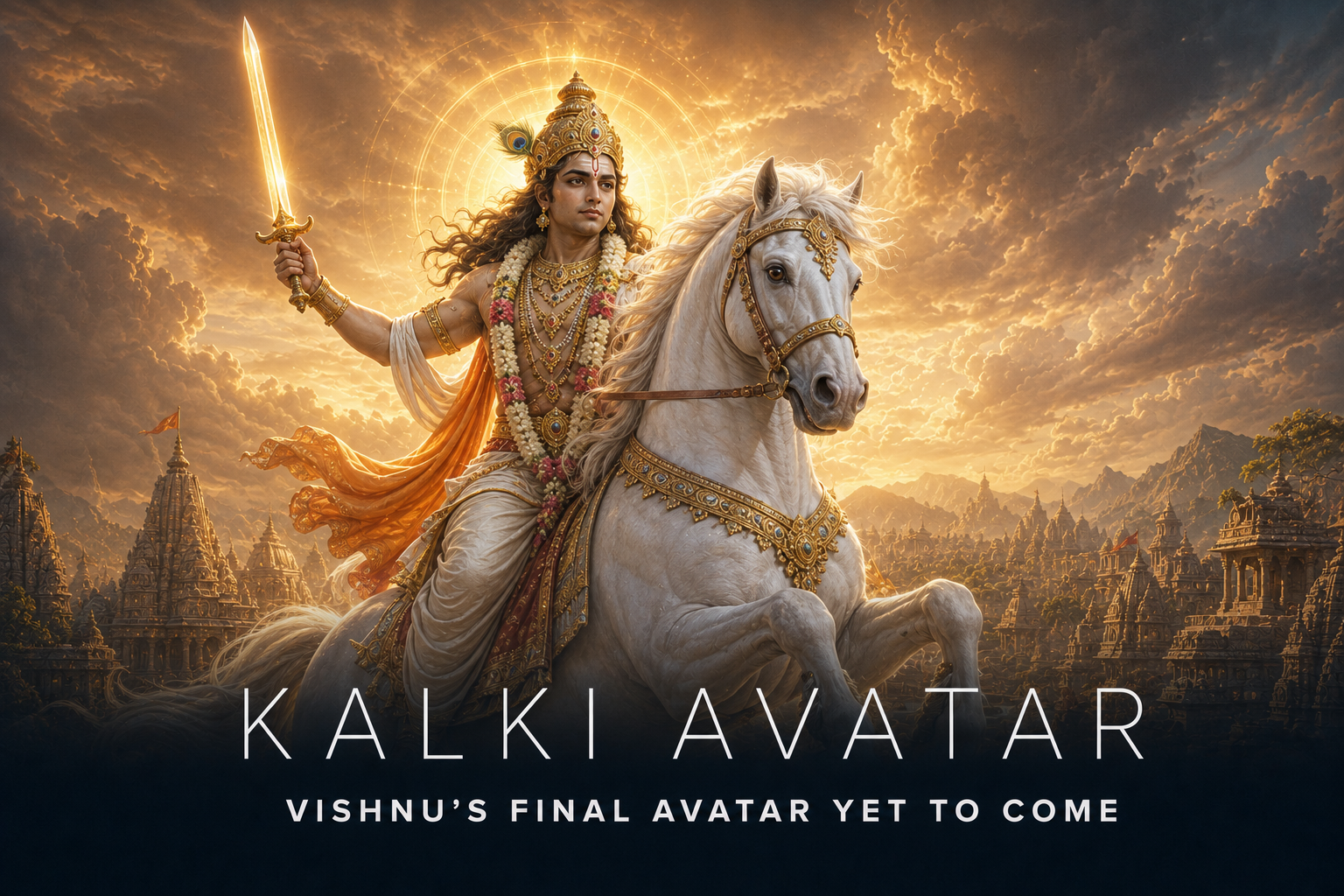
The image everyone knows is Kalki on a white horse, sword raised. The horse has a name in the tradition — Devadatta, “god-given”. It is worth noting that the older Sanskrit describes the mount as ashuga, “swift-moving”, rather than white; the whiteness is an inheritance from later iconography, where it reads as purity and as the untainted light that follows a long night.
The sword is described in the Kalki Purana as having a jewelled hilt. In devotional reading, the blade is not violence for its own sake — it is viveka, discrimination. It separates what is true from what only looks true. That is precisely the faculty an age of confusion loses first.
Speed, purity, discernment. Read as symbols rather than as a police report, the three elements describe exactly what a collapsing world lacks.
Why Kalki Belongs to the End of Kali Yuga
In the Puranic view of time, the ages do not improve. Satya, Treta, Dvapara and Kali follow one another like a wheel turning downward, dharma standing on four legs, then three, then two, then one. Kali Yuga — our age — is the shortest and the heaviest.
The Bhagavata’s description of that age’s end is unsparing: rulers who govern by appetite, truth reduced to whatever is convenient, learning measured only by wealth, and human life shortened by its own excesses. Kalki appears when this has run its full course — not partway through, when reform might still work, but at the point where only a turning of the wheel will do.
And then comes the part people forget. Kalki does not end the story. He closes Kali Yuga and opens Satya Yuga again — the age of truth. The cycle does not terminate in ruin; it returns to its beginning. Hindu cosmology has no final judgement and no last page. It has a wheel.
The avatars are remembered not only in stories but at the altar. A complete Vishnuji puja combo brings together the essentials for Vishnu worship at home — so Thursday aarti, Ekadashi and Chaturmas observances are ready without a last-minute scramble.
What the Kalki Story Is Really Asking
Read literally, Kalki is a prophecy about a rider who has not arrived. Read the way the acharyas have always read the avatars, it is something more immediate.
Every avatar answers a question about where dharma has gone. Matsya asks what is worth saving when everything is swept away. Narasimha asks whether faith holds when it costs everything. Krishna asks how to act without being owned by the result. Kalki asks the last question: what remains when almost nothing remains?
The answer the story gives is Shambhala — one household still keeping the lamp lit while the world forgets. The tradition is not saying that a horseman will fix things while we wait. It is saying that the future is born wherever dharma is still practised quietly, without an audience. That is a demand made on the present, not a prediction about the distant end.
Which is why devotees are usually cautioned against date-fixing. Kalki is not a countdown. He is a reason not to give up.
Frequently Asked Questions
Has Kalki already been born?
The classical texts place Kalki at the close of Kali Yuga, and the traditional reckoning puts that end far in the future — hundreds of thousands of years away. Individuals have claimed the title at various points in history, but no such claim carries the sanction of the Puranic tradition itself.
Is Kalki the ninth or the tenth avatar?
Kalki is always the final avatar in the Dashavatara list. The disagreement between lists concerns the eighth and ninth places — some traditions count Balarama and Krishna, others count Krishna and the Buddha — but Kalki’s position at the end is constant.
Where is Shambhala said to be?
The Puranas name Shambhala as a village but do not fix it on a map, and several places in India claim the association. Most commentators treat the name as significant in itself — a “place of peace” — rather than as a geographical puzzle to be solved.