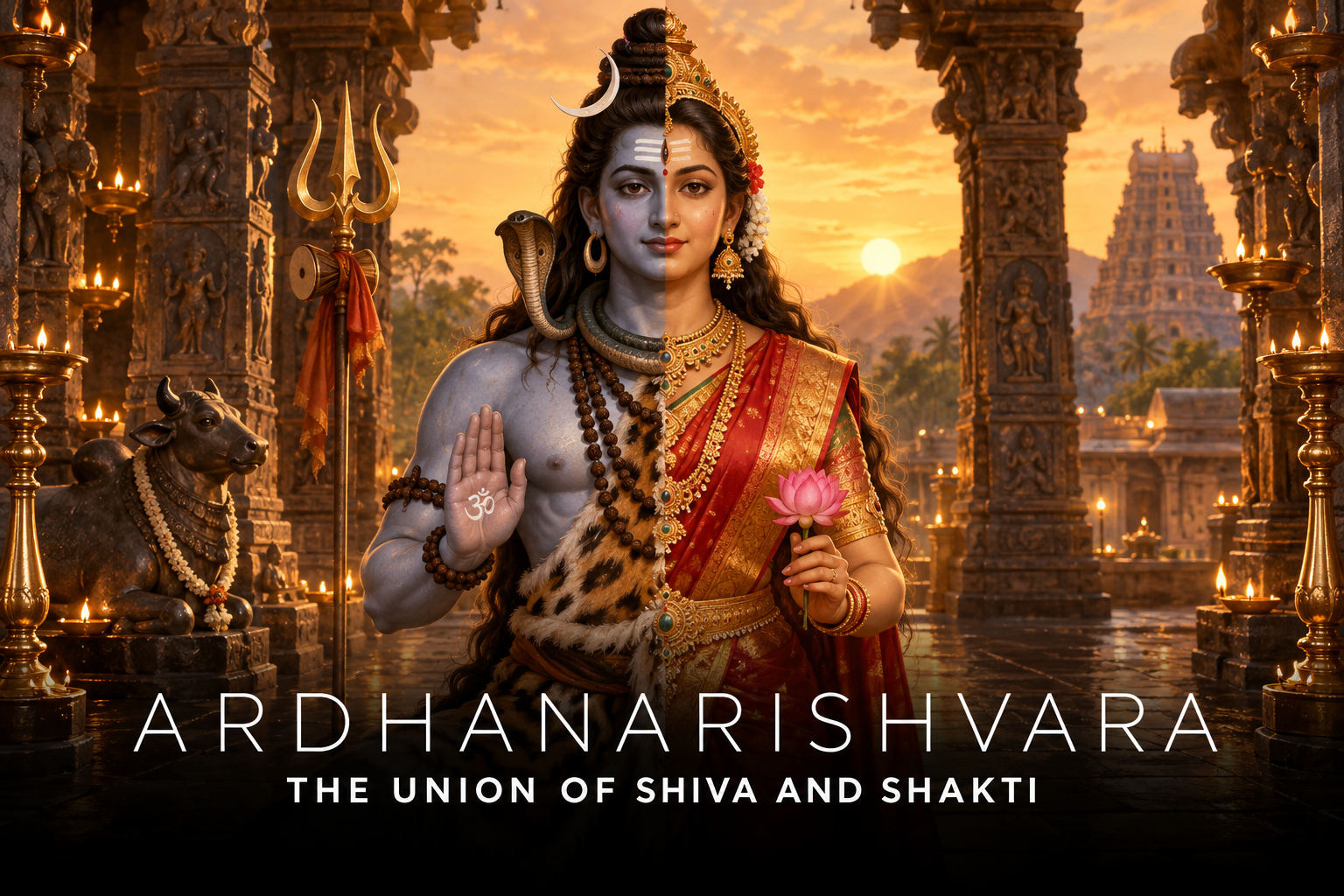

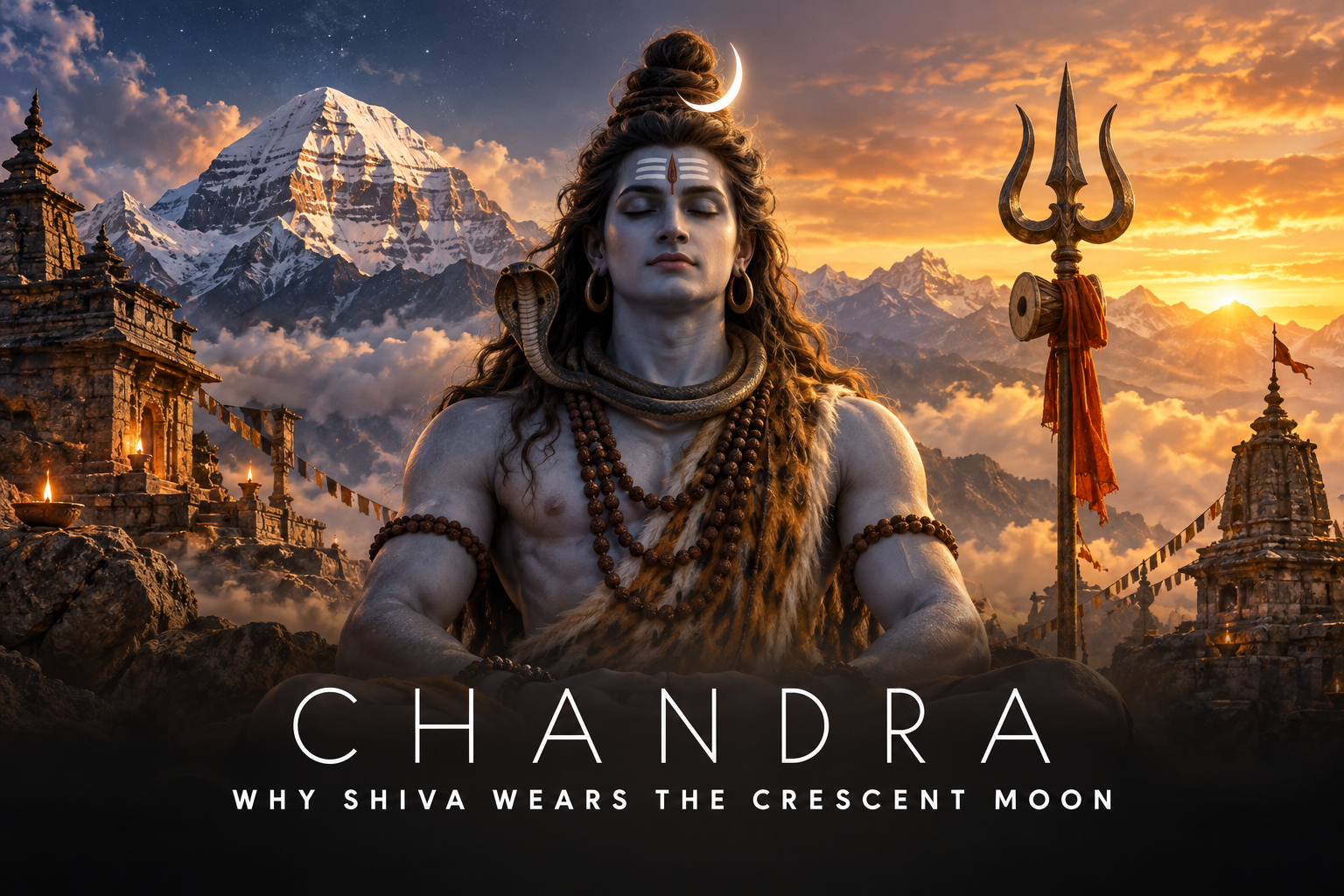
Look at almost any image of Lord Shiva and you will find it: a thin sliver of moon resting in his matted hair, just above the forehead. Not a full moon. Not a crown of gold. A crescent — the moon at its most fragile, the shape it takes when it is barely there at all.
It is one of the most quietly beautiful details in all of Hindu iconography, and it is not decoration. Behind that sliver lies a story of jealousy, a father’s curse, a dying god, and a compromise that still governs the night sky above us. This is the story of why Shiva wears the crescent moon — and why he is called Chandrashekhara, “the one crowned by the moon.”
The Moon God Who Loved Only One of His Wives
The story begins with Daksha Prajapati, the same powerful patriarch whose pride would later cost him his daughter Sati. Daksha gave twenty-seven of his daughters in marriage to Chandra, the moon god. These twenty-seven daughters were the nakshatras — the lunar constellations through which the moon travels, one for each night of his monthly journey across the sky.
It was a cosmic arrangement as much as a domestic one. The moon was meant to move evenly through all twenty-seven, giving each her turn, keeping the rhythm of the heavens balanced.
But Chandra fell in love. Among all twenty-seven, one shone brighter in his heart than the rest: Rohini. He lingered in her house. He returned to her again and again. The other twenty-six waited in the dark for a husband who came reluctantly, if he came at all.
In time, the neglected sisters went to their father.
Daksha’s Curse and a Sky Beginning to Empty
Daksha did not curse immediately. He warned his son-in-law — repeatedly, the Puranas say — to give each of his wives her due. But Chandra was proud of his beauty and certain of his own heart, and he did not change.
So Daksha spoke the curse: the body of which you are so proud will waste away.
And it began at once. Night by night, the moon grew thinner. His silver light dimmed. What had been a private family grievance became a crisis for all creation, because the moon in Sanatana thought is never only a lamp in the sky. He is the lord of coolness, of tides, of the sap that rises in plants, of the herbs that ripen under his rays, of the settled rhythm of the mind at night. As Chandra faded, the oceans lost their pull, crops faltered, and a strange restlessness spread through living beings.
The devas grew alarmed. A dying moon meant a dying order.
Why Chandra Turned to Shiva
Chandra went first to Brahma, who told him plainly what he did not want to hear: a curse once spoken cannot simply be erased. There was only one refuge — Shiva, the one who takes what the universe cannot digest and holds it without harm. The same Shiva who drank the halahala poison at the churning of the ocean. The same Shiva who catches the falling Ganga in his hair.
So Chandra travelled to Prabhasa Tirtha, on the western shore where the Saraswati meets the sea. There he shaped a lingam of earth with his own hands and worshipped Shiva through six long months of austerity — growing weaker with every waning night, and refusing to stop.
That lingam is worshipped to this day as Somnath — Soma, another name for the moon, and natha, lord or protector. The Protector of the Moon God. It is counted as the first of the twelve Jyotirlingas, and its name is a permanent memorial to a devotee who was saved when nothing else could save him.
The Compromise That Still Rules the Night Sky
Shiva appeared. And what he offered was not a cancellation of the curse but something more interesting — a settlement.
“Daksha’s word cannot be made empty,” Shiva said in effect. “But neither will you be allowed to vanish. For fifteen nights you will wane, as the curse demands. For the next fifteen you will wax and be whole again.”
This is the origin, in the Puranic telling, of krishna paksha and shukla paksha — the dark fortnight and the bright fortnight that structure the entire Hindu calendar, every Ekadashi, every Purnima, every Amavasya, every vrat a household keeps. The curse was honoured. The moon was saved. And the sky was given a rhythm instead of a straight line.
Then Shiva did one more thing. He lifted the frail crescent — the moon at the very lowest point of the curse, the moon at its most vulnerable — and set it in his own hair. Not the full moon at its proudest. The thin one. The one nobody would have chosen.
From that day he is Chandrashekhara: the moon-crested Lord.
What the Crescent Moon Actually Means
Once you know the story, the symbolism opens out in several directions at once — and the tradition has never insisted on only one reading.
Mastery over time. The moon is the visible clock of the cosmos. It is born, it swells, it decays, it disappears, it returns. To wear that cycle on your head is to stand outside it. Shiva is Mahakala, the Great Time; the crescent in his hair is time itself, worn as an ornament rather than obeyed as a master.
Mastery over the mind. In Indian thought the moon governs manas, the mind — which is why we still speak of a mind that waxes and wanes, of moods that rise and fall with no obvious cause. The thin crescent, fixed and steady above Shiva’s brow, is the restless mind finally stilled. Not destroyed, note — still present, still a sliver. Just no longer in charge.
Coolness against fire. Shiva carries a great deal of heat: the third eye that burns, the poison held in his throat, the serpent Vasuki coiled at his neck. The moon is amrita-natured, dripping nectar, endlessly cooling. It balances him. The Puranas describe its soothing rays counteracting the venom’s heat — an image of perfect equilibrium between what scorches and what heals.
And a promise about grace. This may be the deepest layer of all. Shiva accepted the moon at its weakest — cursed, fading, guilty of a real fault, rejected by the family it married into. He did not wait for Chandra to be restored to full brightness before honouring him. He took him as he was, at his thinnest, and gave him the highest seat in all creation.
That is why devotees have loved this image for centuries. The crescent on Shiva’s head is not a trophy. It is evidence.
The crescent moon, the bhasma, the bilva leaf — every element of Shiva’s form has a place in his worship. Our Shiv Shringar Kit brings the complete traditional samagri together in one set, ready for daily abhishek, Somvar puja or Mahashivratri.
Frequently Asked Questions
Why is Shiva called Chandrashekhara?
Chandra means moon and shekhara means crest or crown. Shiva earned the name when he gave refuge to the cursed moon god and placed the crescent in his own matted hair, making Chandra a permanent part of his form.
Is the moon on Shiva’s head connected to Somnath temple?
Yes. According to the Puranic account, Chandra worshipped a lingam he installed at Prabhasa Tirtha in present-day Gujarat to be freed from Daksha’s curse. That lingam became Somnath — literally “Lord of the Moon” — and is revered as the first of the twelve Jyotirlingas.
Why is it always a crescent and never a full moon?
Because the crescent is the moon in its cursed, diminished state — and that is precisely the point. Shiva took the moon at its weakest, not at its brightest. Symbolically the sliver also stands for a mind reduced to its barest trace: quiet, controlled, no longer ruling the one who wears it.