

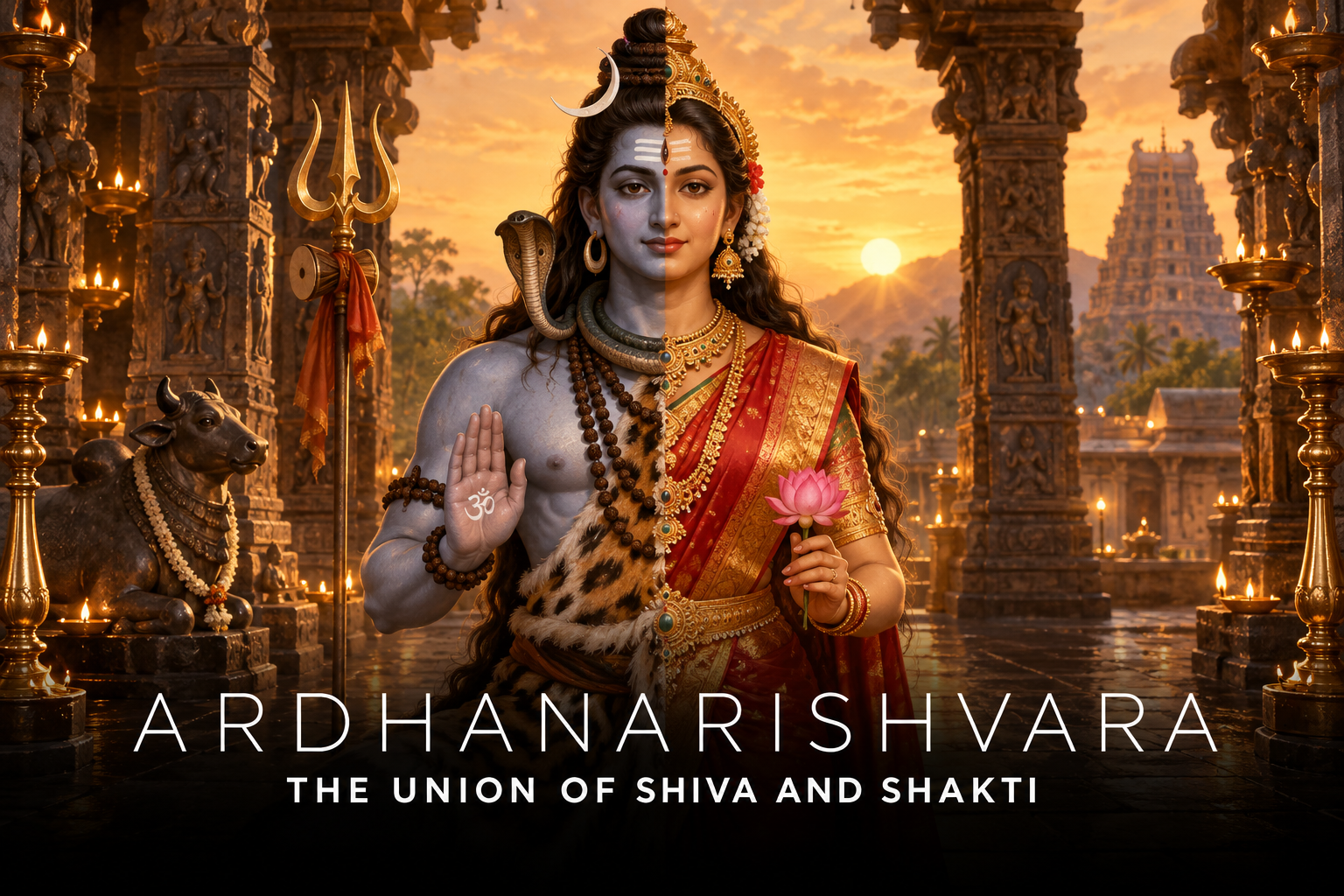
One body, two distinct halves, and a single serene presence: Ardhanarishvara is among the most profound images of Shiva. One side bears the features of Shiva, while the other reveals the Goddess. The meaning of Ardhanarishvara begins with this striking unity. Shiva and Shakti are shown together in a form that invites us to look beyond separation.
This sacred image speaks through both story and symbolism. A creation narrative in the Shiva Purana explains why the combined form appears, while centuries of sculpture make its message visible. For the devotee, it offers a gentle invitation to recognise relationship, creative power, and wholeness at the heart of existence.
What the Name Ardhanarishvara Means
The Sanskrit name is commonly translated as “the Lord who is half woman.” Its parts bring together ardha, half; nari, woman; and ishvara, lord. In familiar devotional language, the form unites Shiva with Parvati, also revered as Uma and as Shakti, divine power. The British Museum identifies the figure as Shiva and Parvati combined in one deity.
The name describes the appearance, but the image asks us to contemplate its unity. The two halves are recognisable without becoming two separate figures. There is one stance and one shared presence. This visual choice makes relationship inseparable from identity: the Goddess belongs within the sacred form itself, rather than standing outside it as an optional addition.
The Creation Story in the Shiva Purana
In the Shatarudra Samhita, chapter 3, Brahma is distressed because the beings he has created do not multiply. Directed to bring forth creation through pairs, he turns to Shiva in penance. Shiva appears united with Shakti in a form that is half male and half female.
The Goddess then manifests separately, and Brahma honours her as the source of the powers needed for creation. He asks for the capacity to create women, and she grants it. After bestowing the necessary power, she reunites with Shiva. Creation can now proceed through couples.
This is one particular Puranic account, not a sequence that must replace every regional telling. Its central insight is clear: Brahma’s creative work needs the Goddess’s power. The narrative gives Shakti an essential place in the unfolding of life. The combined form is therefore a revelation about creation, as well as a striking divine appearance.
How Sacred Art Shows the Two Halves
Artists often divide the figure along a vertical axis, with Shiva on the figure’s own right and Parvati on the left. Differences in dress, ornaments, and bodily features help the viewer recognise each side. Yet the figure remains continuous. A shared outline holds the distinctions together.
The Los Angeles County Museum of Art’s early Mathura sculpture, dated to the second or third century, shows this approach. Its curatorial notes identify Shiva’s raised hand in the gesture of reassurance and a flower held on Parvati’s side. Such details allow the image to speak through more than its divided appearance.
The tradition also changes across place and time. The Metropolitan Museum of Art records a bronze Ardhanarishvara from Kerala, dated around the thirteenth century. These surviving works remind us that the form has inspired different artists over many centuries. No single list of ornaments describes every example.
Shiva and Shakti: Stillness and Creative Power
A familiar philosophical reading understands Shiva as the contemplative or witnessing presence and Shakti as the energy through which life becomes manifest. LACMA’s interpretation of its sculpture connects Shiva’s yogic detachment with Parvati’s enlivening creative power, and reads the united image as an expression of divine nonduality.
For devotional reflection, this can be approached through the relationship between awareness and action. Stillness gives us room to see clearly; energy allows us to respond. Ardhanarishvara brings these qualities into one field of contemplation. Neither needs to be treated as an enemy of the other.
These symbolic associations do not mean that everyday men and women must possess fixed, opposite personalities. Quiet attention, courage, tenderness, and creativity are not limited to one group of people. The image concerns the divine and the structure of existence; applying it to human life calls for care rather than rigid assumptions.
A Devotional Reflection on Wholeness
The meaning of Ardhanarishvara can become especially moving when we stop looking for a contest between the two sides. The shared body invites a different question: what becomes possible when we recognise what we depend upon? In prayer, this may encourage gratitude for strength received through relationship.
It can also inspire a more balanced inner life. Reflection without compassionate action may remain unfinished, while constant activity without attention can become exhausting. Holding the image in mind offers a way to consider how listening and responding might support one another. This is a personal devotional application, not a promise of a particular spiritual result.
Ardhanarishvara ultimately directs the gaze back to unity. The differences remain visible, but they do not break the sacred form apart. Shiva and the Goddess are contemplated together, inviting reverence for a reality richer than any single quality we might try to isolate.
Explore thoughtfully selected puja essentials for a peaceful home altar and meaningful moments of prayer, gratitude, and contemplation.
Frequently Asked Questions
Who is shown in Ardhanarishvara?
The familiar form combines Shiva and Parvati, the Goddess revered as Shakti. They appear as two recognisable halves of one divine body.
Which side represents Parvati?
In the usual arrangement, Parvati occupies the figure’s own left and Shiva the right. Artistic details vary across regions and periods.
What is the main meaning of Ardhanarishvara?
The image expresses the inseparability of Shiva and Shakti. Devotional and philosophical readings emphasise creative unity, interdependence, and divine wholeness.