
The Yaksha story in the Kena Upanishad turns a moment of triumph into a lesson in humility. The devas celebrate victory, but a mysterious presence confronts them with a question their strength cannot answer. A single piece of straw becomes more revealing than a display of power.
The encounter unfolds in the third and fourth sections of the text. Agni, Vayu, and Indra approach the unknown being; Uma provides the understanding that resolves the mystery. For a devotional reader, this compact narrative offers a beautiful invitation to gratitude, honest inquiry, and reverence for wisdom.
Victory and the Mystery of the Yaksha
Kena Upanishad 3.1–2 begins by saying that Brahman secured victory for the devas. They take the greatness of that victory as their own. Brahman appears before them, yet they cannot identify the mysterious being, called a yaksha.
In this narrative, the unknown presence interrupts certainty. The devas know that they have won, but their explanation of the victory remains incomplete. The story asks the reader to attend to that gap between an achievement and a full understanding of what made it possible.
As a contemporary reflection, we might remember how easily success narrows our attention. We see our effort clearly while overlooking teachers, colleagues, circumstances, or help received. Gratitude can make our account of success more truthful. This everyday comparison is an application of the story, not another event described in the Upanishad.
Why Agni and Vayu Cannot Move the Straw
Agni approaches first. Asked about his power, he declares his ability to burn what is on earth. The yaksha places straw before him, but he cannot burn it. Vayu then approaches, speaks of his power to carry things away, and cannot lift the straw placed before him. These exchanges occupy 3.3–10.
The simplicity of the challenge makes the scene memorable. There is no vast mountain or elaborate weapon. Something apparently insignificant reveals a limit that a grand claim had concealed. The contrast gives the narrative its quiet force.
Read devotionally, the scene can prompt humility about our abilities. Being capable in one setting does not make us independent of every condition. Recognising a limit need not mean denying a gift. It can mean holding that gift with greater care, without turning competence into a claim of complete self-sufficiency.
Indra Encounters Uma
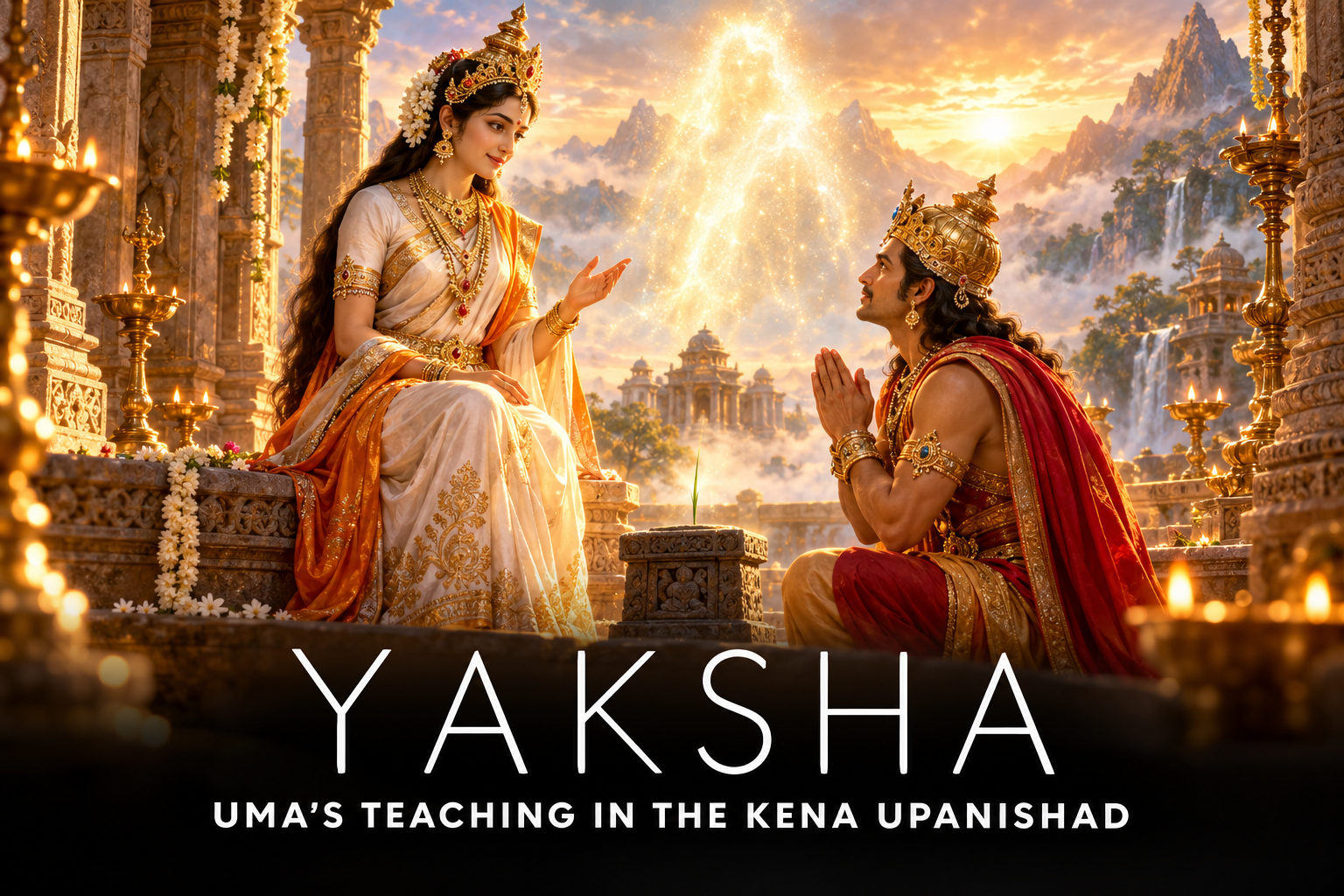
When Indra approaches, the yaksha disappears. In the same place he encounters Uma Haimavati and asks who the being was. Kena Upanishad 4.1 gives her answer: it was Brahman, through whose victory the devas had become great. Indra then understands the identity of the mysterious presence.
Uma’s role is decisive. The narrative reaches understanding through her teaching. Indra’s arrival alone does not settle the mystery; asking and receiving an answer matter. Power gives way to a relationship between the one who seeks and the one who knows.
For a reader, that movement can be deeply reassuring. We do not have to turn every uncertainty into a contest. Sometimes the wiser response is to become a student. An honest question allows someone else’s understanding to reach us.
Uma’s presence also makes room for reverence toward wisdom in feminine form. Here she speaks the answer the devas need. Attending closely to that moment honours her place in the text, without adding a battle or a speech that the passage does not contain.
Brahman and the Limits of a Boast
The story names the source of victory as Brahman. Brahman here refers to ultimate reality; it should not be confused with Brahma, the creator deity. In the Advaita commentary tradition presented with the Kena Upanishad and Shankara’s commentary, the narrative challenges mistaken claims of independent agency and ownership of victory.
This reading places the encounter within spiritual inquiry, rather than treating it only as a warning against bad manners. A boast is incomplete because it mistakes a limited standpoint for the whole truth. The question becomes how our abilities relate to the reality on which they depend.
We can reflect on that question without pretending that a short retelling exhausts the philosophy. Sacred narratives often remain fruitful because they invite repeated study. What first appears to be a story about someone else’s pride can gradually become a question about our own assumptions.
A Lesson in Gratitude and Receptive Learning
One way to carry this narrative into daily life is to let gratitude accompany accomplishment. After finishing something difficult, we can acknowledge both our work and the help that made it possible. Such acknowledgement need not diminish effort; it can place effort in a more generous and accurate account.
Another reflection concerns how we meet a limit. Agni and Vayu’s difficulty makes the mystery visible. In our own lives, a question we cannot answer can invite further learning. Admitting uncertainty may be the beginning of a clearer understanding, especially when we seek guidance with patience.
These are personal applications inspired by the narrative, not promises of instant spiritual insight. For devotees, the enduring image is Uma’s teaching: wisdom received with reverence can change how victory itself is understood. The smallest straw becomes a reminder to leave room for wonder.
Explore puja essentials for a home altar that welcomes prayer, gratitude, and thoughtful time with sacred teachings.
Frequently Asked Questions
Who is the yaksha in the Kena Upanishad?
Uma identifies the mysterious being as Brahman in section 4.1. The devas had not recognised the presence when it first appeared.
What happens to Agni and Vayu?
Agni cannot burn the straw placed before him, and Vayu cannot lift it. Their ordinary claims of power do not resolve the encounter.
What does Uma teach Indra?
She reveals that the being was Brahman and that the devas’ greatness in victory came through Brahman.