

Few images in Sanatana Dharma are as striking as the serpent — coiled at Shiva’s throat, cradling a sleeping Vishnu on the cosmic ocean, or rising with a raised hood over a temple deity. On Nag Panchami, celebrated on the fifth day of the bright fortnight in the sacred month of Shravana, these serpents step from myth into worship. In 2026 the festival falls on 17 August across most of North India.
But why does a tradition so devoted to compassion revere the very creature most people fear? The answer lives in some of the oldest and most beautiful stories in Hindu scripture.
What Is Nag Panchami?
Nag Panchami is a festival of gratitude and reverence toward the Nagas — the divine serpents of Hindu, and also Buddhist and Jain, tradition. Falling during Shravana, the monsoon month most beloved of Lord Shiva, it is a day when devotees offer milk, water, flowers and prayers to serpent deities, whether as living cobras, stone carvings, silver idols, or images painted on the walls of the home.
The timing is not accidental. The monsoon drives snakes from their flooded burrows and closer to human settlements, and the festival transforms a season of fear into one of respect. Rather than harm the creatures, families seek their blessing for protection, fertility and the wellbeing of the household.
The Legend of Astika: How the Serpents Were Saved
The story most closely tied to the day comes from the Mahabharata. King Janamejaya, grieving the death of his father Parikshit — who had died from the bite of Takshaka, the serpent king — resolved to take revenge upon the entire race of Nagas. He began the Sarpa Satra, a great fire sacrifice designed to draw every serpent on earth into its flames and destroy them utterly.
One by one the serpents were pulled toward the fire, and the Naga race stood on the edge of extinction. It was then that a young sage named Astika — himself the son of a Naga mother and a human father — arrived at the sacrifice. Wise beyond his years, he praised the king so gracefully that Janamejaya offered him a boon. Astika asked for only one thing: that the sacrifice be stopped. Bound by his word, the king halted the Sarpa Satra, and the serpents were spared.
That day was the Panchami of Shukla Paksha in Shravana. Ever since, it has been remembered as the day the Nagas were saved from destruction — and so it is honoured with worship rather than fear.
Krishna and Kaliya: The Dance Over the Serpent
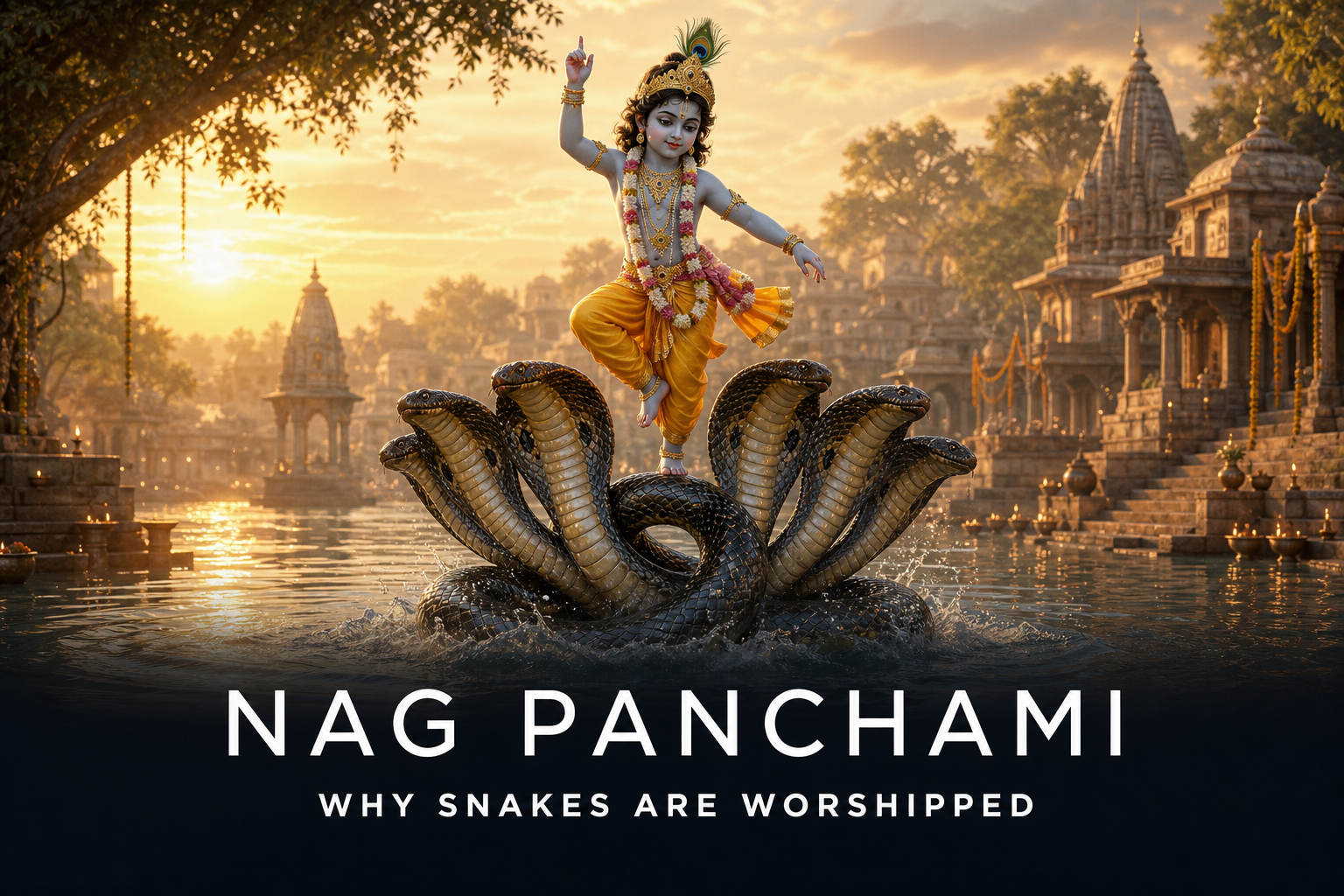
A second, equally cherished tale belongs to the boyhood of Lord Krishna. In the waters of the Yamuna near Vrindavan lived Kaliya, a many-hooded serpent whose venom had poisoned the river and everything that drank from it. When young Krishna’s ball fell into the water, he leapt in after it — and was seized in Kaliya’s mighty coils.
To the terror of the watching cowherds, Krishna expanded his form until the serpent could hold him no longer, then rose to dance upon Kaliya’s countless hoods. Beneath the rhythm of those divine feet, the serpent’s pride was broken. Kaliya surrendered, and Krishna — merciful even in victory — spared his life, commanding him only to leave the Yamuna in peace.
This episode, called Kaliya Mardan, is remembered on Nag Panchami as a picture of the soul mastering the poison of ego and fear. The serpent is not simply destroyed; it is tamed, humbled and released.
Why Serpents Are Sacred in Hindu Tradition
Long before these stories, the serpent was woven into the very fabric of the cosmos. Lord Shiva wears the serpent Vasuki coiled around his neck as an ornament, a sign of his fearless command over death itself. Lord Vishnu reclines upon Shesha, the thousand-headed serpent whose endless coils float on the ocean of eternity — his very name, Ananta, meaning “the infinite.” It was Vasuki, too, who served as the churning rope in the great Samudra Manthan, the churning of the cosmic ocean.
Because the Nagas guard hidden treasures, dwell in the underworld and hold the earth steady, they came to represent the unseen powers that sustain life. To honour them was to honour the mysterious forces on which all existence quietly rests.
The Deeper Meaning Behind the Worship
The serpent shedding its skin became a natural emblem of renewal — of death and rebirth, and of the soul casting off what it has outgrown. In the yogic tradition, the coiled serpent also symbolises kundalini, the dormant spiritual energy said to rest at the base of the spine and rise through awakening.
So Nag Panchami is far more than a day of feeding milk to snakes. It is a meditation on facing what we fear, on treating even the dangerous with respect, and on the endless cycle of shedding and renewal that carries every soul forward. In worshipping the Naga, the devotee honours the balance of creation itself.
Explore our handpicked collection of puja essentials, sacred idols and devotional guides to observe Nag Panchami and the holy month of Sawan with devotion and care.
Frequently Asked Questions
When is Nag Panchami celebrated in 2026?
Nag Panchami falls on 17 August 2026 in most of North India, observed on the Panchami Tithi of Shukla Paksha in the month of Shravana. Some regions following the Amanta calendar, such as Gujarat, observe it on a later date.
Why do Hindus worship snakes on Nag Panchami?
Serpents are seen as divine protectors and are closely linked to the gods — Shiva wears Vasuki, Vishnu rests on Shesha, and Krishna subdued Kaliya. Worshipping them expresses gratitude, seeks protection for the family, and honours the balance of creation.
What is the story behind Nag Panchami?
The best-known legend tells of sage Astika halting King Janamejaya’s serpent sacrifice on this very tithi, saving the Naga race. The day is also linked to Krishna’s victory over the serpent Kaliya in the Yamuna.