
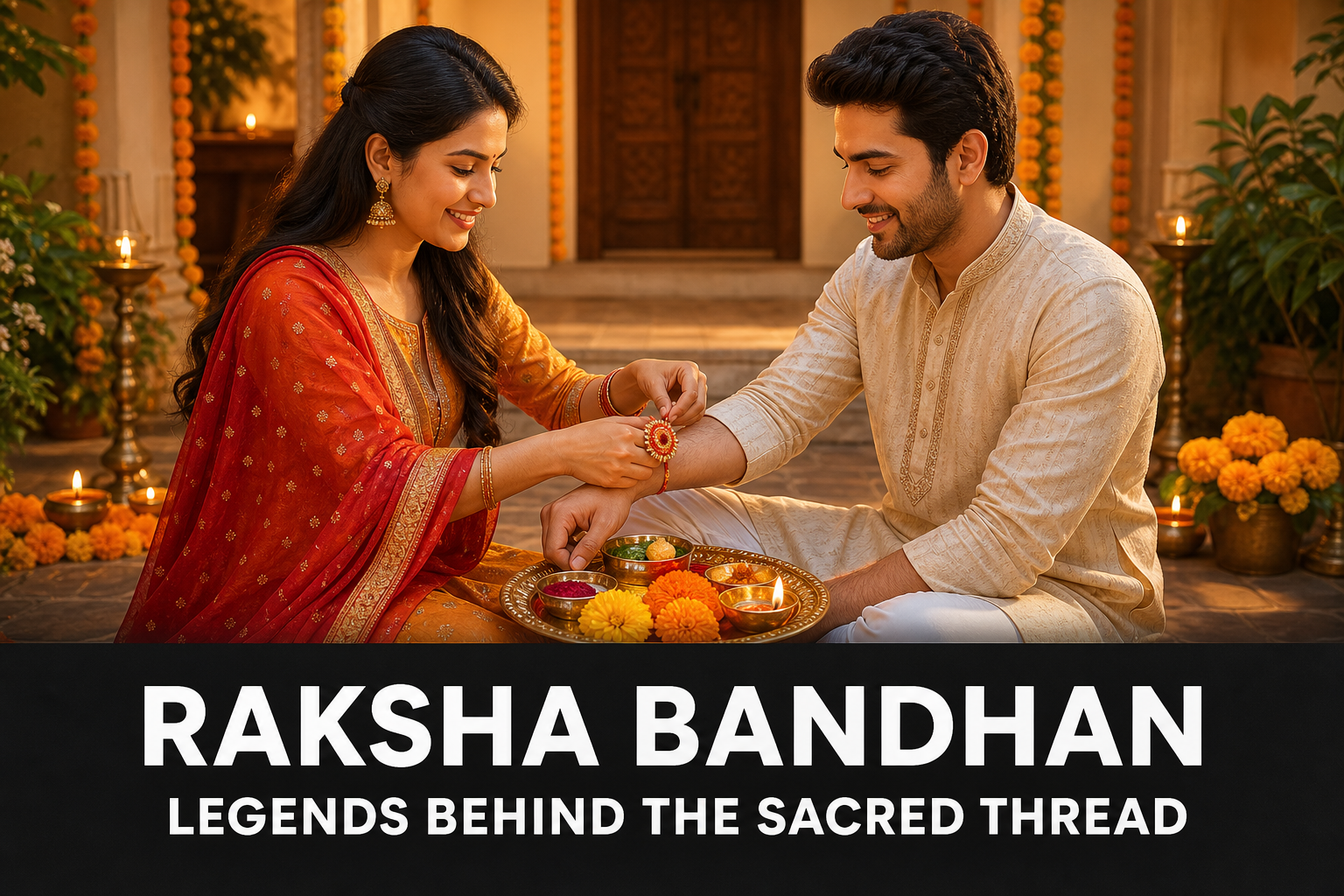
Every year, as the month of Shravan draws to a close, sisters across India tie a slender thread around their brothers’ wrists. The rakhi looks fragile, yet it carries the weight of one of Sanatana Dharma’s oldest promises: raksha (protection) in exchange for bandhan (a bond of love). But where did this custom truly begin? The Raksha Bandhan story is not a single tale — it is a garland of legends drawn from the Mahabharata, the Puranas, and the age-old memory of gods and mortals alike. Together they reveal why a simple cotton thread became sacred.
What Raksha Bandhan Really Means
The words themselves tell the story. Raksha means to guard or shelter; bandhan means to tie or bind. The festival is therefore a mutual vow rather than a one-sided gift. When a sister ties the thread, she is not merely decorating her brother’s wrist — she is invoking divine protection over his life. In return, he pledges to stand between her and every harm the world may bring.
What makes the tradition so beloved is its insistence that this bond need not follow bloodlines. Again and again, the scriptures show the thread being tied between people who share no birth — a princess and a cowherd god, a goddess and a demon king. The rakhi measures the heart, not the family tree.
Krishna and Draupadi: A Bond Beyond Blood
The best-loved of all these tales comes from the Mahabharata. During a festive gathering, Lord Krishna injured his finger — in some tellings on the sharp string of a kite, in others while wielding the Sudarshana Chakra. As blood flowed, Draupadi did not hesitate. She tore a strip from her own sari and wrapped it around his wound.
Krishna was moved beyond words. He vowed to repay every thread of that cloth. Years later, when Draupadi was dragged into the Kaurava court and stripped of her dignity, it was Krishna who answered her silent cry, lengthening her sari without end so that her honour could never be undone. The lesson endures: the value of a rakhi lies not in the richness of the thread but in the love of the one who ties it. Krishna and Draupadi were not siblings by birth, yet theirs became the very model of the brother-sister bond.
King Bali and Goddess Lakshmi: The Sister Who Freed Vishnu
Another legend travels to the court of the righteous demon king Bali. So devoted was Bali that Lord Vishnu, in his Vamana avatar, granted him a boon and agreed to guard his kingdom personally — leaving Vaikuntha and his consort Lakshmi behind. Missing her lord, Goddess Lakshmi came to Bali’s palace disguised as a humble woman seeking shelter.
On the full-moon day of Shravan, she tied a thread of protection around Bali’s wrist. Touched by her gesture, the generous king asked what she desired. She revealed her true form and asked for the return of Vishnu. Honouring the sacred thread, Bali released the Lord and let him return home. From this story comes the belief that the rakhi can bind even the mightiest to keep their word — and that a sister’s thread can move heaven itself.
Yama and Yamuna: The Origin of the Sibling Vow
A gentler tale is told of Yama, the god of death, and his sister Yamuna, the river goddess. For long years Yama did not visit her, and Yamuna grieved his absence. When at last he came, she welcomed him with such warmth and devotion that Yama, overwhelmed, offered her any gift she wished.
Yamuna asked only that he return to see her often. Yama was so pleased that he made a wider promise: any brother who receives a rakhi from his sister and vows to protect her shall be blessed with long life, even immortality. Many believe this moment gave Raksha Bandhan its enduring shape as a festival of the brother-sister bond.
Indra and Sachi: The Thread That Won a War
The Bhavishya Purana preserves an older, cosmic version. When the gods were losing a fierce war against the demons, Indra, king of the devas, stood on the edge of defeat. His wife Sachi — known as Indrani — prepared a sacred thread empowered by prayer and, on the full moon of Shravan, tied it upon Indra’s wrist for his protection.
Strengthened by the thread’s power, Indra returned to battle and led the gods to victory. Here the rakhi is not only a token of affection but a genuine shield — a reminder that in the Sanatana tradition, faith tied with love becomes a real and living force.
Why the Sacred Thread Still Matters
Read together, these legends explain why the thread outlasts the fabric it is made of. It stands for a promise that crosses every boundary — of blood, of rank, even of the line between the human and the divine. It reminds us that protection is not about strength but about presence: showing up, keeping our word, and holding another’s wellbeing as dear as our own.
This is why, long after the festival ends, so many keep their rakhi tied until it falls away on its own. The thread is a small daily reminder that we are bound to one another, and that love — freely given — is itself a form of protection.
Explore our hand-picked collection of sacred threads, pooja essentials and devotional guides — thoughtfully curated to make your festival worship complete and meaningful.
Frequently Asked Questions
What is the main story behind Raksha Bandhan?
The most popular story is that of Krishna and Draupadi. When Krishna’s finger began to bleed, Draupadi bound it with a strip of her sari, and Krishna vowed lifelong protection in return — later saving her honour in the Kaurava court. It shows that the rakhi bond transcends birth relations.
Which gods are connected with Raksha Bandhan?
Several divine pairs are linked to the festival: Krishna and Draupadi, Goddess Lakshmi and King Bali, Yama and Yamuna, and Indra and his wife Sachi (Indrani). Each legend adds a layer of meaning to the sacred thread.
Why is Raksha Bandhan celebrated in the month of Shravan?
Raksha Bandhan falls on the full-moon day (Purnima) of the holy month of Shravan. This month is considered especially auspicious in Sanatana Dharma, and many of the festival’s legends — including those of Lakshmi and Indrani — take place on this very Purnima.