

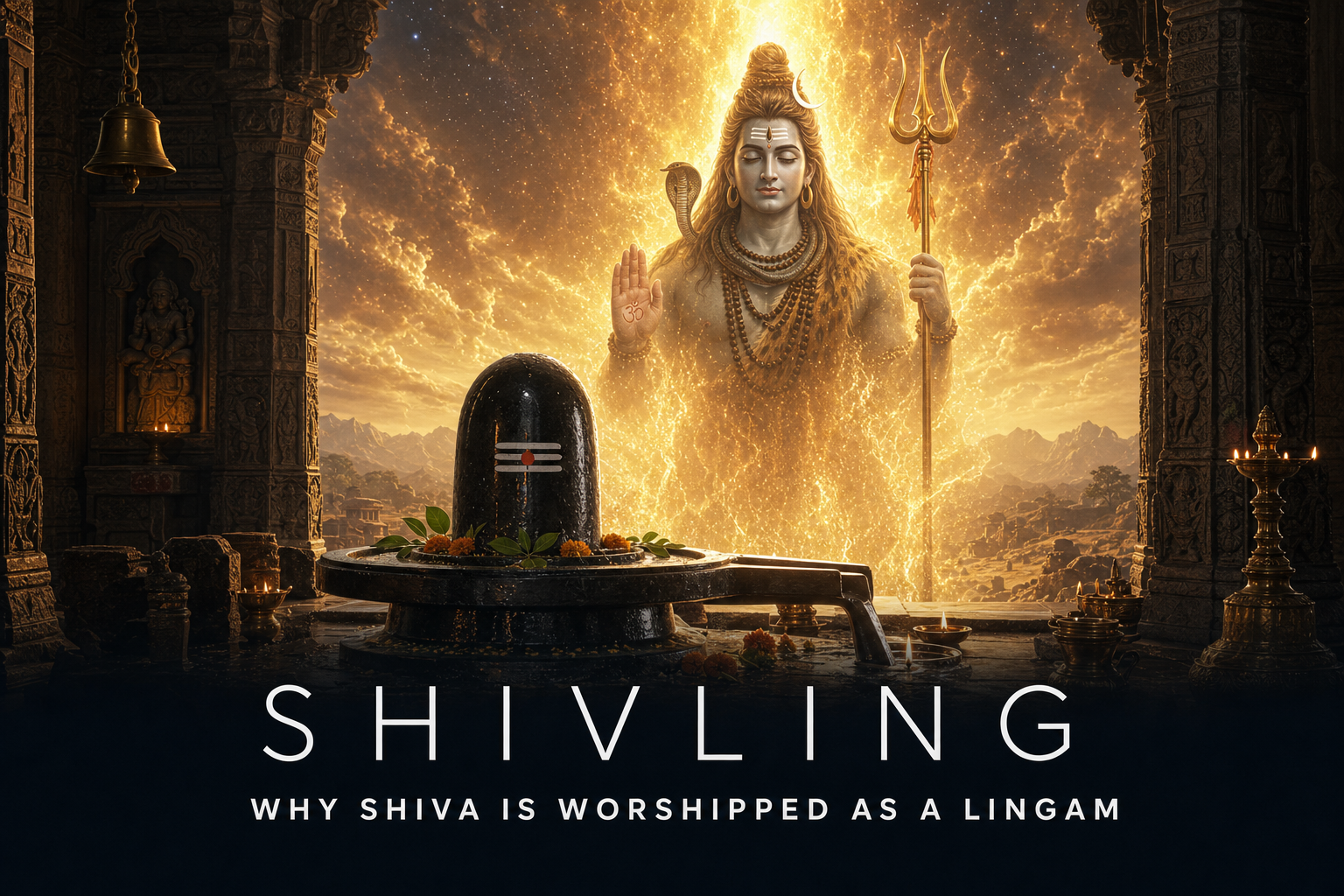
Walk into any Shiva temple and you will not find a grand statue with a face, arms and weapons. Instead, at the very heart of the sanctum sits a smooth, rounded stone rising from a circular base — the Shivling. For millions of devotees this simple, silent form is the most powerful representation of the divine. But why is Lord Shiva, alone among the great deities, worshipped as a lingam rather than an image? The answer reaches into some of the oldest and most profound ideas in Sanatana Dharma.
What Does the Word “Lingam” Actually Mean?
In Sanskrit, the word linga means “sign,” “mark” or “symbol.” It is not a literal portrait of Shiva but a pointer toward him — the way a signpost is not the destination itself but shows the way to it. The Shivling is an attempt to give shape to the formless, to represent that which cannot truly be represented at all.
Hindu philosophy describes the ultimate reality, Brahman, as infinite, without beginning or end, beyond name and form. Most deities are worshipped in saguna form — with attributes, features and personality. Shiva is unique in that he is worshipped primarily in a form that is almost abstract, reminding the devotee that the divine is ultimately nirguna: beyond all limitation. The lingam does not confine Shiva to a single face or body; it opens the mind toward his boundless nature.
The Legend of Lingodbhava: The Infinite Pillar of Light
The most famous story explaining the lingam comes from the Puranas and is known as Lingodbhava — “the appearance of the linga.”
Once, Lord Brahma the creator and Lord Vishnu the preserver fell into a heated argument over who among them was supreme. As their egos clashed, a colossal pillar of blazing fire suddenly appeared before them, stretching infinitely upward into the heavens and infinitely downward into the earth. Its light had no beginning and no end.
A voice declared that whoever could find the source of this pillar would be proven the greater. Brahma took the form of a swan and flew upward to find its top. Vishnu took the form of a mighty boar (Varaha) and dug downward to find its base. They travelled for what felt like ages — yet neither could reach an end. The pillar was limitless.
That infinite column of light was Shiva himself, revealing that the Supreme Truth has no boundary and cannot be measured by the ego. This is why the lingam is understood as the cosmic axis — the still centre around which all creation arises, endures and dissolves.
Why Brahma and the Ketaki Flower Were Cursed
The story carries a moral lesson as sharp as its cosmic vision. Vishnu, unable to find the base, humbly admitted defeat. Brahma, however, could not bear to lose. On his way down he encountered a falling ketaki (kewda) flower and persuaded it to bear false witness, then returned claiming he had reached the summit and offered the flower as “proof.”
Shiva emerged from the pillar and saw through the lie at once. For his dishonesty, he decreed that Brahma — though the creator — would receive almost no worship in temples. The ketaki flower, for testifying falsely, was banished from being offered in Shiva’s worship. To this day it is traditionally kept away from his puja. The tale reminds devotees that before the infinite, humility is worth more than pride, and truth more than victory.
According to the Linga Purana, the moment Shiva manifested as this pillar of light is remembered every year on the sacred night of Maha Shivratri.
The Union of Shiva and Shakti
Look closely at a Shivling and you will see it rests upon a rounded base with a channel, called the yoni or pitha. Together they carry a beautiful meaning. The upright lingam represents Purusha — pure consciousness, the masculine principle of Shiva. The base represents Prakriti or Shakti — nature, energy, the feminine principle.
Neither can create alone. It is only in their union that the universe comes into being. The Shivling therefore is not merely a symbol of Shiva; it is a symbol of the inseparable dance of consciousness and energy that gives rise to all life. This is why it is revered as a symbol of creation itself, whole and complete.
Formless Yet Present: The Deeper Symbolism
Why does this abstract form move the heart of a devotee more than a detailed idol ever could? Because it leaves nothing to distract the mind. There is no face to study, no ornament to admire — only a pure form that invites the worshipper to look inward. When water, milk and bilva leaves are poured over the lingam during abhishekam, the devotee is symbolically cooling the fiery, infinite energy of Shiva and offering the self back to the source of all things.
The Shivling meets the seeker exactly where they are. To a child it is Bholenath, the loving and easily pleased lord. To a philosopher it is Brahman, the formless absolute. To a yogi it is the still centre of consciousness. One silent form holds all of these truths at once.
From sacred Shiva vrat guides to puja essentials for your daily worship, The Divine Store helps you honour Bholenath with devotion and authenticity — especially through the holy month of Sawan.
Frequently Asked Questions
Is the Shivling a physical form of Lord Shiva?
No. The Shivling is a symbol, not a literal image. The word linga means “sign,” and the form is meant to point the mind toward Shiva’s formless, infinite nature rather than depict his body.
What does the base of the Shivling represent?
The rounded base is the yoni or pitha, representing Shakti — the feminine, creative energy of nature. Together with the upright lingam (Shiva, or consciousness) it symbolises the union of Purusha and Prakriti, the source of all creation.
Why is the ketaki flower not offered to Shiva?
In the Lingodbhava legend, the ketaki (kewda) flower bore false witness to Brahma’s lie about reaching the top of the pillar of light. Shiva cursed it never to be used in his worship, and the tradition continues today.