
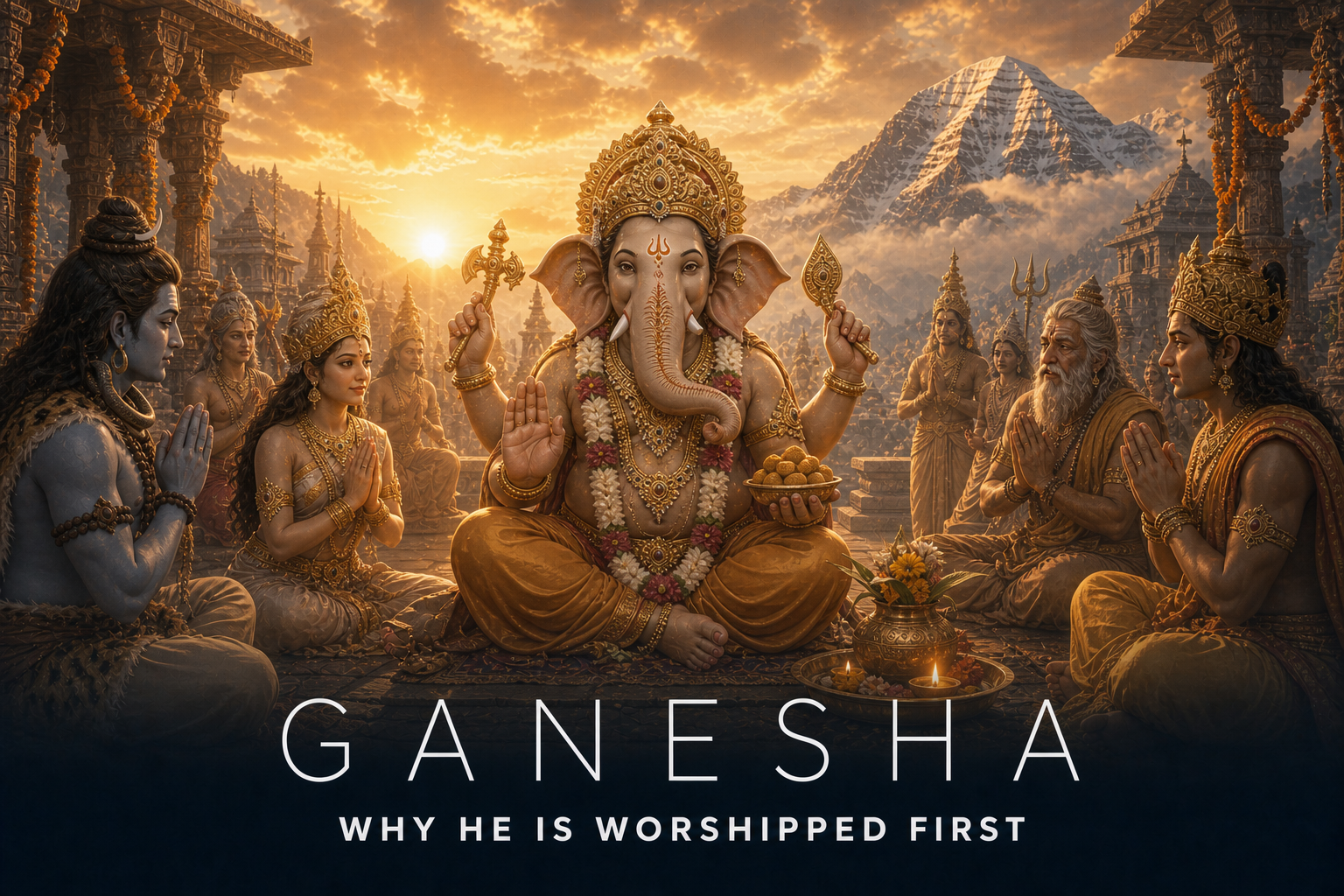
Before a wedding mandap is lit, before a new shop raises its shutters, before a student writes the first line of an exam paper, before the foundation stone of a house is laid — one figure is invoked. A round form, a broken tusk, a small mouse at his feet. No ritual in Sanatana Dharma begins without him.
Ganesha is not the creator of the universe. He is not its preserver, nor its destroyer. And yet, in temple and household alike, he is always first. Why?
The answer is not one rule in one scripture. It is a set of stories that, taken together, say something quietly profound about how our tradition understands wisdom, humility, and the nature of beginnings themselves.
The Boon That Made Him First
The best known account comes from the Shiva Purana. Parvati, wishing for a guardian of her own, shaped a boy from the fragrant paste she used at her bath and breathed life into him. She set him at her door with one instruction: let no one enter.
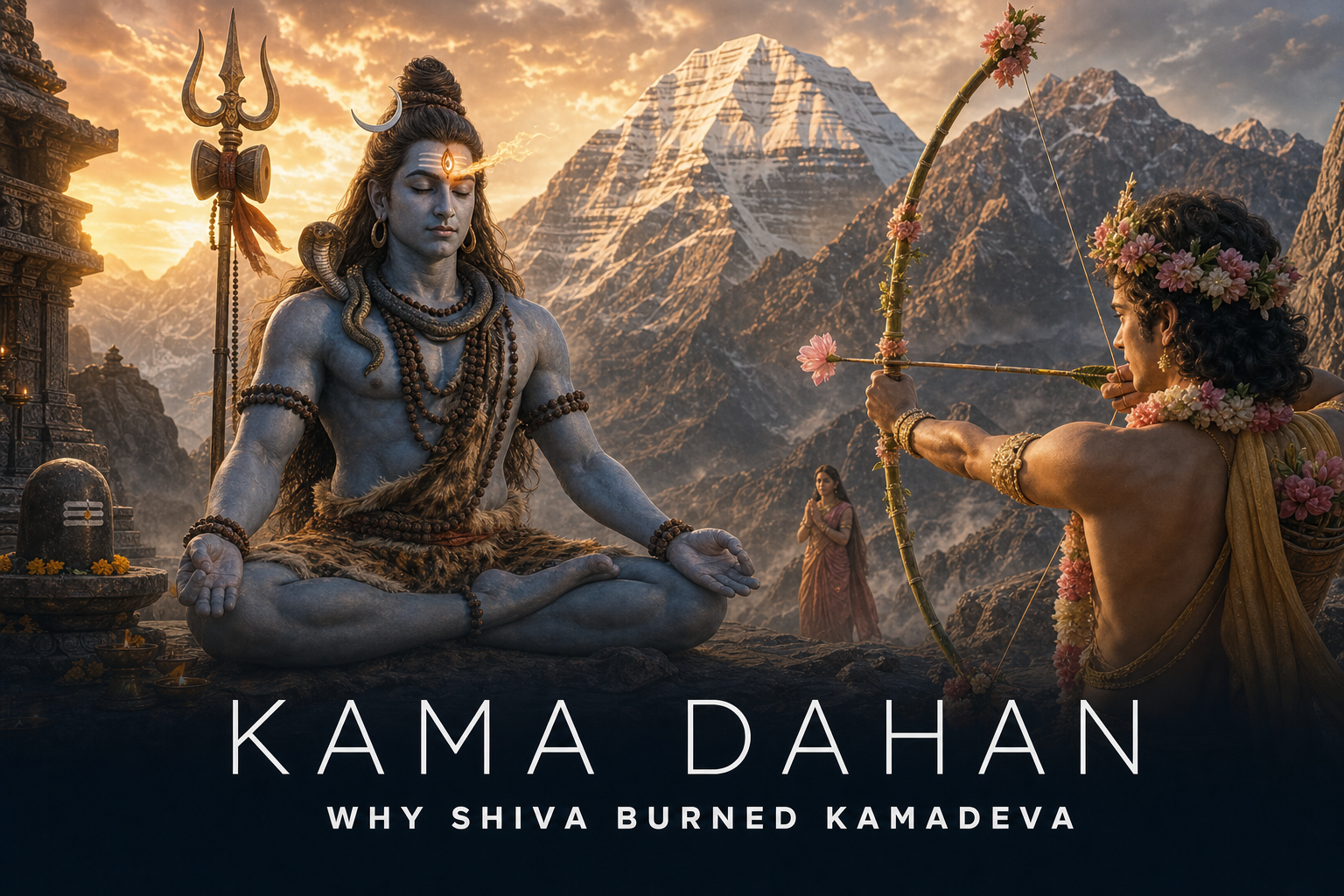
When Shiva returned, the boy — who had never seen him — refused him passage. What followed is one of the most difficult episodes in our mythology: in fury, Shiva severed the child’s head. Parvati’s grief shook the three worlds. To restore him, Shiva placed upon his body the head of an elephant, and the boy rose again.
But Shiva did not stop at restoration. He gave the child a name and a station: Ganapati, lord of the ganas, Shiva’s own attendants. And he granted a boon that has shaped Hindu practice ever since — that no yajna, no puja, no auspicious undertaking would be complete unless Ganesha were honoured at its start.
The boon is not a reward for obedience. It is given to a being who stood his ground on a duty he had been assigned, and who was restored with a form that made him unlike anyone else. First place, in this telling, is not seniority. It is recognition.
The Race Around the World
A second story explains why that first place was earned, not merely granted.
Sage Narada arrived at Kailasa carrying a single extraordinary fruit — one said to hold within it the whole of divine wisdom. It could not be cut or shared. Shiva and Parvati, faced with two sons and one prize, proposed a contest: whoever circled the world three times and returned first would take the fruit.
Kartikeya mounted his peacock and shot into the sky. The oceans, the mountains, the far edges of the earth — he covered them at speed, certain of victory.
Ganesha, whose mount is a mouse, did not move at all at first. Then he rose, walked slowly around his mother and father three times, and folded his hands.
Asked to explain, he said what has been repeated in Hindu homes for centuries: his parents were his world. Everything the earth contained was already contained in them. To circle Shiva and Parvati was to circle creation itself.
Shiva and Parvati recognised the answer for what it was — not a shortcut, but a deeper reading of the question. The fruit of wisdom went to Ganesha, and with it the blessing that he would be remembered first in every act of worship.
The lesson embedded in the story is worth naming plainly: speed is not the same as understanding. Kartikeya answered the question that was asked. Ganesha answered the question behind it.
Vighnaharta: The One at the Threshold
Ganesha carries two titles that sound like opposites. He is Vighnaharta, remover of obstacles. He is also Vighnakarta, placer of obstacles.
Both are true, and the pairing is the point. In the older understanding, Ganesha stands at the threshold of every undertaking the way he once stood at his mother’s door. What passes and what does not is his to decide. An obstacle placed is not punishment; it is a check on whether the beginning is ready to be made.
This is why he is invoked at the start rather than the end. You do not ask Ganesha to fix what has already gone wrong. You ask him, before you begin, that the path be clear — and that you be fit to walk it.
Prathamesh: What “First” Really Means
Beyond the narratives lies a symbolic reading that devotees have drawn on for centuries.
Ganesha is associated with buddhi — discernment, the faculty that decides. His large ears are said to signify listening more than speaking; his small eyes, concentration; his single broken tusk, the willingness to sacrifice something of oneself for a greater work. Riddhi and Siddhi, prosperity and accomplishment, are described as his consorts — the natural companions of clear thinking, not its substitutes.
The mouse at his feet is the most telling detail. A mouse gnaws quietly, in the dark, at things it was never asked to touch. It is desire — small, restless, endlessly nibbling. Ganesha does not destroy it. He sits above it, and it carries him.
Read this way, worshipping Ganesha first is not a formality at all. It is the instruction to settle the mind before setting the hand to work. Clear thought precedes right action. That sequence is the ritual.
Where the Tradition Is Recorded
The practice is not folk custom alone. The Ganapati Atharvashirsha, a short Upanishadic text, identifies Ganesha with Brahman itself and with the syllable Om — and devotees have long noted that his very form resembles the written Omkara. The Ganesha Purana and Mudgala Purana are given over entirely to his forms and exploits. The Shiva Purana carries the birth narrative.
And there is the Mahabharata’s own beginning: when Vyasa needed a scribe swift enough to keep pace with his composition, it was Ganesha who took up the task. The longest epic in the world starts with Ganesha putting stylus to leaf — which is, in its way, the most literal illustration of the principle. Even the telling of the story begins with him.
This is why the sankalpa of nearly every Hindu ritual opens with the same four words: Shri Ganeshaya Namah. Not because the other deities wait their turn out of protocol, but because nothing is properly begun until the mind is steady and the way is clear.
Our Ganesh Chaturthi Guide eBook walks you through 2026 sthapana muhurat, the full puja vidhi, the katha, aarti and the visarjan rituals — everything in one place, in Hindi and English, ready to read on your phone during the puja.
Frequently Asked Questions
Is Ganesha worshipped first in every Hindu ritual?
In the overwhelming majority, yes. The sankalpa of most pujas, havans and samskaras opens by invoking Ganesha, regardless of which deity the ritual is ultimately dedicated to. A few regional and sampradaya-specific traditions follow their own order, but the practice of beginning with Ganesha is close to universal across Hindu households.
Who actually won the race between Ganesha and Kartikeya?
Ganesha. Kartikeya circled the physical world on his peacock, but Ganesha circled his parents instead, arguing that they contained the whole of creation. Shiva and Parvati accepted his reasoning and gave him the fruit of wisdom, along with the blessing of being worshipped first.
Why is Ganesha called both remover and placer of obstacles?
Because he guards the threshold of every undertaking. The obstacles he places are not punishment but a test of readiness; the obstacles he removes are those standing between sincere effort and its fruit. Invoking him at the start is a request for both — a clear path, and the discernment to deserve it.