
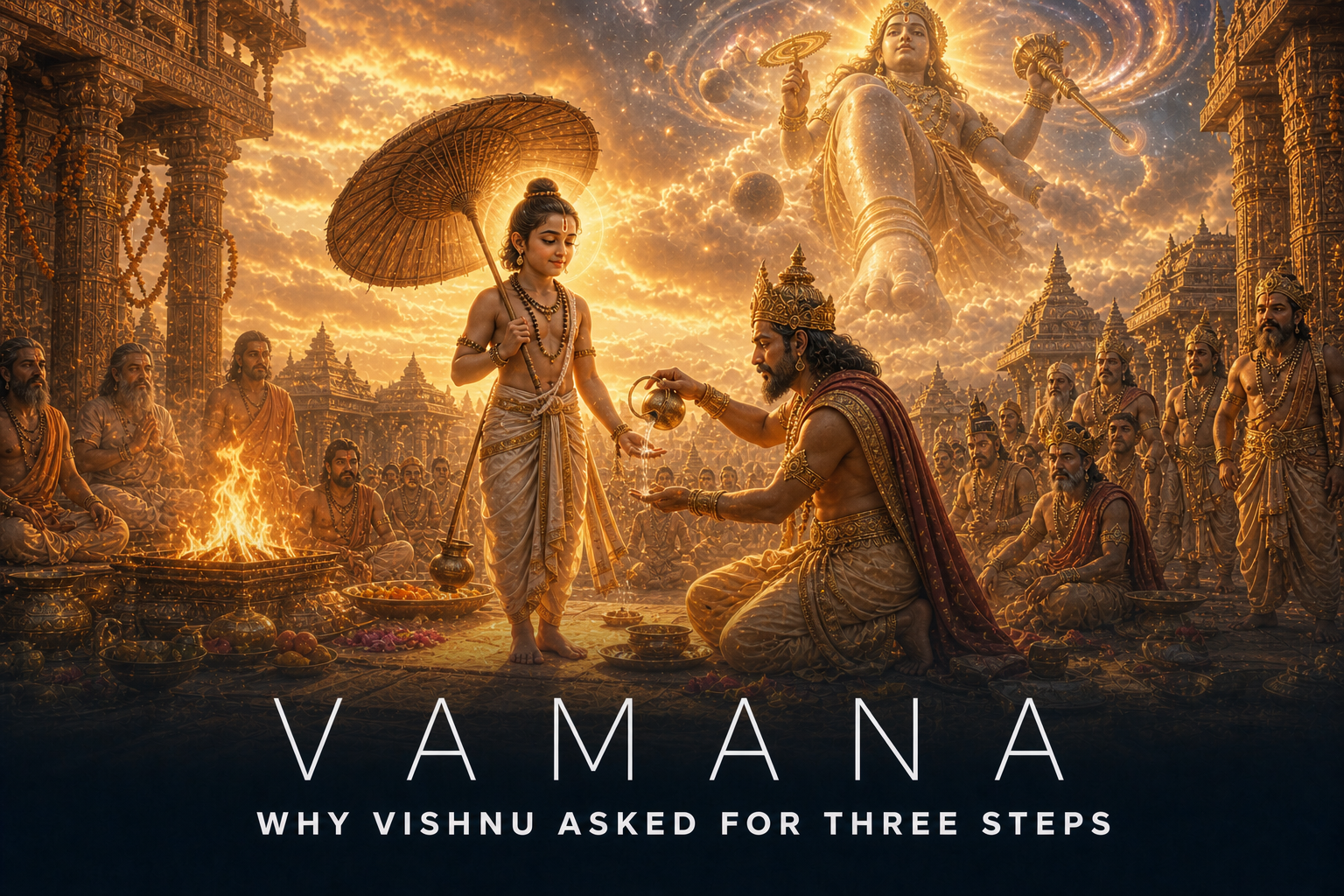
Of all the ten avatars of Vishnu, none is stranger than the fifth. There is no war in it. No weapon is lifted, no demon is torn apart, no army marches. A small brahmin boy walks into a king’s sacrificial hall carrying a wooden umbrella and a water pot, and asks for three steps of land. The king laughs and grants it. And with that single yes, the three worlds change hands.
This is the story of Vamana avatar — and it is not really a story about a dwarf outwitting a king. It is a story about what happens when someone gives everything away and, in doing so, wins more than he lost. To understand it, you have to first understand that the “villain” of this tale was one of the greatest devotees Hinduism has ever named.
Who Was King Bali, and Why Did He Have to Be Stopped?
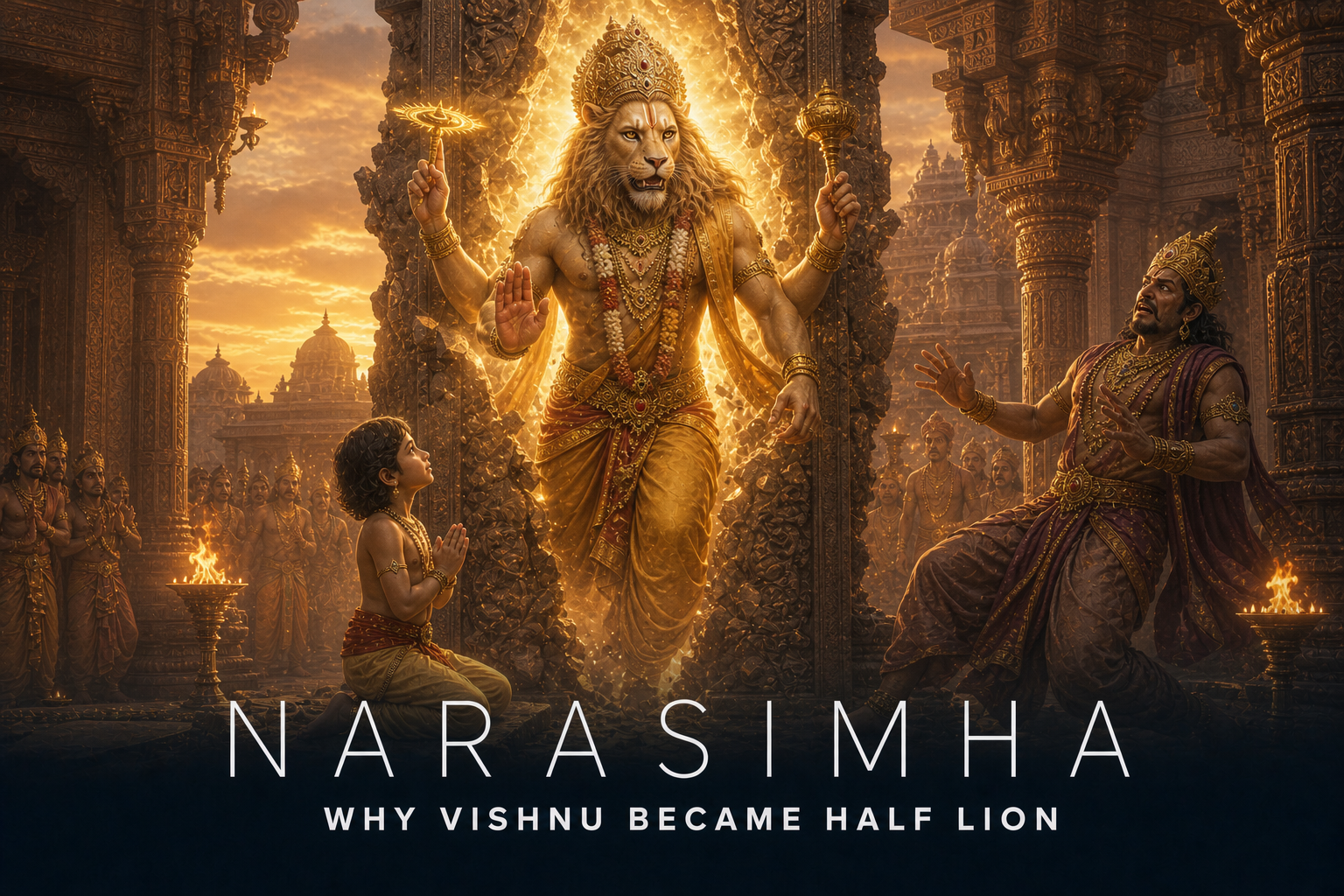
Mahabali — usually called Bali — was an asura king, but his lineage tells you everything. He was the grandson of Prahlada, the boy whose unbreakable devotion to Vishnu brought Narasimha out of a pillar. Devotion ran in that family’s blood.
Bali was generous, truthful and fiercely committed to his word. Under his guru Shukracharya he performed great yajnas, grew immensely powerful, defeated Indra and took Swarga Loka — heaven itself. The devas were driven out. And here is the difficulty the Puranas quietly place before us: Bali had not become cruel. His rule was, by most accounts, just.
So the problem was never wickedness. It was imbalance. The cosmic order assigns realms and roles, and Bali’s conquest — however righteous the man himself — had pushed that order out of shape. Aditi, mother of the devas, turned to her husband Sage Kashyapa in grief, and together they prayed to Vishnu. He answered by being born as Aditi’s own son.
Why Vishnu Came in the Smallest Possible Form
Vishnu could have come as anything. Against Hiranyakashipu he had come as a creature of terrifying force. Against Bali he came as Vamana — a short-statured brahmachari boy, barely noticeable, holding a palm-leaf umbrella and a kamandalu.
The choice is deliberate. Bali could not be defeated in battle, and more importantly, he did not deserve to be. You do not humble a genuinely great man by breaking him. You humble him by giving him the chance to be exactly as great as he claims to be — and letting the consequences follow.
So Vishnu came as the one thing Bali’s power could not resist: a small guest with an open hand.
Shukracharya’s Warning and the Blade of Grass
Bali was performing the Vishwajit yajna, the sacrifice of one who has conquered everything, and had vowed to refuse no one who asked. Vamana arrived, and Bali — delighted by the boy’s radiance — offered him villages, cattle, gold, whole kingdoms.
Vamana refused all of it. He asked only for as much land as he could cover in three steps.
Shukracharya, guru of the asuras, saw through it instantly. He knew who stood in that hall. He warned Bali plainly: this is Vishnu, and he has come to take everything from you and return it to Indra. Refuse him. A promise made in ignorance may be broken.
Bali’s answer is the heart of the whole episode. He knew, he said, that if the Lord of the universe had come to his door as a beggar, then no fortune in existence could be greater than that. What kind of man would he be if the one time Vishnu asked him for something, he said no?
Shukracharya then tried to stop the ritual itself. The gift is sealed when water is poured from the kamandalu over the receiver’s hands — so Shukracharya shrank himself and lodged in the spout of the pot, blocking the water. Vamana, understanding perfectly, took a blade of darbha grass and pushed it into the spout to clear it. The grass pierced Shukracharya’s eye. He fled, and the guru of the asuras carried that blindness ever after.
The water fell. The gift was given.
The Three Steps That Measured the Universe
The moment the water touched his palm, the small boy began to grow.
This form is called Trivikrama — “he of the three strides.” Vamana expanded until his body contained the elements, the directions, the sun and moon, until there was no vantage point left from which to see all of him. With the first step he covered the earth and everything upon it. With the second he crossed the sky and took Swarga, the heavens Bali had won.
And then he stopped, and asked where he should place the third.
Bali had nothing left to give. He had two choices: break his word, or find a third measure of ground. He knelt and offered his own head.
Vamana placed his foot there — and pressed Bali down to Sutala, a realm of the lower worlds.
Why This Was Not a Punishment
Read quickly, the ending looks like defeat. Read properly, it is the opposite.
Sutala, as the Bhagavata Purana describes it, is no prison. It is a realm free of misery, fear and defeat — described as more beautiful and more secure than the heaven Bali had just lost. Vishnu declared Bali to be among the greatest of his devotees, promised him the position of Indra in a future cosmic cycle, and did something he had done for no one else: he took up station as the guardian at Bali’s door, remaining personally present in his kingdom.
Bali gave away three worlds and received the Lord himself as his gatekeeper. That is the trade the story is actually describing.
In Kerala, this reading is taken further still. There Mahabali is remembered not as an asura at all but as the beloved king of a golden age, in whose reign there was no theft, no falsehood and no want — and Onam is the festival of his yearly return to see whether his people are still happy. The same story, held from the other side.
The Meaning of the Vamana Avatar
Three ideas sit inside this legend, and they are worth separating.
The small contains the vast. Vishnu chose the least imposing form available and then filled the universe with it. Size, status and visible power are not where reality is measured. The tradition returns to this again and again — a dwarf, a cowherd boy, a sound, a stone.
Dharma is not the same as goodness. Bali was virtuous and still had to be moved. The Puranas are unsentimental about this: cosmic balance is a structural matter, not a moral scoreboard. Sometimes what must be corrected is not a sin but a position.
Surrender is the only complete offering. Bali gave land, then heaven, and none of it finished the debt. Only when he offered his own head — himself, not his possessions — was the third step satisfied. This is why Vamana’s story is quoted so often in bhakti traditions: the final thing God asks for is never the wealth. It is the head that counts what the wealth is worth.
Vamana is the fifth avatar, the first to appear in fully human form after the animal and hybrid incarnations of Matsya, Kurma, Varaha and Narasimha. From here the Dashavatara becomes human and stays human — a progression that carries its own quiet meaning.
Ekadashi is Vishnu’s own vrat — the day the devotee offers not wealth but attention. Our Sampurna Ekadashi Guide brings together all 26 kathas, the complete 2026 calendar, vidhi and udyapan in one instant download.
Frequently Asked Questions
Which avatar of Vishnu is Vamana?
Vamana is the fifth of the ten Dashavatara incarnations, following Matsya, Kurma, Varaha and Narasimha. He is the first avatar to appear in complete human form.
Why did Vishnu ask King Bali for only three steps?
Bali could not be defeated by force, and as a devotee and man of his word he did not deserve to be. Asking for a small, almost trivial gift allowed Bali’s own generosity and truthfulness to complete the act — the surrender was his choice, not a conquest.
Was King Bali punished by Vamana?
No. Bali was given Sutala, a realm described as free of sorrow and defeat, the promise of becoming Indra in a future cycle, and Vishnu’s own presence as guardian of his door. In Kerala he is honoured every year as the returning king of Onam.