
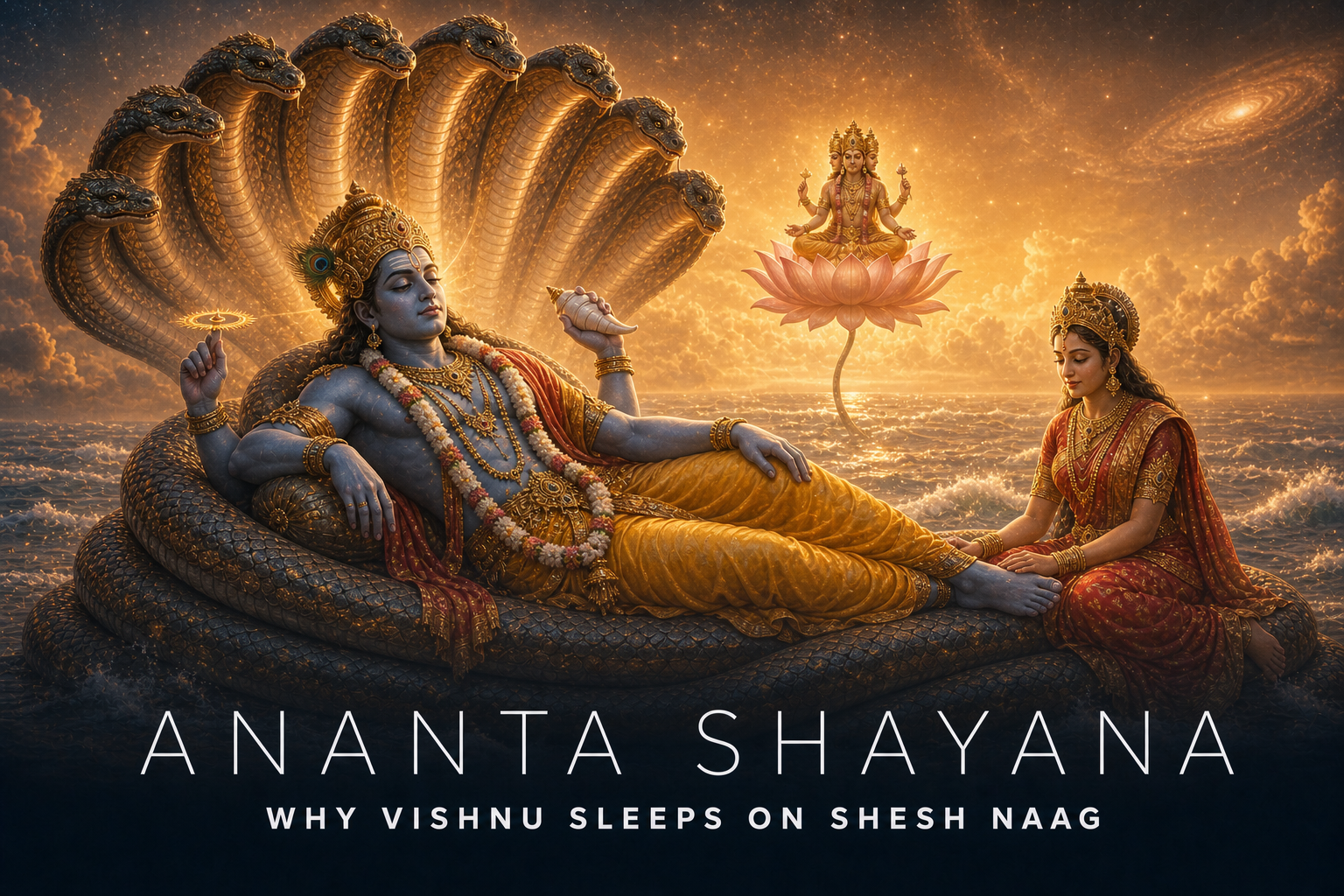
Almost every image of Bhagwan Vishnu shows him the same way: not standing, not seated on a throne, but lying down. He reclines on the coils of an enormous many-hooded serpent, floating on a silver ocean, one hand resting near his head, Lakshmi seated at his feet. It is one of the most familiar pictures in Sanatana Dharma — and one of the least questioned.
Why is the sustainer of the universe asleep? And why is his bed a snake?
This form has a name: Ananta Shayana — “resting upon Ananta,” the endless one. Once you understand what the serpent is and what that sleep actually means, the image stops being a picture of rest and becomes a statement about how the cosmos holds together.
Who Is Shesh Naag, the Serpent Called “The Remainder”?
Shesh Naag is also called Adishesha — the primordial Shesha — and, most tellingly, Ananta, “the one without end.” In the Puranas he is counted among the sons of the sage Kashyapa and Kadru, and he is the king of the nagas.
But his most important name is the plainest one. Shesha means “the remainder” — what is left over. When a cycle of creation dissolves and the worlds are withdrawn, everything nameable comes to an end. What remains is Shesha. He is the residue of existence that no dissolution can consume, the substratum that is still there when nothing else is.
The Puranas describe him bearing the earth and the planets upon his many hoods, and singing the glories of Vishnu ceaselessly from all his mouths. He is not a decorative creature under a god. He is the very idea of continuity, given a form.
The Ocean of Milk and Yoga Nidra: What Vishnu’s Sleep Really Means
Vishnu reclines on Shesha in the Kshira Sagara, the ocean of milk — the still, luminous, undifferentiated field from which forms arise and into which they return.
And he is not sleeping in the way we sleep. The tradition is careful about this word. His state is Yoga Nidra: yogic sleep, a conscious repose in which awareness never lapses. Ordinary sleep is absence. Yoga Nidra is presence without agitation — completely awake, completely at rest, doing nothing and sustaining everything at the same time.
This is why the image is not a picture of a tired god. It is a picture of effortless sustenance. The one who holds the universe together does not strain to do it.
The same idea returns in the familiar detail of the lotus. From Vishnu’s navel a lotus rises, and upon it sits Brahma, who begins creation. This is why Vishnu is called Padmanabha, “lotus-navelled,” and why the great shrine at Thiruvananthapuram is named Ananta Padmanabhaswamy. Creation does not come from exertion. It blossoms out of stillness.
Why a Serpent and Not a Throne? The Symbolism of Ananta Shayana
A throne would have been simpler. The serpent is chosen deliberately, and it carries meanings a throne cannot.
- The changing rests on the unchanging. The world we live in is restless — seasons turn, bodies age, kingdoms rise and fall. All of that motion is shown resting on Ananta, the endless. Impermanence is real, but it is not the foundation. Something steadier lies underneath it.
- Time is coiled, not straight. The serpent’s coils are read as the cycles of time — yugas turning into yugas, creation into dissolution and back again. Vishnu rests upon those coils rather than being carried away by them: the eternal is not inside time, time is arranged around the eternal.
- Devotion as shelter. Shesha’s hoods are spread above Vishnu like a canopy. The servant does not merely carry the Lord; he shields him. In bhakti readings this is the highest picture of service — so complete that the devotee becomes both the seat and the shelter of the divine.
- Fearlessness. The serpent is, in every human culture, the image of danger. Here it is a bed. What terrifies the world is, in the presence of the divine, simply where one lies down.
It is worth noting that Shesha is not the serpent of the Samudra Manthan. That was Vasuki, who served as the churning rope while the devas and asuras pulled. Shesha’s role is quieter and larger: not to be used in a great effort, but to remain when every effort is over.
Shesha on Earth: Lakshmana, Balarama and the One Who Never Leaves
The tradition holds that when Vishnu descends, Shesha descends with him — because the support does not abandon the supported.
In the Treta Yuga, when Vishnu came as Rama, Shesha is said to have come as Lakshmana, the brother who followed him into fourteen years of forest exile without being asked twice. In the Dvapara Yuga, when Vishnu came as Krishna, several traditions identify Balarama as the incarnation of Shesha — the elder brother, the steady one, the strength standing behind the charm.
Read this way, the Ananta Shayana image is not only cosmology. It is a portrait of a relationship. Wherever the divine goes, the one who upholds it goes too — as brother, as companion, as the presence that stays through exile and war and everything after.
Vishnu’s Four Months of Rest, and the Vrat of the Endless One
This reclining form is not abstract in practice. It shapes the Hindu year.
During Chaturmas, the four sacred months from Devshayani Ekadashi to Dev Uthani Ekadashi, Vishnu is said to enter his yogic sleep upon Shesha. Households pause weddings and new ventures, and turn instead to fasting, japa and study. The devotee’s calendar mirrors the Lord’s posture: a season for withdrawal before a season for beginnings.
And once a year, the reclining form itself is worshipped. On Anant Chaturdashi — falling on 25 September 2026, the day that also concludes the ten-day Ganesh Utsav with visarjan — devotees worship Vishnu specifically as Ananta. A sacred thread of fourteen knots, the Ananta sutra, is offered and worn, standing for the fourteen worlds and for a bond with the endless one that is not meant to be broken.
The complete guide to worshipping Vishnu in his Ananta form — the full vrat katha, puja vidhi, and the ritual of the fourteen-knot Ananta sutra, in one downloadable book.
Frequently Asked Questions
Why does Vishnu sleep on Shesh Naag instead of sitting on a throne?
Because the serpent carries a meaning a throne cannot. Shesha means “the remainder” — that which endures after everything else dissolves. Vishnu resting on him shows the changing universe supported by an unchanging foundation, and his coils represent the endless cycles of time over which the divine presides rather than being swept along by them.
Is Vishnu’s sleep the same as ordinary sleep?
No. His state is called Yoga Nidra, or yogic sleep — a conscious repose in which awareness never lapses. It represents effortless sustenance: the universe is upheld without strain. From this stillness the lotus rises from his navel bearing Brahma, which is why creation is said to blossom out of rest rather than out of exertion.
Are Lakshmana and Balarama really incarnations of Shesh Naag?
The Puranic tradition holds that Shesha descends whenever Vishnu descends. Lakshmana is widely regarded as Shesha’s incarnation alongside Rama in the Treta Yuga, and several traditions identify Balarama, Krishna’s elder brother, as Shesha in the Dvapara Yuga — in both cases, the one who supports and shelters, taking human form.