

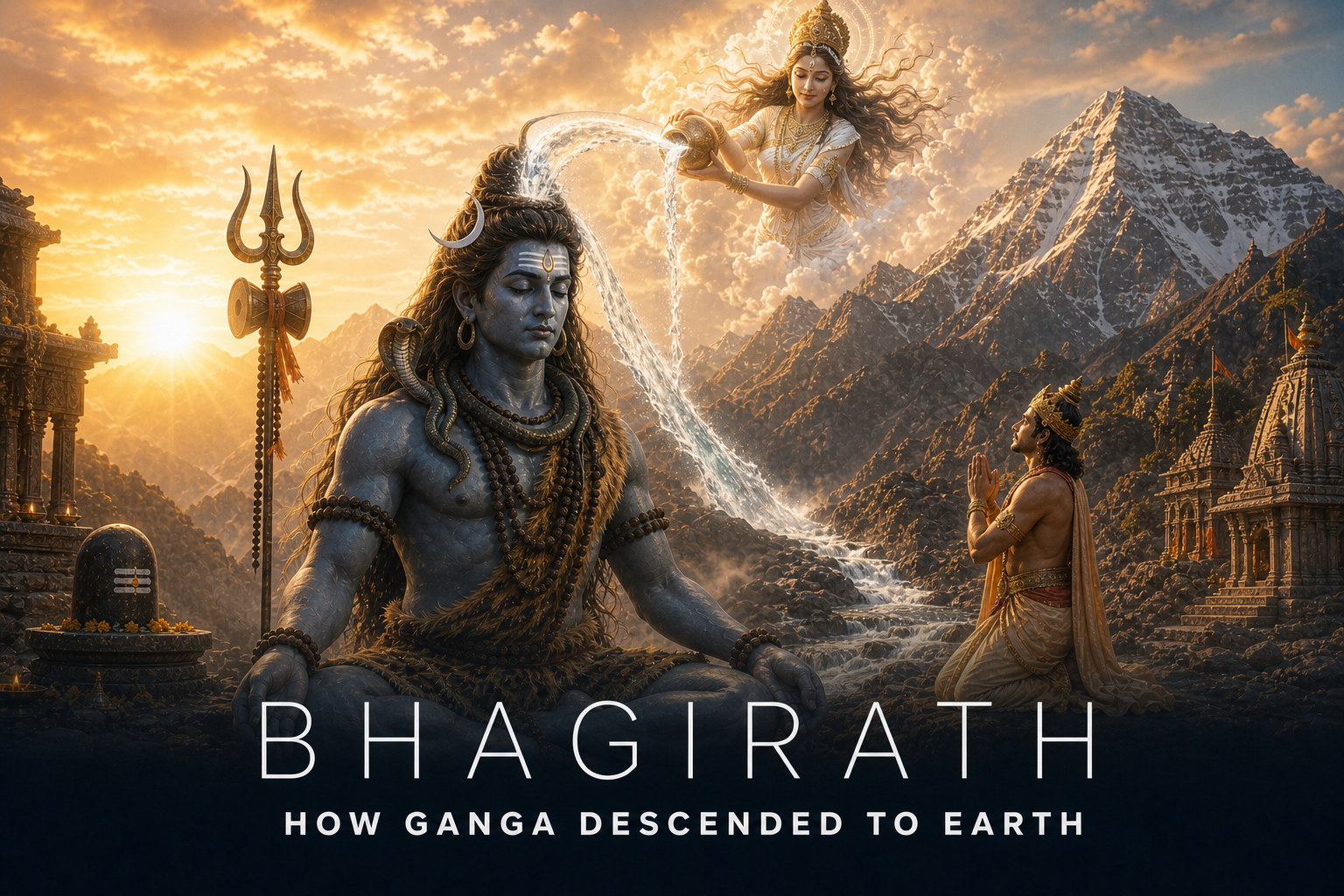
Every year, millions of Hindus stand on the banks of the Ganga to bathe, pray, and immerse the ashes of their ancestors, trusting that her waters carry the dead toward liberation. Few pause to ask how the river came to flow through the human world at all. The answer lies in one of Hindu mythology’s most moving stories of devotion — the tale of King Bhagirath, whose relentless penance brought the celestial Ganga down from the heavens, and of Lord Shiva, who alone had the strength to receive her.
Who Was King Bhagirath?
Bhagirath was a king of the Suryavansha (Solar Dynasty), a descendant of the great King Sagara of Ayodhya. He inherited not a kingdom at peace, but a debt left unpaid by his ancestors — sixty thousand souls trapped between life and liberation, waiting for a redemption only he could offer.
The Curse That Doomed 60,000 Sons
The story begins generations earlier with King Sagara, who performed an Ashwamedha Yajna (horse sacrifice) to declare his supremacy. Indra, fearing a challenge to his throne, stole the sacrificial horse and tied it near the ashram of the meditating sage Kapila Muni. Sagara’s sixty thousand sons, sent to search for the horse, found it near the sage and — assuming him to be the thief — prepared to attack him. Disturbed from his deep meditation, Kapila Muni opened his eyes, and the fire of his gaze reduced all sixty thousand princes to ashes instantly.
Their souls could not find peace. Only the sacred waters of the celestial Ganga, it was said, had the power to touch their ashes and grant them moksha (liberation). Generation after generation of Sagara’s descendants tried and failed to bring Ganga down to earth. That burden eventually fell to Bhagirath.
Bhagirath’s Tapasya to Brahma
Determined to free his ancestors, Bhagirath renounced his throne and retreated to the Himalayas, where he performed extraordinarily severe tapasya (penance) for years, surviving on air and enduring extreme conditions without complaint. His devotion was so absolute that it eventually moved Brahma, the creator, to appear before him.
Brahma agreed to send Ganga to earth, but he issued a warning: the river’s descent from the heavens would be so forceful that the earth itself could not withstand the impact. Only one being had the power to absorb that force — Lord Shiva.
Why Only Shiva Could Tame the Ganga
Bhagirath turned his tapasya toward Mount Kailash, praying to Shiva to receive Ganga in his matted locks (jata) before releasing her gently onto the earth. Ganga herself, proud of her celestial power, felt insulted at being asked to descend and is said to have resolved to sweep the entire earth away with the sheer force of her fall.
Shiva, in his infinite compassion, agreed to Bhagirath’s request. As Ganga plunged from the heavens with tremendous force, Shiva caught her entirely within his matted hair, humbling her pride and containing her power. Trapped in the labyrinth of his locks, Ganga wandered for what felt like years before Shiva, moved once again by Bhagirath’s unwavering prayer, released her in gentle, controlled streams.
The Seven Streams and Bhagirath’s Guiding Chariot
From Shiva’s jata, Ganga is said to have flowed out in seven sacred streams — three flowing east, three flowing west, and the seventh following directly behind Bhagirath’s chariot as he rode ahead, guiding her path across the plains of India. Wherever his chariot led, the river followed, eventually reaching the site where the ashes of Sagara’s sixty thousand sons lay. The moment her waters touched the ashes, their souls were released and attained liberation at last.
In gratitude to the king whose devotion made her earthly journey possible, the river came to be known by another name — Bhagirathi, one of the principal headstreams of the Ganga that still flows from Gaumukh in the Himalayas today.
What “Bhagirath Prayatna” Means Today
The phrase Bhagirath Prayatna has entered everyday Hindi as an idiom for a task requiring extraordinary, almost superhuman effort and persistence. It captures the essence of the legend itself: that some outcomes are worth generations of unwavering striving, and that even the mightiest forces of nature can be approached, and eventually received, through humility, patience, and devotion.
The story also carries a deeper spiritual teaching. Ganga’s descent needed both tapasya (Bhagirath’s effort) and grace (Shiva’s compassion) — neither alone was sufficient. It is this union of human striving and divine mercy that Hindu tradition holds as the true path to liberation.
Just as Bhagirath brought the sacred Ganga down for his ancestors, you can bring her purifying presence into your daily pooja. Genuine Gangajal, sourced with care, for rituals, abhishekam, and blessing your home.
Frequently Asked Questions
Why did Ganga have to pass through Shiva’s hair before reaching earth?
Brahma warned Bhagirath that the earth could not bear the sheer force of Ganga’s descent directly from the heavens. Lord Shiva agreed to receive her in his matted locks first, absorbing and controlling her power before releasing her gently onto the earth in manageable streams.
Who were the 60,000 sons of King Sagara, and why were they turned to ashes?
They were the princes of King Sagara’s Ayodhya dynasty. While searching for their father’s stolen sacrificial horse, they wrongly accused the meditating sage Kapila Muni of theft. Disturbed from his penance, the sage’s gaze instantly reduced them all to ashes.
What does the phrase “Bhagirath Prayatna” mean?
It is a popular Hindi idiom describing an effort of extraordinary scale, difficulty, and persistence — drawn directly from Bhagirath’s generations-spanning penance to bring Ganga to earth and liberate his ancestors.