
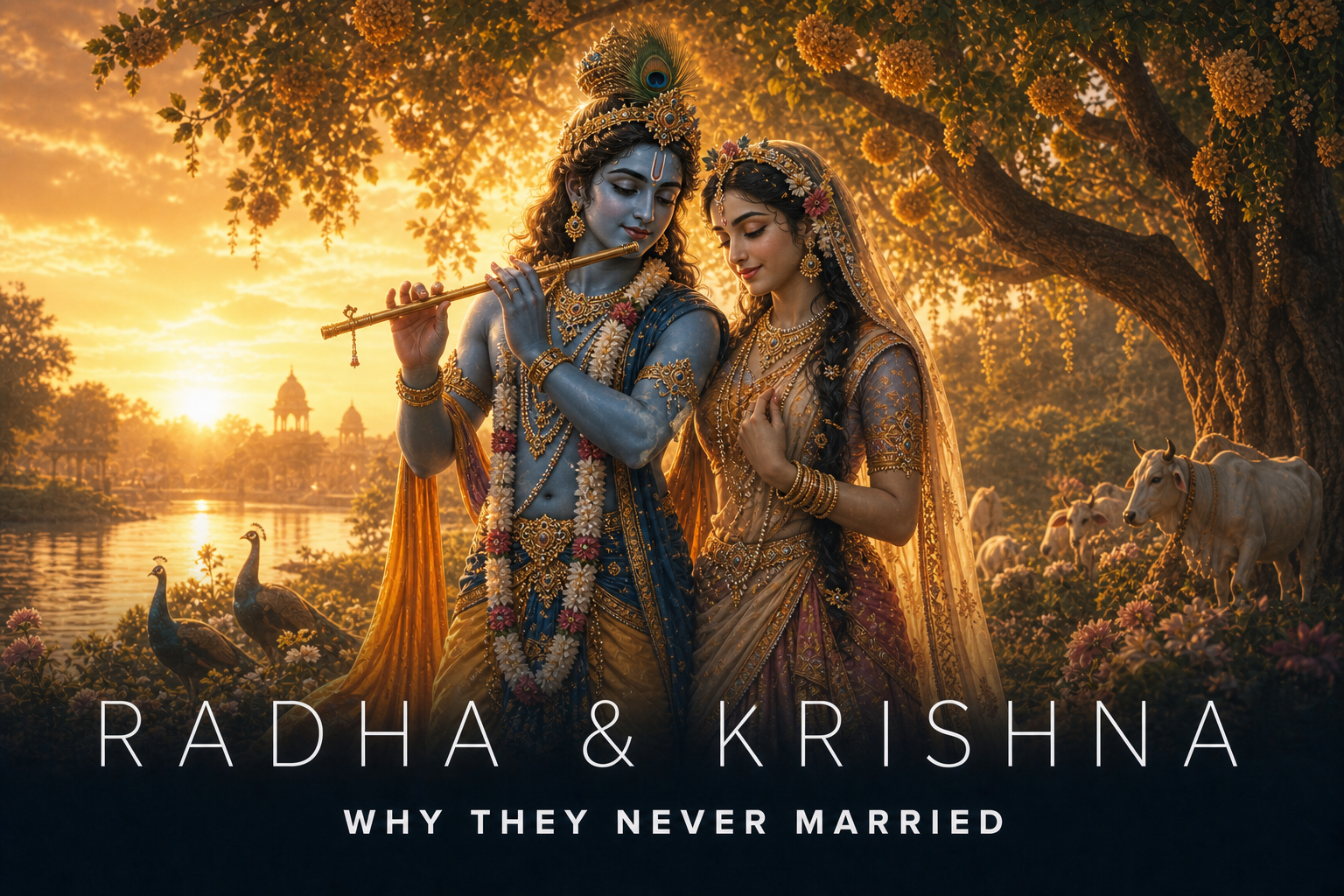
Of all the love stories in Sanatana Dharma, none is quoted more often — or understood less — than the story of Radha and Krishna. Their names are spoken together in a single breath. Temples across Braj enshrine them side by side. And yet Krishna, who married Rukmini and ruled as king in Dwarka, is never shown living out an ordinary married life with Radha in Vrindavan.
This has puzzled devotees for centuries. Was it a curse? A tragedy? A love that simply ran out of time? The Puranas answer in a way most people do not expect — and the answer says more about the nature of devotion than about romance.
Where Radha’s Story Actually Comes From
Radha is not prominently named in the Bhagavata Purana, the text that gives us most of Krishna’s Vrindavan leela. Her full identity emerges later and more richly — in the Prakriti Khanda of the Brahma Vaivarta Purana, in the Padma Purana, in the Garga Samhita, and most beautifully in Jayadeva’s twelfth-century Sanskrit poem, the Gita Govinda.
It was Jayadeva who gave Radha her voice — her longing, her pride, her sulking, her surrender. From there, the Bhakti poets of Bengal and Braj carried her forward. By the time of Chaitanya Mahaprabhu in the fifteenth century, Radha was no longer simply Krishna’s beloved. She was understood as the highest expression of divine love itself.
The Marriage the Puranas Do Describe
Here is the first surprise: several scriptures say Radha and Krishna were married.
The Brahma Vaivarta Purana and the Garga Samhita both narrate a wedding at Bhandirvan, a forest grove near Vrindavan. In this account, Brahma himself descends, acts as the priest, and solemnises the union — a Gandharva Vivah, a marriage sealed by mutual love rather than by family arrangement. The site is still venerated today as Radha Krishna Vivah Sthali.
So the question is not really whether they married. It is why that marriage never became a household, a lineage, a shared throne. And that is where the second thread of the story begins.
The Curse of Sridhama
The Brahma Vaivarta Purana traces the separation back to Goloka, Krishna’s eternal abode, long before either of them took birth on earth. Krishna, in the midst of the rasa dance with Radha, left to spend time with another gopi, Viraja. Radha, wounded, went looking for him.
In the confrontation that followed, Krishna’s attendant Sridhama spoke sharply against Radha. Radha cursed him to be born on earth; Sridhama, in return, pronounced that Radha too would descend, and would be separated from Krishna for a hundred years.
This is the crucial detail most retellings miss: the separation was not a failure of love. It was a condition accepted in advance, by both of them, before either of them was born. Viraha — the ache of separation — was written into the script.
One Soul in Two Forms
The deepest answer, though, is not narrative at all. It is theological.
The Brahma Vaivarta Purana says Radha emerged from Krishna’s own left side. Not created separately, not brought from elsewhere — she came out of him. In the Gaudiya Vaishnava understanding, Radha is Krishna’s hladini shakti, his innate power of bliss. The Padma Purana uses the same language.
Marriage joins two people who were previously separate. But Radha and Krishna were never two. He is the source of joy; she is joy itself. To marry them would be to formalise a union that was never broken in the first place. As the tradition puts it: what ceremony could possibly bind what was never divided?
Some accounts add a further layer — that Radha’s earthly shadow-form married the cowherd Ayan, fulfilling the terms of the curse in the world of appearances, while Radha herself remained wholly Krishna’s. Her worldly obligation and her real belonging were simply not in the same realm.
Why Separation Is Treated as the Higher Love
In Bhakti thought, viraha is not the opposite of love — it is its most intense form. A love fulfilled settles. A love in separation burns, remembers, calls out, and never grows casual.
This is why Radha, not Rukmini, became the emblem of the devotee’s heart. Rukmini’s love is the love of the wife: secure, established, honoured. Radha’s love is the love of the soul that has glimpsed the Divine and can no longer be at peace without it. It asks nothing, claims nothing, and is bound by no contract — which, in the logic of bhakti, makes it the purest offering possible.
The gopis of Vrindavan are held up in the same way. They had everything to lose and nothing to gain. That is precisely what made their love the standard.
Why Her Name Comes First
Listen to how devotees actually speak. Not Krishna-Radha, but Radha-Krishna. Not Krishna’s name alone, but Radhe Radhe as a greeting across all of Braj.
In the Braj tradition, Krishna is approached through Radha. She is not a subordinate figure in his story; she is the door to him. A love that was never legalised turned out to be the one relationship the tradition placed above every other — including his marriages, his kingship, and his role as counsellor on the battlefield of Kurukshetra.
That, finally, is the answer. Radha and Krishna did not need a wedding to complete them. Their story stays unfinished on purpose, because a longing that never closes is the only kind that never fades.
Janmashtami falls on 4 September 2026. Our illustrated eBook brings together the Nishita puja muhurat, the full janma katha, step-by-step vrat vidhi, aarti and parana rules — everything you need in one instant download.
Frequently Asked Questions
Did Radha and Krishna ever get married?
Yes, according to the Brahma Vaivarta Purana and the Garga Samhita, they were married at Bhandirvan near Vrindavan in a Gandharva Vivah solemnised by Brahma. What they never had was an ordinary worldly married life together.
Is Radha mentioned in the Bhagavata Purana?
She is not named prominently there. Radha’s fully developed identity appears in the Brahma Vaivarta Purana, the Padma Purana, the Garga Samhita, and in Jayadeva’s Gita Govinda, and was elevated further by the Bhakti poets and the Gaudiya Vaishnava tradition.
What does hladini shakti mean?
Hladini shakti means the power or energy of bliss. Radha is described as Krishna’s own hladini shakti — meaning she is not a separate being but the very joy inherent in him, which is why the tradition sees them as one reality in two forms.