
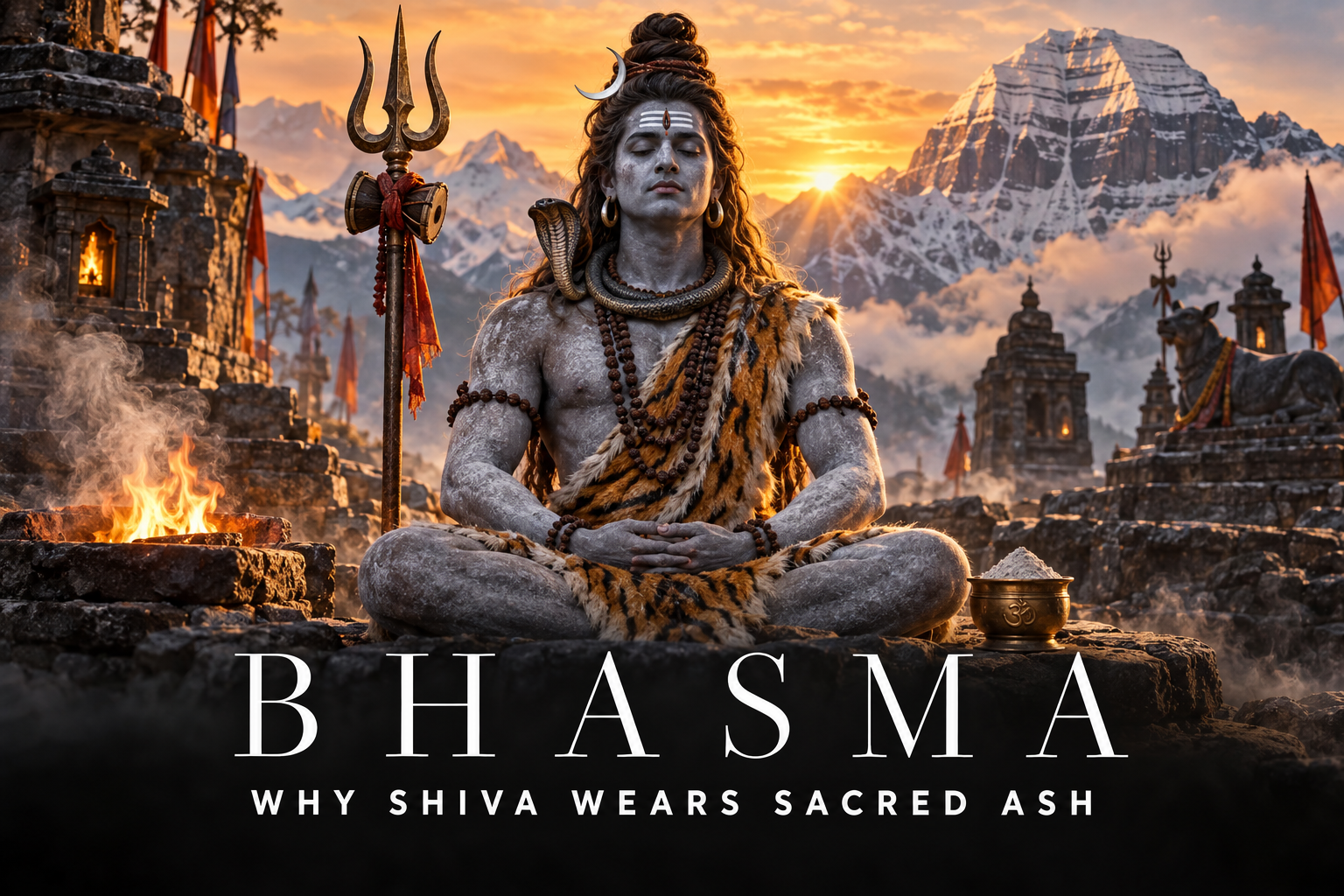
Every other deity in the Hindu pantheon is described in terms of splendour — silks, gold, garlands, crowns. Shiva is described in terms of what is left over after a fire. He sits on a tiger skin with matted hair, a serpent at his throat, and his entire body smeared grey-white with bhasma: ash from the cremation ground.
It is the most deliberately uncomfortable image in all of Sanatana Dharma. And that discomfort is the teaching. When you understand why Shiva wears ash, you understand why he is called Mahadeva — the god who has nothing left to lose.
What Bhasma Actually Is
The Sanskrit word bhasma comes from the root meaning “that which is burnt” — what remains when fire has taken everything it can take. The other common name, vibhuti, carries a startlingly different sense: greatness, glory, abundance, divine power. One word for the same substance means residue; the other means splendour.
That pair of names is the whole philosophy in miniature. Ash is simultaneously the poorest thing in the world and the richest. It is what is left when illusion is burnt away, and what is left is precisely what cannot be burnt.
Ritually, bhasma is prepared from burnt cow dung, dried wood, and ghee offered in the sacred fire — the residue of a completed yajna. In the Kapalika and Aghori streams of Shaiva practice, ash from the cremation ground itself is used. In both cases the logic is identical: this is matter that has passed completely through fire and has nothing further to give.
Why Shiva Wears It: The Lesson of the Shmashan
Shiva’s chosen residence is the shmashan — the cremation ground. Every other sacred space in Hinduism is defined by purity, boundaries, and the careful exclusion of death. Shiva walks into the one place from which everything auspicious is excluded and makes it his home.
By covering himself in the ash of that place, he declares something no other form of divinity declares: that he is beyond the duality of pure and impure, auspicious and inauspicious, living and dead. Fear of death is the root fear from which every other fear grows — fear of loss, of failure, of ageing, of ending. Shiva does not defeat that fear by conquering death. He defeats it by living in death’s own courtyard and wearing its remains as ornament.
This is why he is Bhasmabhushita, “adorned with ash,” and why his devotees have never read the image as morbid. Ash on the body of Shiva is not a symbol of grief. It is a declaration that the thing you are terrified of is, to him, cosmetics.
The Ash of Kamadeva: Desire Reduced to Powder
There is a second, more pointed story behind the ash. When the devas needed Shiva to father a son who could defeat the asura Taraka, they sent Kamadeva — the deva of desire — to break his meditation. Kama loosed his flower arrow. Shiva opened his third eye, and Kamadeva was reduced to ash where he stood.
Rati, Kama’s wife, pleaded for her husband, and Shiva relented — but restored him as Ananga, “the bodiless one.” Desire was returned to the world, but stripped of form.
The ash Shiva wears is read in this light too: it is the residue of burnt desire. Not desire repressed, not desire hidden, but desire genuinely consumed and carried openly on the skin as a reminder. This is why the Shiva Purana speaks of bhasma as purifying — it is the physical mark of what tapas actually does to the ego. You can read that episode in full in our piece on Kama Dahan.
Authentic sacred ash, prepared for puja and tripundra tilak — the same three lines Shaiva devotees have worn for millennia. Fine, clean and temple-grade, in a 50g pack that lasts months of daily sadhana.
The Tripundra: Why Three Lines?
Devotees do not smear ash the way Shiva does. They wear it as tripundra — three horizontal lines drawn across the forehead, traditionally from the middle of the brow outward with the fingers of the right hand.
The three lines are read on several layers at once, and the tradition does not ask you to choose between them:
- The three gunas. The lowest line is tamas (inertia, darkness), the middle rajas (restless activity), the top sattva (clarity, balance). Wearing them is a daily acknowledgement that all three move through you.
- The three malas. In Shaiva Siddhanta, the soul is bound by three impurities: anava (the sense of being small and separate), karma, and maya. The ash marks their burning.
- The three fires, three worlds, three Vedas, and the three syllables of AUM. The same triad recurs at every scale of the cosmos.
The Shiva Purana (1.18) adds a detail worth sitting with: every individual particle of ash that clings to the skin when tripundra is applied is to be regarded as a lingam in its own right. The devotee who applies bhasma is not decorating a forehead. He is covering himself in countless small forms of Shiva. There is even a minor Upanishad, the Bhasmajabala, devoted entirely to the discipline of sacred ash.
What the Ash Asks of You
Strip away the mythology and one instruction remains. Every morning, before anything else, you take the residue of a fire and draw it across the part of your body you are most attached to — your face, the seat of your identity — and you remember that this too will be ash.
It is not a gloomy thought. It is the most liberating thought available, because everything that makes a human being anxious is downstream of forgetting it. The ash does not say “you are nothing.” It says: what burns is not you. Something remains that fire cannot touch, and finding it is the entire point of the practice.
This is the same assurance Shiva gave the boy Markandeya when Yama’s noose closed around him — the story of how a devotee of Shiva stepped past death itself. Shiva’s ash and Markandeya’s rescue are the same teaching told twice.
Frequently Asked Questions
Is bhasma really made from cremation ashes?
Shiva’s own ash is described as coming from the cremation ground, and some ascetic orders such as the Aghoris do use it. The bhasma or vibhuti used by householders in daily puja is not — it is prepared from burnt cow dung, dried wood and ghee offered in a sacred fire, which is why it is fine, white-grey and odourless.
Which direction should tripundra be applied?
Tripundra is drawn as three horizontal lines across the forehead, applied with the fingers of the right hand moving from the centre outward. Horizontal ash lines mark Shaiva affiliation; the vertical urdhva-pundra mark belongs to the Vaishnava tradition.
Why is ash called vibhuti when it means “glory”?
Because in Shaiva thought the two are the same. What is left after everything perishable has burnt away is, by definition, the imperishable — and that is the only real wealth. Calling ash “glory” is the tradition’s way of inverting how we normally rank things.