
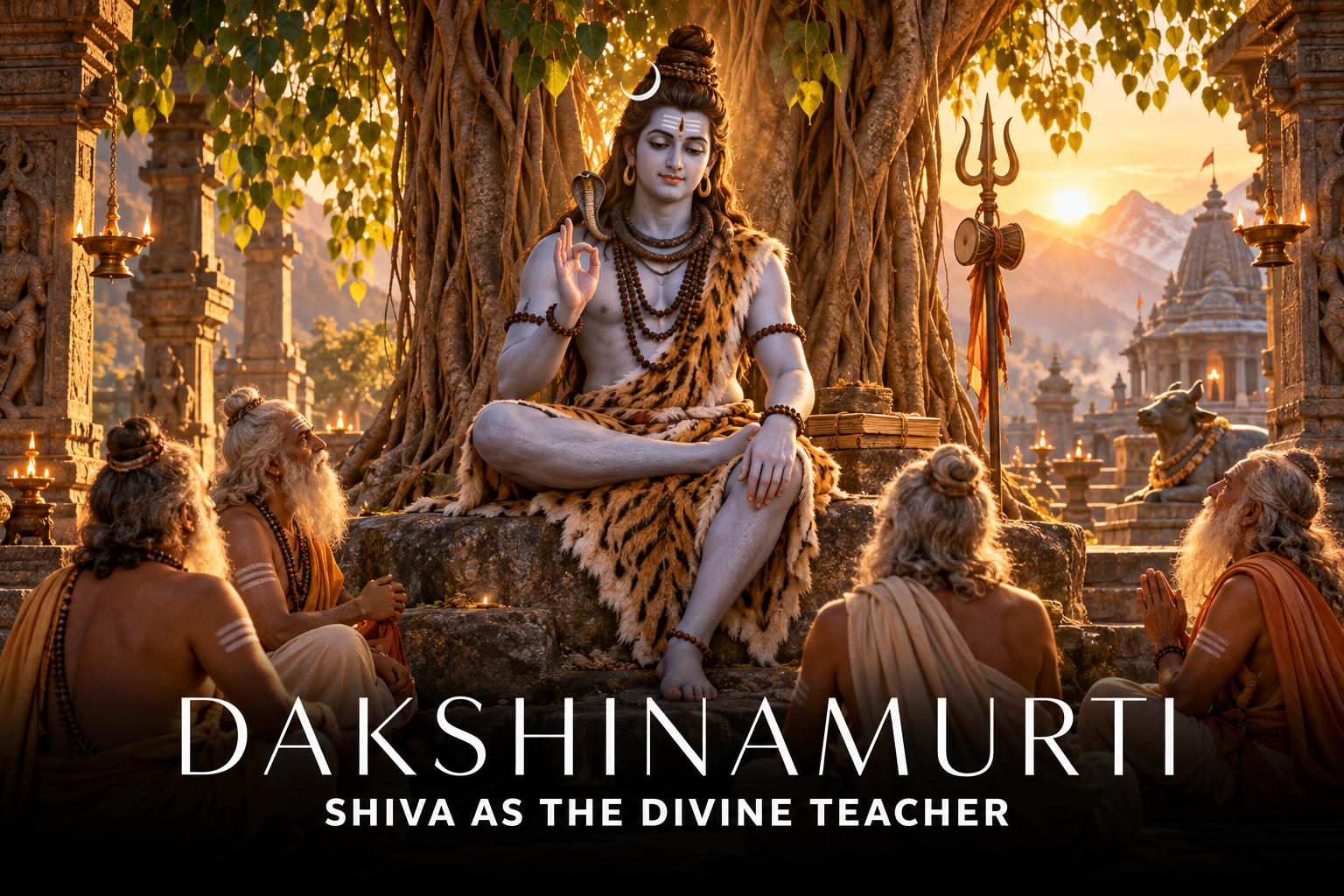
Shiva is often remembered as the cosmic dancer, the great ascetic, or the compassionate protector. As Dakshinamurti, he reveals another beloved presence: the divine teacher. Seated calmly, with a hand raised in instruction and disciples nearby, he makes wisdom visible. The meaning of Dakshinamurti begins with this image of learning in the presence of stillness.
This form invites us to consider knowledge that changes how we understand ourselves. Its beauty lies in the relationship between teacher and student, between sacred study and inward recognition. Sculpture and devotional poetry approach that relationship in different ways, offering complementary windows into Shiva’s role as guru.
What the Name Dakshinamurti Means
Dakshinamurti is commonly translated as “south-facing form” or “south-facing image.” It names Shiva in his aspect as teacher. The National Museum of Asian Art’s glossary identifies Dakshinamurti as a manifestation of Shiva as a guru. The name describes a sacred form, rather than a separate deity unrelated to Shiva.
The direction also finds architectural expression. LACMA’s account of Shiva as the Supreme Teacher notes that this form is typically placed on the southern wall of a Shiva temple. This is a familiar convention, not a claim that every image occupies an identical setting.
For a visitor, recognising the teacher changes the encounter. The quiet seated figure asks for a different kind of attention from a dramatic scene of battle or dance. Here, the devotee stands before divine understanding made present in a humanly recognisable relationship.
The Teacher Beneath the Tree
A traditional scene places Dakshinamurti beneath a tree, offering knowledge to sages. The Walters Art Museum’s wooden sculpture presents this teaching form and explains the tradition that Shiva faced south while instructing ancient forest-dwelling sages. The image belonged to a temple chariot or palanquin, bringing the teacher into the life of a devotional community.
The setting matters because learning is shown as an encounter. A disciple turns toward Shiva with joined hands. Attention and reverence become visible alongside the teacher’s composure. The sculpture does not reduce wisdom to a book or an isolated symbol; it presents a relationship in which understanding can unfold.
Read devotionally, the tree offers an evocative setting for patient learning. Its shade can suggest shelter from distraction, and its rootedness can invite reflection on steadiness. These are contemplative associations with the scene, rather than a single scriptural definition of every branch or leaf.
The Teaching Hand and the Figure of Ignorance
Small details help identify Dakshinamurti. In LACMA’s sculpture from Tamil Nadu, dated around 950–1000, Shiva has four arms, a manuscript, and a lower right hand held in a teaching gesture. His right foot rests upon Apasmara, a figure associated with ignorance, while sages appear below as his audience.
The contrast is striking: ignorance is beneath the foot, while the hand opens a path toward understanding. The image can be contemplated as the overcoming of confusion through wisdom. It need not be read as hostility toward an imperfect student. The student’s very presence shows that learning remains possible.
Attributes differ between works. The Walters sculpture includes a book and an antelope, while other surviving images preserve different objects or have lost parts over time. Looking carefully at an actual work is more respectful than assuming that one fixed checklist explains every representation.
Why Dakshinamurti Is Called the Silent Teacher
The language of silence is especially important in Advaita devotional reflection. The Dakshinamurti Stotra translation preserved by Arunachala Ashrama includes an introductory contemplation of a youthful teacher surrounded by aged sages, communicating nondual truth through silence. Its account of the joined thumb and forefinger connects the gesture with the identity of the individual self and the supreme Self.
Silence here is spiritually expressive. It points toward recognition that cannot be exhausted by multiplying descriptions. The hymn also uses words, images, and philosophical reasoning, so the tradition need not be understood as rejecting study or speech. Words can direct attention; the understanding they indicate must become clear to the seeker.
The youthful teacher and older disciples make a memorable contrast. Within the devotional image, wisdom is not measured simply by age. The scene honours the openness to learn, even when the student already possesses experience and learning.
What This Form Can Mean in Everyday Reflection
Dakshinamurti offers a thoughtful image for anyone overwhelmed by information. Receiving more facts does not always bring greater clarity. Sometimes we need time to listen carefully, examine an assumption, and understand what a teaching actually asks us to see. The calm teacher can remind us of that difference.
This is a devotional application of the image, not a promise that sitting quietly automatically produces insight. Honest questions, sustained study, and guidance remain valuable. Humility matters too: recognising confusion can be the beginning of understanding, rather than a reason to abandon the search.
The figure also invites gratitude toward those who help us learn. A patient teacher can make room for questions without turning learning into a contest. A receptive student can bring attention without pretending to know everything already. In this shared space, knowledge becomes a responsibility carried with care.
To contemplate Shiva as Dakshinamurti is to honour wisdom with both reverence and curiosity. The raised hand, attentive disciples, and composed presence together suggest that clarity can be gentle, and that the deepest learning may change the learner’s way of seeing.
Explore thoughtfully selected puja essentials for a peaceful home altar and meaningful moments of devotion, gratitude, and reflection.
Frequently Asked Questions
Is Dakshinamurti a form of Shiva?
Yes. Dakshinamurti is Shiva revered as the divine guru or supreme teacher, associated with wisdom and spiritual understanding.
What does Dakshinamurti mean?
The name is commonly translated as “south-facing form.” This teaching image is often placed on the southern wall of a Shiva temple.
Why is Dakshinamurti associated with silence?
Advaita devotional tradition uses his silence to express direct recognition of truth beyond description, while continuing to honour teaching, study, and inquiry.