
Sometimes the hardest part of learning is the feeling that everyone else is moving forward while we remain where we began. The story of Upakosala gives that feeling a place within sacred literature. A devoted student waits for instruction, struggles with sorrow, and receives an unexpected teaching from the very fires he has served.
Found in the Chandogya Upanishad, sections 4.10–4.15, this narrative brings together human kindness, the presence of Brahman in the world, and a teacher’s guidance towards the Self. Its wonder lies in the way a familiar responsibility becomes an opening into a larger vision.
1. A student waits beside the sacred fires
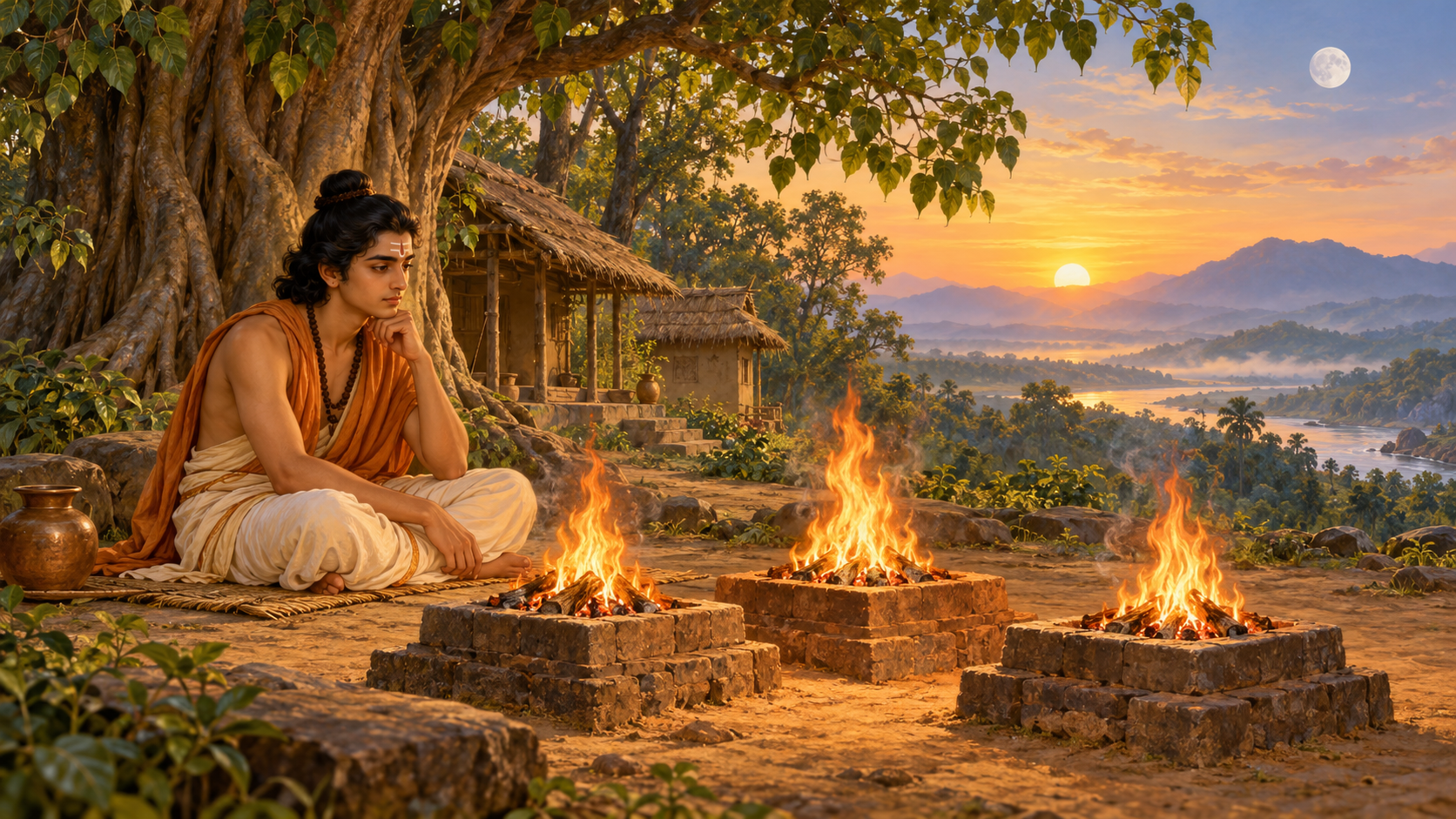
Upakosala Kamalayana lives as a student with Satyakama Jabala. For twelve years he tends his teacher’s sacrificial fires. Other students complete their period of study and are permitted to return home, but Upakosala remains. When Satyakama’s wife urges her husband to teach this diligent student, he leaves on a journey without giving that instruction.
The passage does not spell out the teacher’s private reasons. Later explanations may understand the delay as preparation or testing; the narrative itself asks us first to notice a student who is suffering. Remembering that distinction helps us read with both reverence and care.
Satyakama is the same figure whose earlier student life appears in this Upanishad. Here we meet him in a different role, responsible for another seeker. Spiritual learning passes from one generation to the next, yet each learner’s journey has its own difficulties.
2. Compassion enters before the teaching
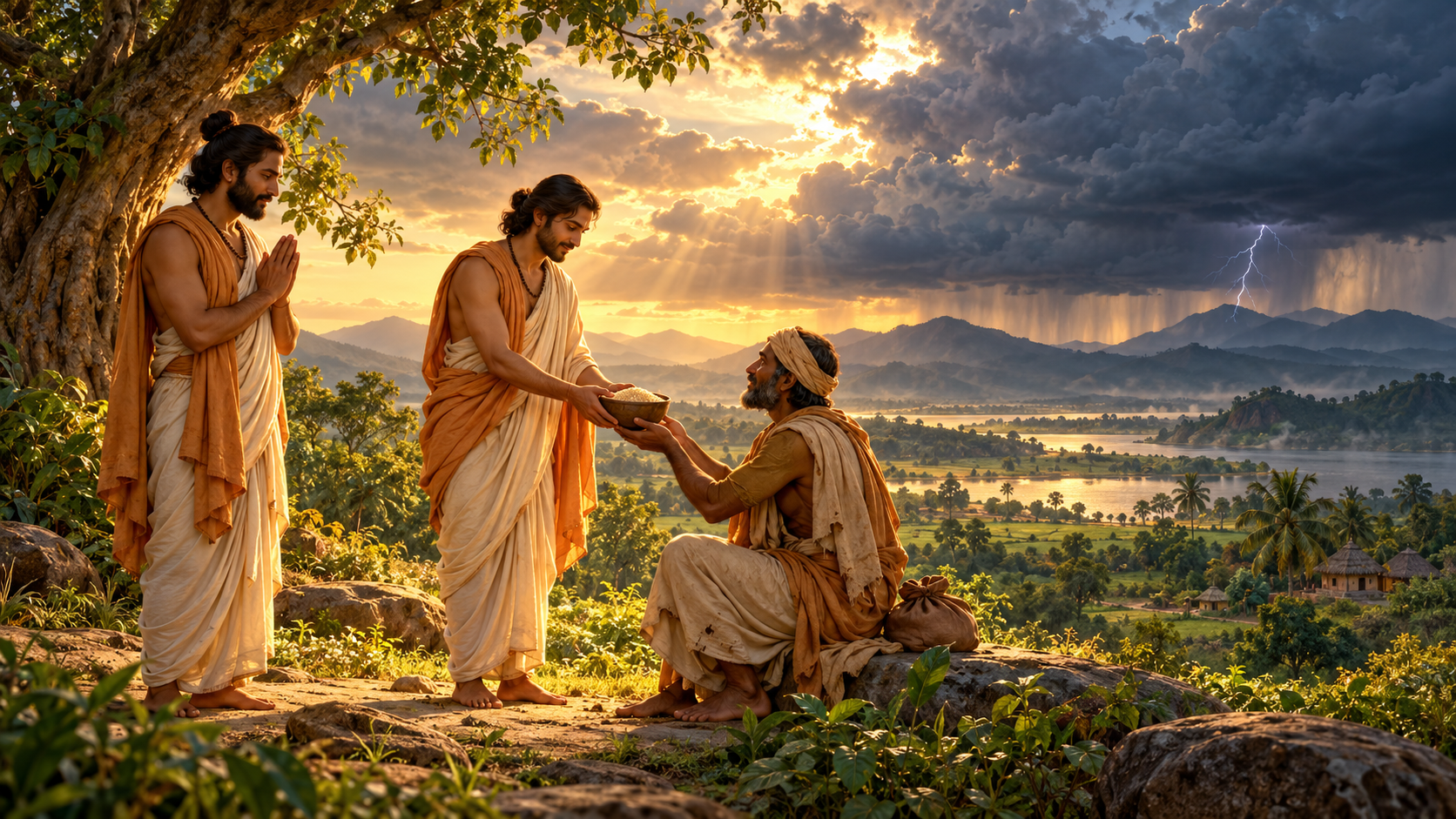
Distressed, Upakosala stops eating. His teacher’s wife approaches and encourages him to take food. He speaks of desires pulling him in different directions and of the sorrow weighing upon him.
Her concern is a tender part of the story. Before the great words about Brahman arrive, someone notices whether the student has eaten. For a devotional reader, this offers a simple reflection: care for a person’s immediate needs belongs within a life devoted to wisdom.
The episode describes Upakosala’s distress; it gives no instruction to imitate it. We need not turn his refusal of food into a spiritual method. The wife’s response gives us a compassionate example to remember when someone near us feels discouraged or overlooked.
Service may shape attention over many years, but patience does not make a person’s pain invisible. That is one reason this ancient narrative still feels close to ordinary life.
3. The fires speak of life, joy and space
The sacred fires now speak together. Recognising how faithfully Upakosala has cared for them, they decide to teach him. Their opening instruction connects Brahman with prana, ka and kha: life or breath, joy, and space.
Upakosala does not pretend to understand everything. He says that he understands the statement about prana, while ka and kha remain unclear. The fires answer by relating the two terms to one another.
In Swami Sivananda’s Vedantic explanation, joy and space qualify each other, directing attention beyond passing pleasure towards the fullness associated with Brahman. This is an interpretation of the teaching’s meaning; the brief Upanishadic exchange itself leaves room for sustained contemplation.
Upakosala’s question is especially encouraging. Devotion has not silenced his intelligence. He receives the teaching respectfully and names the place where he needs help. We can bring that same honesty to reading scripture: an unanswered question can become the beginning of deeper understanding.
4. Three flames open onto a wider world
The fires then teach individually. The Garhapatya fire connects its instruction with earth, fire, food and the sun. The Anvaharyapachana fire, also associated with the southern fire, speaks through water, the directions, stars and the moon. The Ahavaniya fire draws together prana, space, heaven and lightning.
These correspondences belong to the Upanishad’s contemplative language. The teaching moves between the fire before the student and the vast world around him. Sunlight, nourishment, the night sky and the life within his own body become part of an expanding field of sacred attention.
A devotional reflection follows naturally: what we care for faithfully can teach us to notice relationships we once missed. A meal recalls the earth and sunlight; a breath recalls our dependence on life. Such reflections do not replace the text’s specific teaching, but they help us approach its sense of connectedness.
The fires also tell Upakosala that his teacher will explain the further way. Their extraordinary instruction leaves space for the human teacher’s return.
5. Satyakama returns and points towards the Self
When Satyakama returns, he notices that Upakosala’s face shines like that of someone who knows Brahman. The student eventually indicates the fires and recounts their teaching. Satyakama then offers further instruction, using the image of water that does not cling to a lotus leaf.
In section 4.15, he identifies the person seen in the eye with the Self, described as immortal, fearless and Brahman. Vedantic commentary understands this as a teaching about the divine Self, rather than an ordinary reflection alone. The passage continues with the path leading towards Brahman.
The story therefore holds together two forms of guidance: revelation through the sacred fires and instruction from Satyakama. Upakosala’s learning grows through both.
For us, its lasting invitation may be to keep devotion and inquiry together. Serve with attention, allow compassion to remain practical, and speak honestly when something is unclear. Upakosala’s light appears within a journey that began with daily care. Even before understanding feels complete, that care has meaning.
Bring mindful devotion into everyday life
Explore thoughtfully chosen devotional essentials for a peaceful sacred space at home.
Frequently Asked Questions
Where is the story of Upakosala found?
It appears in the Chandogya Upanishad, sections 4.10–4.15. Upakosala Kamalayana is a student of Satyakama Jabala.
Who teaches Upakosala?
The three sacred fires first instruct him. When Satyakama returns, he gives further teaching concerning the Self and Brahman.
What can we learn from Upakosala’s story?
It invites reflection on faithful service, compassion and honest inquiry. These are devotional applications of the narrative, not a promised formula for attaining knowledge.
Sources: Chandogya Upanishad 4.10–4.15; consult the translations of 4.10, 4.11, 4.12, 4.13, 4.14 and 4.15 by Max Müller. Interpretive context: Swami Sivananda on the Being in the Eye. Reflections on everyday life are offered as devotional interpretation.