

A child reaches for his father’s affection and meets rejection. From that painful beginning, the story of Dhruva unfolds into one of the Bhagavata Purana’s most moving accounts of devotion. His search begins with a wish to gain an exalted place, but the encounter with the Divine changes his understanding of what is worth seeking.
Dhruva is remembered for steadfastness. Yet his story carries more than a lesson about determination. It also holds a mother’s concern, a teacher’s compassion and the grace through which an imperfect beginning can lead toward a deeper spiritual longing.
A Child’s Hurt in the Royal Household
Bhagavata Purana 4.8 introduces King Uttanapada and his two queens, Suniti and Suruchi. Dhruva is Suniti’s son; Uttama is Suruchi’s son. The king favours Suruchi, and this imbalance shapes the painful scene that follows.
Seeing Uttama on their father’s lap, Dhruva also tries to approach. Suruchi rebukes him, denying him that place because he was not born to her. His father remains silent. The child leaves in distress and goes to Suniti.
The episode gives his later determination an emotional setting. Before Dhruva becomes the devotee remembered in sacred narration, he is a little boy longing to be welcomed. His anger and tears belong to that hurt.
For a reader, this beginning invites tenderness. The desire for recognition can have roots in a simple need for affection. Understanding those roots helps us listen to the story without reducing the child to either a flawless hero or a symbol of ambition.
Suniti’s Care and Narada’s Compassion
Suniti receives her grieving son. Her own sorrow is real, but she urges him not to wish harm upon others. In 4.8.17, her counsel turns his attention away from the wish to answer pain with pain. She directs him toward the Lord as his refuge.
Dhruva leaves home with firm resolve and encounters Narada. The sage first speaks to him about contentment and the difficulty of the path he has chosen. Dhruva listens, yet honestly admits that his stepmother’s words still trouble him. He wants a position beyond anything his forebears attained.
Narada’s response is compassionate. The text specifically describes that compassion in 4.8.39, before the sage gives further guidance. He recognises the child’s determination and directs it into devotion to the Lord.
There is warmth in this meeting between teacher and seeker. Dhruva does not arrive with every motive purified. He arrives with longing, wounded pride and an earnest wish to proceed. Guidance meets him there, giving his intensity a spiritual direction.
The Lord Appears Before Dhruva
Under Narada’s guidance, Dhruva turns toward worship and contemplation in Madhuvana by the Yamuna. The narrative describes extraordinary austerities and absorption; its central devotional movement is the gathering of his attention around the Lord.
In chapter 4.9, Vishnu comes to him. The form Dhruva has contemplated within his heart is now before his eyes. Filled with love and reverence, the child wishes to offer prayers, but cannot immediately find the words.
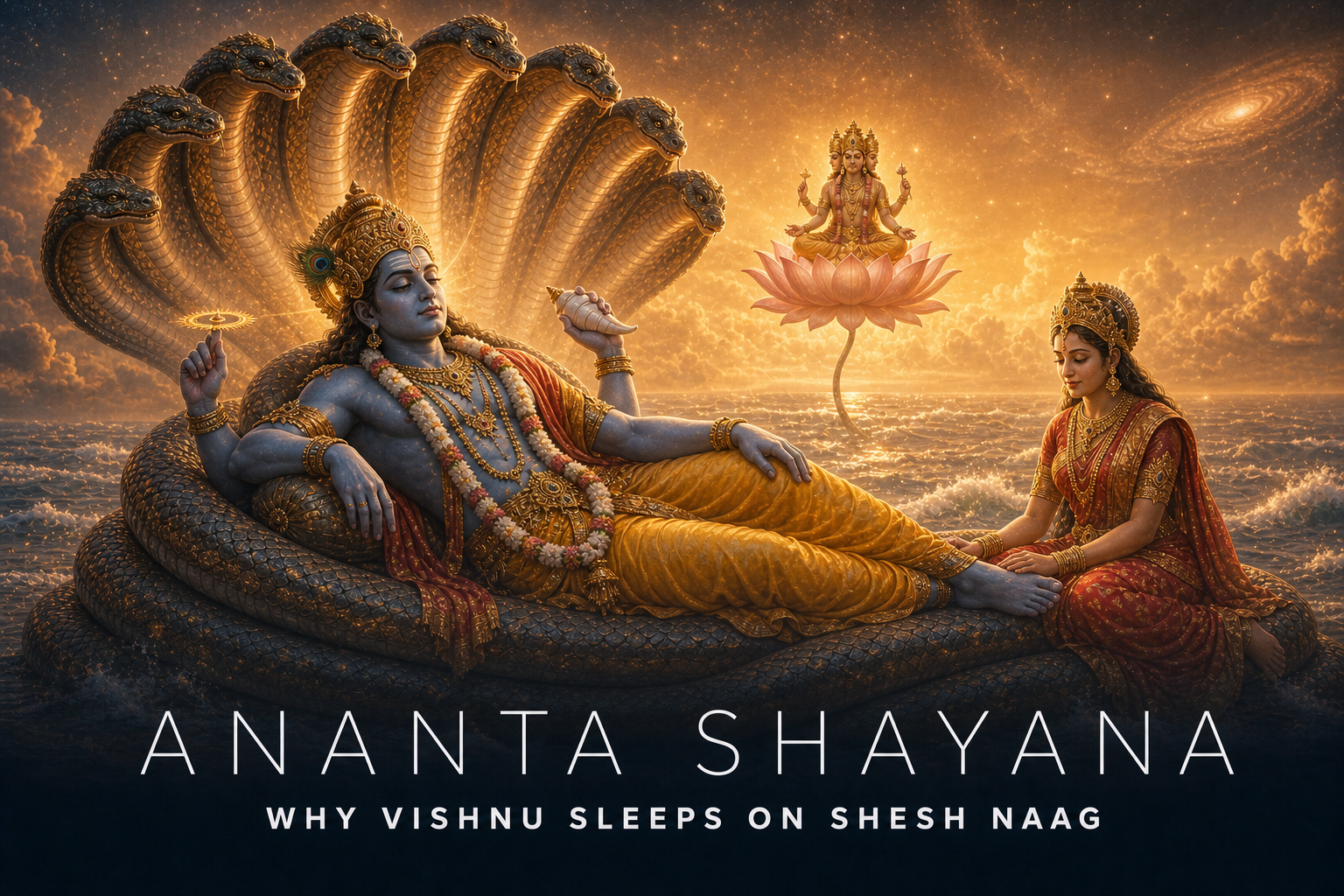
Vishnu understands his hesitation and touches him with his conch. The account presents this as an act of mercy that enables Dhruva’s praise. His prayer begins with gratitude for the divine power that awakens his faculties, including speech.
This moment brings grace into the heart of the story. Determination has brought Dhruva far, but his encounter is also a gift. The Lord understands the child before the child can express himself fully.
That image can comfort a devotee who feels inadequate in prayer. Reverence need not begin with polished language. A sincere heart may have much to offer even when words come slowly.
The Polestar and a Changed Understanding
The Lord grants Dhruva an extraordinary place, associated in 4.9.20–21 with Dhruvaloka, the polestar. The passage describes it through the Bhagavata’s sacred cosmology, with the celestial lights circling a stable centre.
In devotional imagination, that image gives visible form to steadfastness. Amid movement, Dhruva’s place becomes a point of stability. This symbolic reading draws meaning from the narrative without treating its cosmological description as a modern astronomy lesson.
But the blessing is accompanied by an inward change. Dhruva reflects on the narrowness of his original desire. In 4.9.31, he regrets having approached the Lord, who grants freedom from worldly bondage, while asking for something perishable.
The story’s depth lies in this revaluation. Receiving what he wanted does not simply complete his journey. The encounter has made him aware of a greater good than prestige. His understanding grows beyond the wish with which he first entered the forest.
What Dhruva’s Steadfastness Means
Dhruva returns home, and his father welcomes him with affection. The narrative carries the seeker back into relationship after the forest encounter. Its movement includes both the opening wound and a return marked by reunion.
For devotees, Dhruva’s example offers hope about spiritual beginnings. People may approach prayer with fear, hurt, hope or a desire for relief. The story allows those motives to be acknowledged while showing how devotion can deepen and transform them.
His steadfastness also gains meaning through the guidance he receives. Suniti discourages ill will; Narada directs his resolve; Vishnu’s grace enlarges his understanding. Determination grows within relationships of care and wisdom.
A contemporary reflection might be to consider the difference between remaining faithful to a worthy purpose and remaining imprisoned by an old grievance. Dhruva’s story encourages a devotion capable of changing the seeker’s desires, even as the seeker continues with sincerity.
We remember the child beneath the sky because his story joins resolve with tenderness. A heart wounded by the wish for a place discovers a far deeper relationship with the Divine. That transformation gives the story of Dhruva its enduring light.
Create space for everyday remembrance
Explore devotional essentials for your home and quiet moments of reflection.
Frequently Asked Questions
Who were Dhruva’s parents and teacher?
Dhruva was the son of King Uttanapada and Queen Suniti. The sage Narada guided him on the path of devotion to the Lord.
Where is the story of Dhruva told?
This retelling follows Bhagavata Purana 4.8–4.9, covering his departure, Narada’s guidance, Vishnu’s appearance and his return home.
Did Dhruva immediately turn into a star?
The Bhagavata describes the Lord granting him the exalted abode associated with the polestar. He returns home and later rules; the episode is not an immediate bodily transformation into a star.
Sources: Bhagavata Purana 4.8 and 4.9, especially 4.8.17, 4.9.4, 4.9.20–21 and 4.9.31. This account is paraphrased; symbolic readings and present-day reflections are interpretations.