

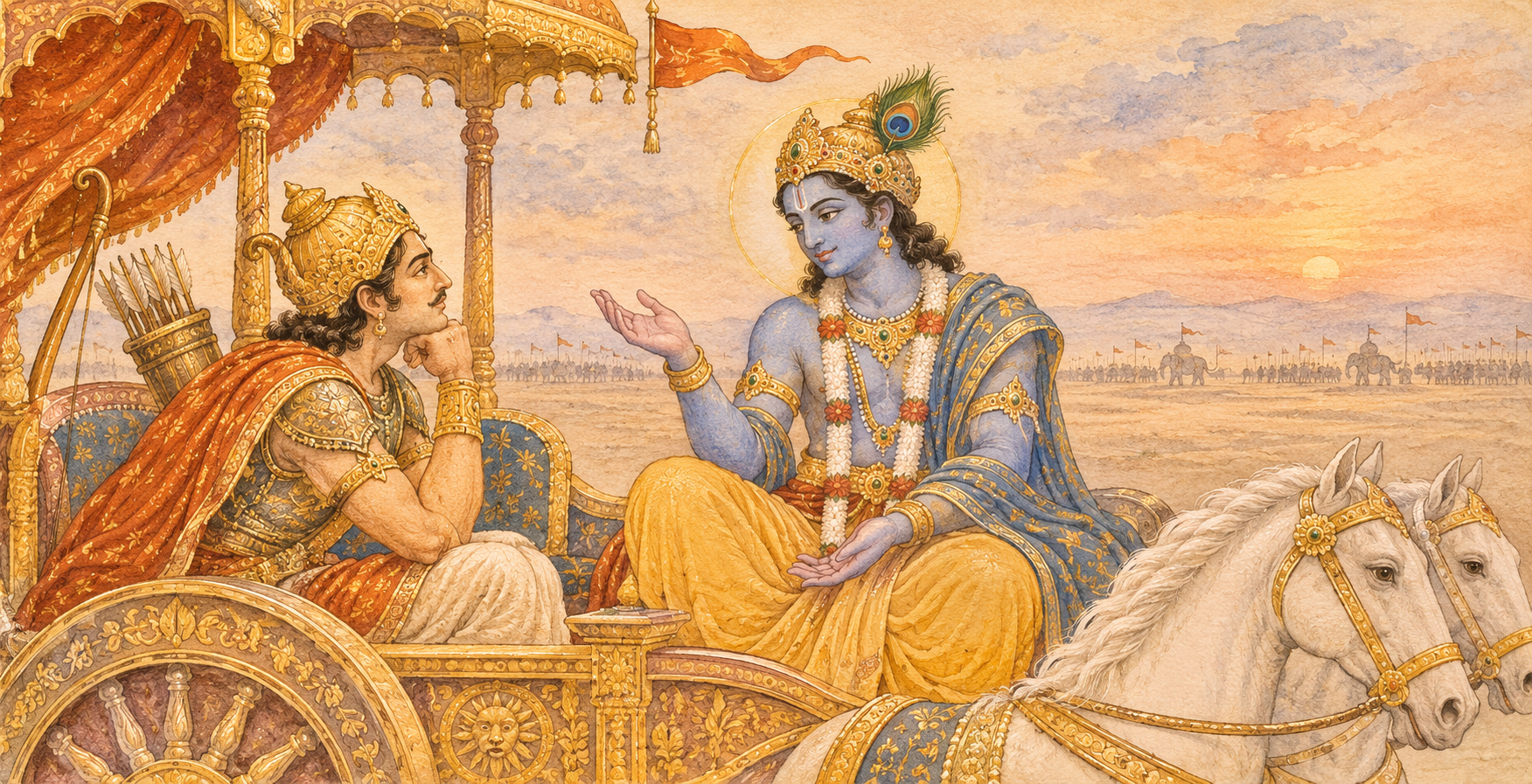
Life rarely waits for us to feel settled. A kind word brings delight; a disappointment unsettles the heart. The meaning of Sthitaprajna in the Bhagavad Gita opens a deeper question: can wisdom become so firmly rooted that changing circumstances no longer decide the direction of our inner life?
Krishna’s answer unfolds near the end of chapter two. He describes a person whose understanding has become steady, whose satisfaction rests inwardly, and whose senses no longer pull the mind wherever they please. The teaching carries the warmth of guidance offered to someone in distress.
For a devotee reading today, this passage can become an invitation to patient reflection. Its images of a tortoise and an ocean make a profound spiritual ideal easier to remember, while its attention to desire and anger brings that ideal close to ordinary experience.
Arjuna’s question about a life shaped by wisdom
In Bhagavad Gita 2.54, Arjuna asks Krishna about the person of established wisdom: how such a person speaks, sits and moves. The setting matters. Arjuna is seeking clarity amid the crisis at Kurukshetra, where familiar relationships and duties have become painfully difficult to reconcile.
His question brings spiritual understanding into the visible texture of a life. What would settled insight look like in someone’s presence, words and conduct? Krishna’s reply turns attention toward the inner freedom from which those outward expressions arise.
The Sanskrit expression sthita-prajna is commonly rendered as a person of steady or established wisdom. Here, wisdom means more than information remembered at the right moment. It suggests understanding that has become a stable orientation.
That distinction gives the passage its enduring force. We may know that anger clouds judgment and still speak harshly. Arjuna’s question concerns the deeper transformation through which what is understood begins to shape how one lives.
Contentment that does not depend on the next desire
Krishna begins in 2.55 with the relinquishing of desires arising in the mind and with satisfaction in the Self. The verse locates steadiness in a profound inward contentment. It points beyond the familiar hope that one more possession or recognition will finally make life complete.
This is a demanding spiritual description. It should be approached with the humility appropriate to a teaching about realised wisdom. A pleasant mood after a successful day is a different experience from the settled freedom Krishna describes.
As a present-day reflection, the verse may help us notice how quickly satisfaction becomes conditional. A compliment feels sufficient until another person receives greater praise. A gain feels secure until comparison turns it into a lack. The mind keeps moving the place where contentment is supposed to begin.
Krishna’s teaching opens another horizon: a source of fulfilment deeper than this restless movement. Devotional traditions understand that inward turning together with a loving orientation toward the Divine, an emphasis made explicit later in the passage.
Steadiness through sorrow, pleasure and anger
Verse 2.56 describes the sage whose mind remains unagitated in sorrow, who is free from craving amid pleasure, and who has moved beyond attachment, fear and anger. These qualities reveal the emotional depth of established wisdom.
For readers still learning, the verse can inspire care in how we meet our reactions. A moment of sorrow does not make a person spiritually worthless. The ideal can be held reverently while recognising that growth often includes vulnerability, honest self-examination and support from others.
Krishna also traces a troubling sequence in 2.62–63. Sustained dwelling on sense objects gives rise to attachment; attachment feeds desire, and desire leads to anger. Anger then brings delusion, confusion of memory and the collapse of discernment.
A contemporary example might be repeatedly rehearsing an imagined entitlement until an obstacle feels intolerable. This example is an interpretation of the passage’s pattern. It helps us see why the quality of our attention matters long before a heated word is spoken.
The tortoise and a heart oriented toward Krishna
In 2.58, Krishna compares the withdrawal of the senses from their objects to a tortoise drawing its limbs into its shell. The image gives restraint a memorable form. Attention need not remain exposed to every invitation that appears before it.
For a modern reader, the image can suggest a quiet freedom to pause when stimulation becomes absorbing. That reflection belongs to our own setting; the verse itself speaks of mastery over the senses and firmly established wisdom.
The teaching also has a devotional centre. In 2.61, Krishna joins restraint of the senses with being directed toward him. The heart receives a sacred orientation. Discipline has a purpose beyond the effort of holding something back.
Verse 2.64 then speaks of moving among sense objects with the senses under control, free from attachment and aversion. Read beside the tortoise image, it broadens our understanding: the passage concerns the inner quality of engagement as well as the capacity for withdrawal.
The ocean as an image of peace
One of the passage’s most spacious images appears in 2.70. Waters enter the ocean, yet it remains firmly established. Krishna uses this comparison to describe the person into whom desires enter without overthrowing peace. He contrasts that steadiness with the person continually seeking fulfilment through desire.
The image invites contemplation of depth. A life can contain encounters, impressions and changing conditions while its deepest orientation remains steady. In devotional reflection, remembering Krishna may become a way of returning to that orientation when the mind feels scattered.
Verse 2.71 adds freedom from craving, possessiveness and ego to its description of peace. Together, these verses reveal why Sthitaprajna is a spiritual ideal of such richness. The question reaches into what we claim as “mine,” where we seek fulfilment, and what guides us when circumstances change.
We can receive this teaching patiently. Arjuna asks, Krishna answers, and the reader is invited to listen with the same sincerity. Steady wisdom becomes a horizon toward which understanding, devotion and a more attentive life can turn.
Make room for quiet remembrance
Explore devotional essentials for a thoughtful space of prayer and reflection at home.
Frequently Asked Questions
What does Sthitaprajna mean?
Sthitaprajna means a person whose wisdom is steady or firmly established. Bhagavad Gita 2.55 begins Krishna’s description with inward contentment and freedom from mental craving.
Where does the Gita discuss steady wisdom?
Arjuna asks about it in 2.54. Krishna’s reply continues through the closing verses of chapter two, using descriptions of inner freedom and memorable natural images.
What do the tortoise and ocean represent?
The tortoise in 2.58 illustrates withdrawal of the senses. The ocean in 2.70 illustrates a steadiness that remains undisturbed by the arrival of desires.
Sources: Bhagavad Gita 2.54, 2.55, 2.56, 2.58, 2.61, 2.62–63, 2.64, 2.70 and 2.71; compared with IIT Kanpur’s 2.55 translation and commentaries. Verses are paraphrased; contemporary examples and devotional reflections are interpretations.