

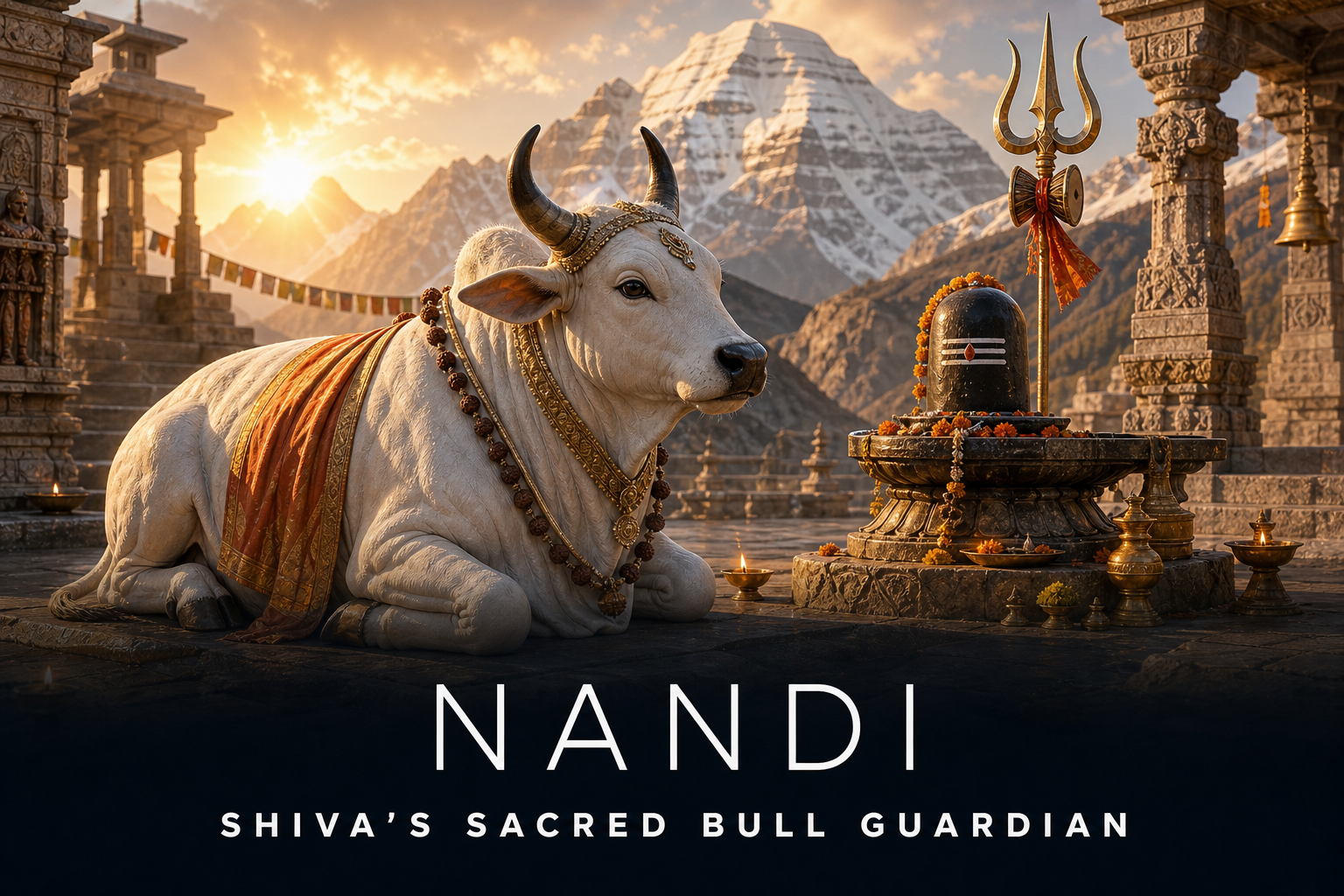
At the entrance of nearly every Shiva temple in India sits a large stone bull, its gaze fixed unblinking on the sanctum inside. This is Nandi — not a mere mount for Lord Shiva, but his most devoted disciple, the guardian of Mount Kailash, and, according to tradition, the very first being to receive Shiva’s wisdom. To understand Nandi is to understand what devotion looks like when it becomes complete.
Who Is Nandi? Shiva’s Eternal Companion
Nandi appears throughout Hindu scripture as a bull-formed being of extraordinary purity, most often shown seated calmly facing the Shiva lingam, front legs folded, eyes half closed in meditation. His name comes from the Sanskrit root “nand,” meaning joy or happiness — fitting for a figure Shiva himself is said to have called his most beloved gana, or attendant. Nandi is Shiva’s vahana, the vehicle that carries him, but temple tradition treats him as something greater: the gatekeeper of Kailash, the chief among Shiva’s many ganas, and the silent teacher who models what unwavering devotion looks like.
The Birth of Nandi: Sage Shilada’s Boon
One widely told account traces Nandi’s origin to the sage Shilada, who performed intense penance for a son who would be free of death and decay. Pleased by his devotion, Shiva granted Shilada’s wish — and Nandi is said to have emerged from the sacred fire of Shilada’s yajna as a divine child in bull form. Raised by the sage, Nandi grew so devoted to Shiva that Shiva made him his eternal companion and gave him a place at the gates of Kailash itself, elevating him from mortal son to divine gatekeeper.
Guardian of Kailash: The Legend of Ravana’s Curse
Nandi’s role as protector is best known through the story of Ravana, the demon king of Lanka, who once tried to lift Mount Kailash to carry it away in a display of strength. As the mountain shook, Nandi stood firm and warned Ravana to stop disturbing Shiva’s meditation. When Ravana mocked him for his bull-like appearance, Nandi is said to have cursed him — foretelling that Ravana’s kingdom would one day be destroyed by monkey-faced beings. That curse is remembered as a quiet prophecy of the Ramayana, fulfilled generations later when Hanuman and the vanara army crossed into Lanka.
What Nandi’s Form Symbolizes
Every detail of Nandi’s traditional form carries meaning. His white color represents purity, truth, and the unblemished nature of the soul. His powerful hump signifies untapped spiritual potential, while his horns are read as a symbol of righteousness pointing toward the divine. His stillness — seated, alert, eyes fixed on the sanctum — is held up as the model of dhyana, single-pointed meditative focus. In Shaiva philosophy, a bull standing steady on four legs has traditionally been said to represent the four pillars of righteous conduct.
Why Devotees Whisper Their Wishes in Nandi’s Ear
Visit any Shiva temple and you will see devotees leaning close to Nandi’s ear before entering the sanctum, whispering a prayer or a private wish. The custom rests on the belief that because Nandi sits nearest to Shiva and is deep in constant meditation, anything spoken into his ear is carried directly to Shiva, with nothing lost along the way. Some tellings trace the practice to a moment when Ganesha is said to have shared something through Nandi rather than approaching Shiva directly, establishing him as the trusted intermediary. Beyond the mythology, the ritual carries its own quiet psychology: speaking a burden aloud, even to a stone bull, has a way of lightening it before a devotee steps into prayer.
Nandikeshvara: The Teacher, Not Just the Vehicle
In the wider Shaiva tradition, Nandi is honored as Nandikeshvara — not simply Shiva’s mount, but the foremost of Shiva’s disciples and the figure through whom Shiva’s teachings on dance, music, and yoga were first transmitted to sages on earth. Some traditions credit Nandi with compiling the Shiva Sutras, the foundational aphorisms of Kashmir Shaivism, and with instructing the sage Bharata in principles later recorded in the Natya Shastra. Seen this way, Nandi is less a passive symbol at the temple door and more an active teacher — proof that devotion, taken far enough, becomes wisdom worth passing on.
Just as Nandi keeps eternal watch at Shiva’s door, a pure Shivling lets you welcome that same devotion into your own home for daily abhishek and prayer.
Frequently Asked Questions
Why is Nandi always shown facing the Shiva lingam?
Temple architecture places Nandi directly opposite the sanctum so his gaze stays fixed permanently on Shiva, modeling the ideal of single-pointed devotion. Devotees are traditionally asked to look past Nandi toward the lingam rather than stand between them.
Is Nandi worshipped as a god in his own right?
Yes. While closely tied to Shiva, Nandi receives his own worship at temple entrances, and many Shaiva communities revere him as Nandikeshvara, a teacher and guardian deity independent of his role as vahana.
What does it mean when Nandi is shown with folded legs and closed eyes?
This seated, meditative posture represents deep dhyana, or focused meditation, and is often read as a reminder to quiet the mind before approaching the divine.