
Of all the ten avatars of Vishnu, the first is the strangest to look at and the easiest to overlook. Before the boar, before the man-lion, before Rama and Krishna, the Preserver of the universe arrived as a fish — small enough to sit in the cupped palms of a king.
The story of Matsya avatar is a story about the moment everything is about to be lost, and about who shows up. A flood is coming that will erase the world. The Vedas have been stolen from a sleeping Brahma. And the rescue begins not with thunder, but with a tiny golden fish asking for help.
Why Vishnu Took the Form of a Fish
In Sanatana Dharma, Vishnu descends whenever dharma is in danger of being erased. Each avatar is shaped by the crisis it answers. The crisis at the end of that age was water — a pralaya, a dissolution in which the earth would be submerged and the cycle of creation would reset.
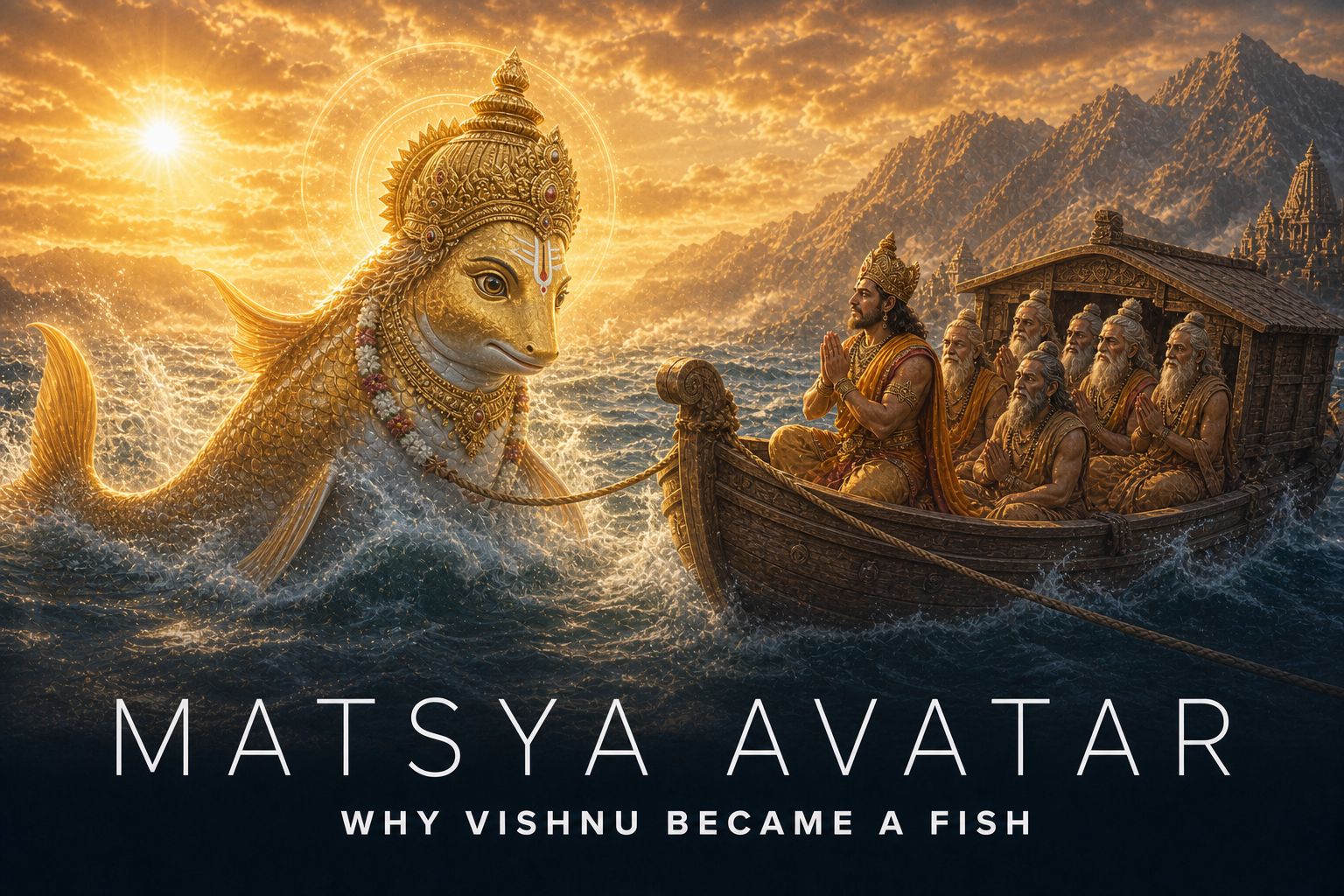
A flood cannot be answered by a form that walks. It has to be answered by a form that swims. So the Preserver took the shape best suited to the emergency: Matsya, the fish. He is usually depicted with a human upper body and the tail of a great fish, holding the shankha and chakra — divinity wearing the shape the moment demanded.
There is a second reason, and it matters just as much. In the Puranic telling, a demon — named Hayagriva in some versions, Shankhasura in others — had stolen the Vedas from Brahma while he slept and carried them to the bottom of the ocean. Knowledge itself had sunk. Someone had to go down and bring it back.
The Little Fish in the King’s Palms
The most beloved version of the story belongs to King Satyavrata, the righteous ruler of the Dravida land, who is also identified with Manu, the progenitor of humanity.
Standing in the river at dawn, Satyavrata was performing tarpan — offering water to the ancestors from his cupped hands. As he lifted his anjali, he found a small golden fish swimming in the water held in his palms. He moved to release it back into the current, and the fish spoke: the river is full of creatures larger than me. Do not abandon me here.
Moved by the plea, the king carried it home in his kamandalu. By morning the fish had outgrown the pot. He shifted it to a larger vessel, then a well, then a lake, then a river — and each time, by dawn, the fish had grown too large again. Finally he carried it to the ocean, and even the ocean seemed small.
That was when Satyavrata understood he was not holding a fish. He folded his hands and asked who this truly was. Vishnu revealed himself, and told the king what was coming.
The Flood, the Boat, and the Serpent Rope
In seven days, the fish said, the oceans would rise and the world would drown. A boat would appear. Satyavrata was to board it with the Saptarishi — the seven great sages — and with the seeds of every plant and the essence of every living species, so that life could begin again on the other side.
“When the waters rise,” the Lord told him, “call me, and I will come as a great fish with a horn.”
The rains came as promised. The boat appeared. And out of the churning water rose Matsya, immense now, a single horn on his head. Vasuki — the serpent king — became the rope. The sages bound the boat to the horn, and the fish towed them through the deluge.
The most beautiful detail is what happened during the crossing. Matsya did not simply pull the boat in silence. Through the long night of the flood, he taught. He spoke to Manu and the sages of the Vedas, of the nature of the soul, of dharma and the supreme truth. The rescue was also a transmission. What was saved was not just a boatload of survivors — it was the knowledge they would need to rebuild.
The Vedas Returned
Somewhere in that same cosmic night, Matsya dived to the ocean floor, found the demon who had carried the Vedas away, defeated him, and returned the scriptures to Brahma.
Notice what the avatar actually saves. Not a kingdom. Not an army. A boat of seeds and sages, and four books of knowledge. In the Hindu imagination, that is what a civilisation is: living beings and the wisdom that tells them how to live. Lose either one and the world does not truly survive.
What the Matsya Avatar Means
Life begins in water. The first avatar is aquatic, the second (Kurma) amphibious, the third (Varaha) a land mammal, the fourth (Narasimha) half-man — and only then does the fully human form arrive. Many readers have noticed how closely the Dashavatara sequence tracks the ascent of life itself. Whether or not that was the intent, it says something true: consciousness does not arrive fully formed. It rises.
The small thing you protect may be the thing that saves you. Satyavrata had no reason to help a fish that could fit in his hands. He did it because it asked and because he was kind. That single act of compassion is what stood between the world and oblivion.
Knowledge is worth rescuing before treasure. Gold sinks and no one goes after it. The Vedas sank and Vishnu himself went down to bring them back.
Endings are not the end. Pralaya is not punishment in Sanatana Dharma — it is a breath between cycles. The flood does not destroy dharma; it washes away what has grown corrupt so that dharma can begin again, carried by a small boat and a fish who refuses to let go.
The conch that Matsya carries is the same Panchjanya sound that opens every Vishnu puja — the note said to drive away negativity and awaken the household. Naturally sourced, temple-grade, and ready for your altar.
Watch: The Great Flood Story of the Matsya Purana
Frequently Asked Questions
Who did Matsya save from the flood?
King Satyavrata — identified with Manu, the progenitor of humankind — along with the Saptarishi and the seeds of all living species, carried in a boat towed by the fish through the deluge.
Which scriptures tell the story of Matsya avatar?
The oldest surviving version appears in the Shatapatha Brahmana, where the fish is not yet named as Vishnu. The fuller Puranic tellings are found in the Matsya Purana, the Vishnu Purana, and Canto 8 of the Bhagavata Purana.
Why is Matsya the first of the ten avatars?
Because it answers the earliest crisis in the cosmic cycle — the dissolution by water — and because life itself begins in water. The Dashavatara sequence opens in the ocean and rises steadily toward the human form.