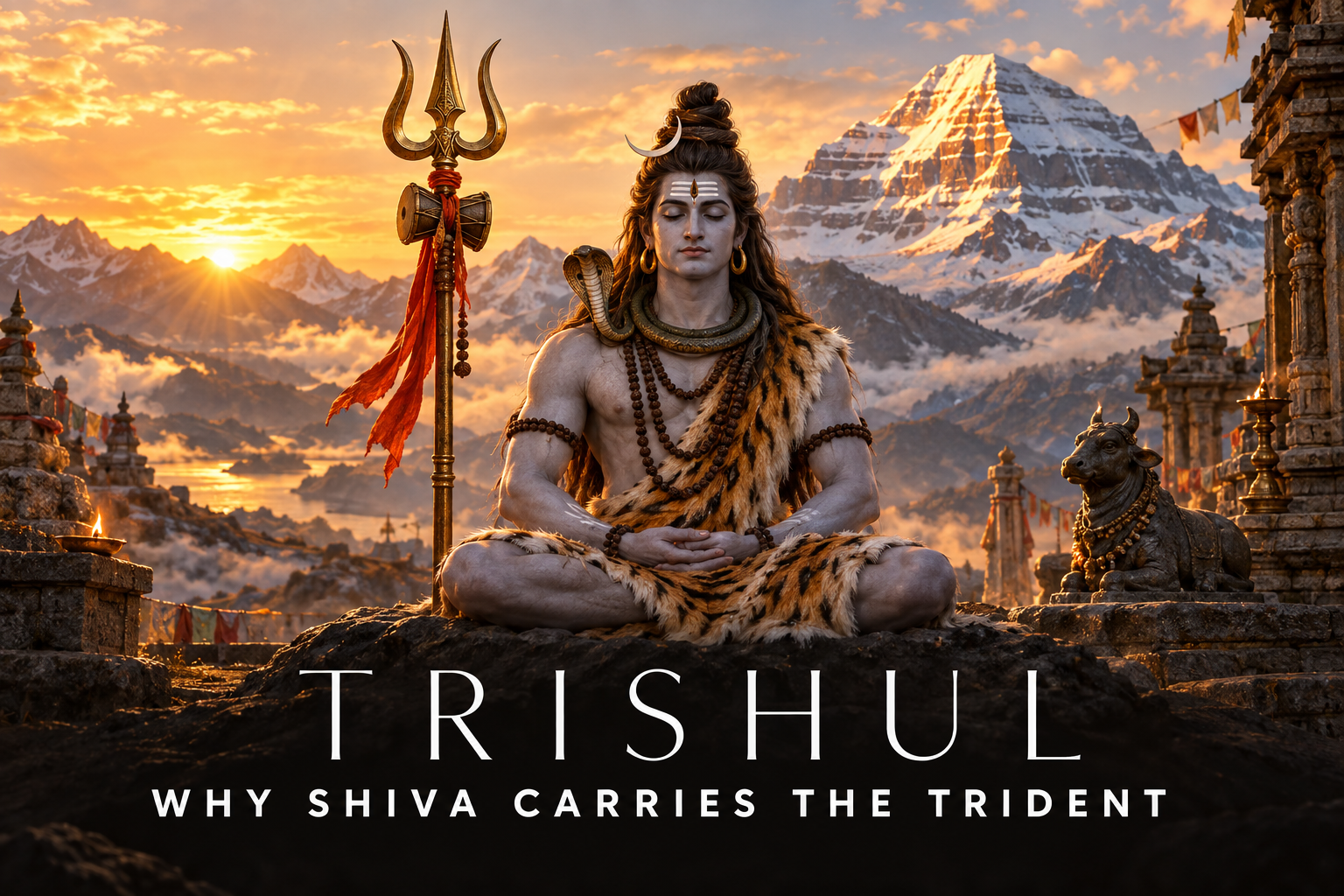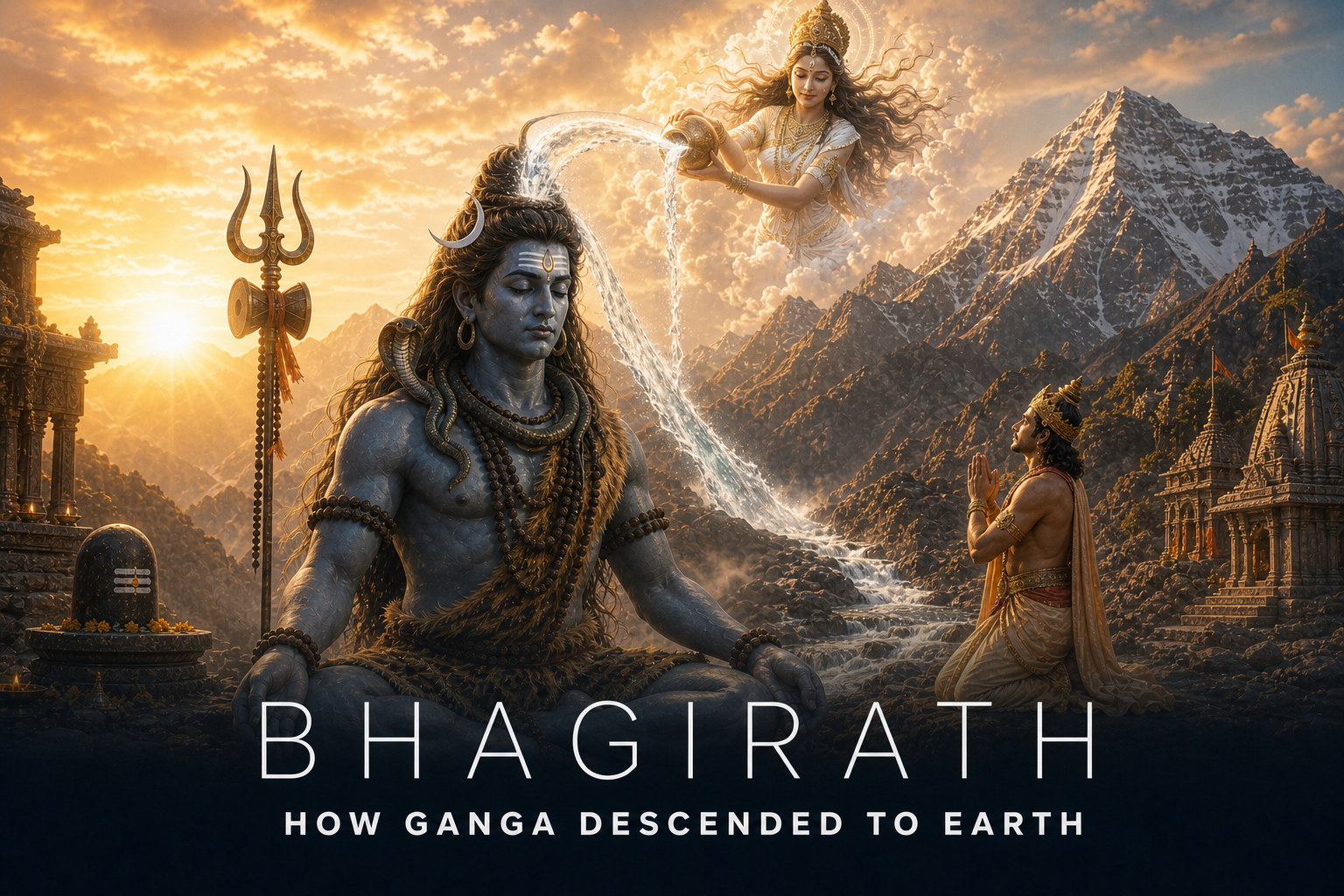

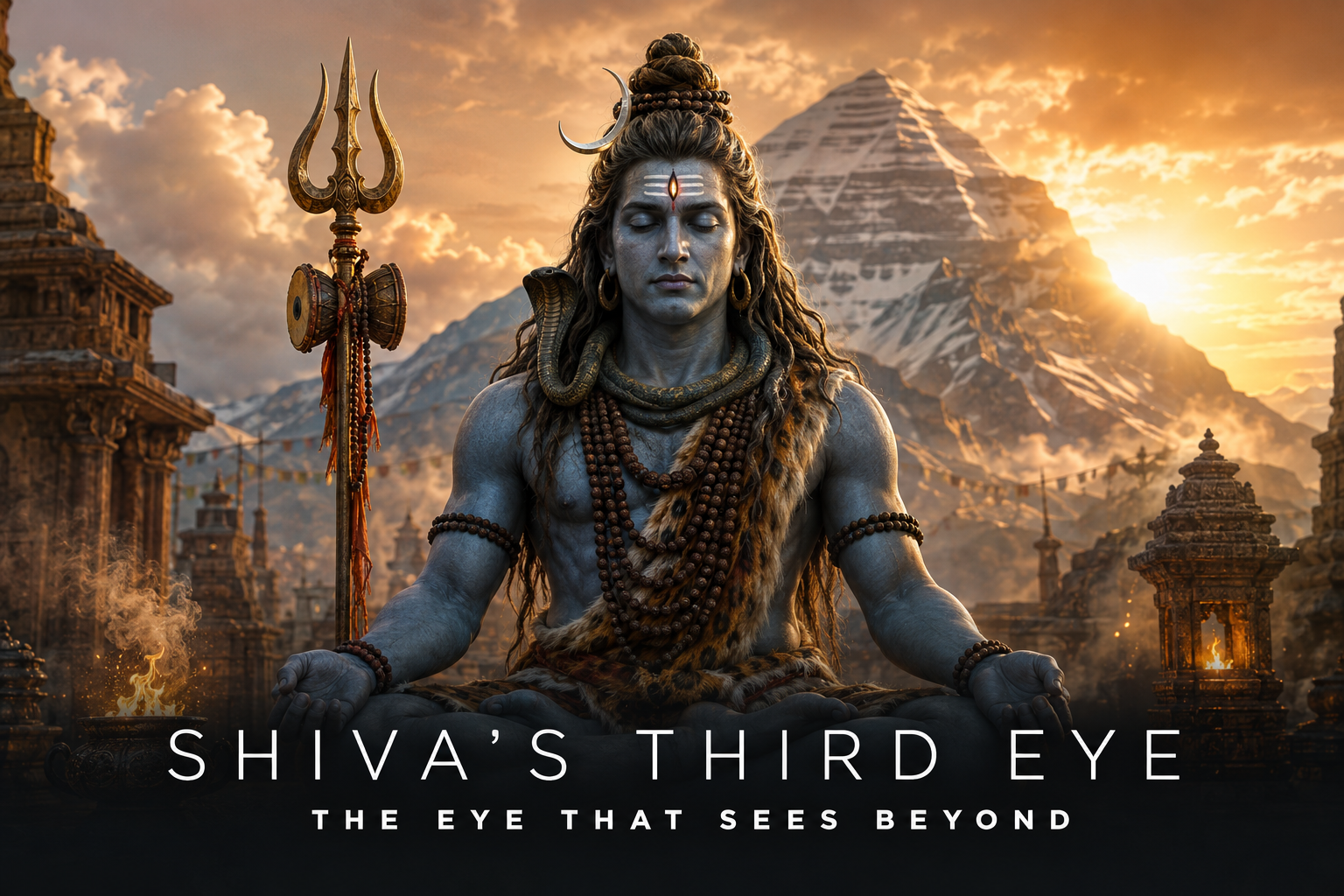
Of all the images in Sanatana Dharma, few are as instantly recognisable as the third eye of Shiva — that vertical, half‑closed eye resting in the centre of Mahadeva’s forehead, above and between the other two. Children draw it. Temples carve it. Devotees mark the same spot with tilak every morning without always knowing why.
It is easy to reduce it to a weapon: the eye that opens and burns. But in the Puranas and in the yogic tradition that grew alongside them, the third eye is something far more interesting. It is the eye that sees what the other two cannot — and the stories about how it appeared tell us exactly what kind of seeing that is.
Tryambaka: The Lord of Three Eyes
One of Shiva’s oldest and most sacred names is Tryambaka — “the three‑eyed one.” It is the name invoked at the very opening of the Mahamrityunjaya Mantra: Om tryambakam yajamahe sugandhim pushtivardhanam. Every time that mantra is chanted for healing or protection, the devotee is calling on Shiva precisely by this attribute.
Traditional commentary reads the three eyes as the three great lights of creation. The right eye is the sun, the left eye is the moon, and the third eye is fire (agni). The sun and moon govern day and night — ordinary, dualistic time. Fire belongs to neither. It is the light that reveals things when both day and night have failed.
Read that way, the third eye is not simply an extra eye. It is a different order of sight altogether — which is why it is also called Gyana Chakshu, the eye of knowledge.
The Story of Parvati’s Hands and the Darkness
The best‑loved account of how the third eye appeared comes from the Shiva Purana, and it begins with an act of pure playfulness.
Shiva was seated on Kailasa. Parvati, coming up quietly behind him, covered both his eyes with her hands — the kind of small, affectionate mischief between two people who love each other.
The consequence was instant and cosmic. Because Shiva’s eyes are the sun and the moon, closing them extinguished every light in creation. The universe went dark. Birds stopped mid‑flight. Cattle stood frozen in the fields. The tiger halted in mid‑leap and the deer stood still at its feeding ground. Life did not merely dim — it stopped, because time itself, which the sun and moon measure out, had stopped.
To restore the worlds, a third eye blazed open on Shiva’s forehead with the brilliance of a thousand suns, and light returned to creation.
The story then adds a detail that is easy to miss but very telling. The heat of that eye caused Parvati’s palms to perspire, and from that perspiration — Shiva’s fire meeting Shakti’s water, conceived in total darkness — a child was born. Because he came into being in that darkness, he was born blind, and was named Andhaka, “the blind one.”
Within a single episode the tradition places sight and blindness side by side: the eye that sees everything, and the child who sees nothing, born of the very same moment.
Kamadeva and the Eye That Burns
The other famous appearance of the third eye is the one most people remember — the burning of Kamadeva.
Deep in meditation after the loss of Sati, Shiva was unreachable. The devas, needing a son of Shiva to save them, sent Kamadeva, the god of desire, to strike him with a flower arrow and turn his attention toward Parvati. Kama succeeded in disturbing the meditation, and Shiva opened his third eye. Kamadeva was reduced to ash — an event still remembered as Kama Dahan.
It would be a mistake to read this only as anger. What the third eye destroys is not love but compulsion — desire that acts on a being from outside and moves him against his own will. Significantly, Shiva later restores Kama in a bodiless form, Ananga. Desire is not abolished; it is stripped of the power to possess. That is a far more precise piece of theology than “Shiva got angry.”
The same principle governs Shiva as Tripurantaka, the destroyer of the three flying cities of the asuras. Tradition holds that Shiva opens this eye only when every other course — every warning, every chance to turn back — has genuinely been exhausted. It is the last resort of a compassionate god, not the first reflex of an angry one.
A Shivling for your puja space and an original 5 Mukhi Rudraksha mala for japa — the two simplest, most traditional supports for daily Shiva upasana and steady meditation.
The Ajna Chakra: The Third Eye Inside You
Yogic tradition places a subtle centre at exactly the point where Shiva’s third eye is depicted — the Ajna Chakra, between and slightly above the eyebrows. The word ajna means “command,” and this centre is described as the seat of discernment, intuition and inner authority: the place from which a person governs himself rather than being governed by impulse.
This is why the iconography is not decoration. Shiva is Adi Yogi, the first yogi, and his forehead marks the destination of the practice he taught. The two outer eyes gather the world of names and forms. The inner eye perceives what lies behind them — and the tradition is candid that opening it is not comfortable, because the first thing it burns is one’s own illusion.
It also explains a daily habit most Hindu households keep without much thought. Tilak, chandan, vibhuti and kumkum are applied to that precise spot on the forehead. It is a quiet reminder, repeated every morning, of the eye each of us is meant to be developing.
Why the Third Eye Is Always Shown Half‑Open
Look closely at almost any traditional murti or painting of Shiva and you will notice the third eye is rarely drawn wide open. It is half‑closed, or shown as a narrow vertical slit.
The restraint is deliberate. A fully open third eye would mean dissolution — pralaya. The half‑open eye is Shiva holding that power in check for the sake of the worlds, an image of immense force under perfect self‑possession. In the same way, the vertical orientation is contrasted with the horizontal set of the ordinary eyes: sight turned inward and upward rather than outward across the surface of things.
Between the two — the eye that could end everything, and the choice not to open it — sits the whole character of Mahadeva: the destroyer who is called Ashutosh, the one who is easily pleased.
What the Third Eye Asks of a Devotee
Taken together, the stories point in one direction. Parvati’s playfulness shows that the third eye appeared in order to restore light, not to remove it. Kamadeva’s burning shows it acts against compulsion, not against love. Tripurantaka shows it opens only when nothing else remains.
For a devotee, the invitation is less about acquiring a mysterious power and more about a change of vision: to look past appearance to essence, to see one’s own attachments clearly enough that they lose their grip, and to hold whatever strength one has with restraint. That is why the Mahamrityunjaya Mantra addresses Shiva as Tryambaka before it asks for anything at all. The prayer begins by acknowledging the one who truly sees.
Frequently Asked Questions
What do Shiva’s three eyes represent?
The right eye is traditionally identified with the sun, the left eye with the moon, and the third eye with fire. Sun and moon govern ordinary time and duality; the fiery third eye represents knowledge (Gyana Chakshu) that perceives beyond the physical.
How did Shiva get his third eye?
In the well‑known Shiva Purana account, Parvati playfully covered Shiva’s eyes with her hands and the entire universe fell into darkness, since his eyes are the sun and moon. A third eye then blazed open on his forehead to restore light to creation.
Is the third eye only destructive?
No. It appeared in order to restore light, and tradition holds Shiva opens it only when every other option has been exhausted. Even Kamadeva, burned by it, was later restored in a bodiless form. Its primary meaning is inner sight and discernment rather than destruction.