
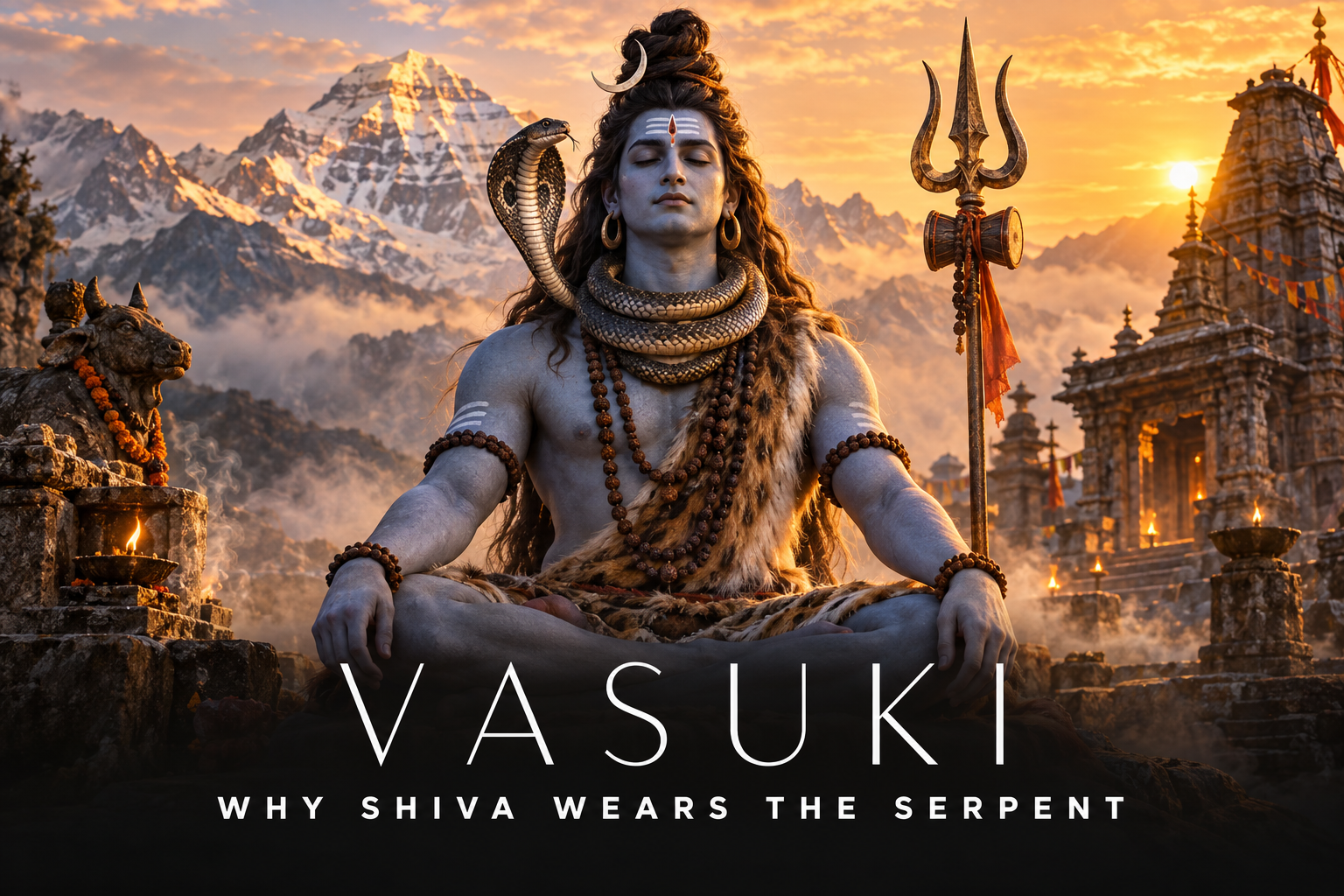
Look at almost any image of Bhagwan Shiva and one detail is impossible to miss: a living serpent coiled calmly around his throat. Not hidden, not restrained — worn openly, like a garland. For a deity who renounced every worldly ornament, the one thing he keeps is the most feared creature in creation.
That serpent has a name. He is Vasuki, king of the nagas, and the story of how he came to rest on Shiva’s neck is one of the most quietly profound in all of Sanatana Dharma. It is a story about poison, devotion, time, and the mastery of everything we are afraid of.
Who Is Vasuki, the Serpent Around Shiva’s Neck?
Vasuki is not an anonymous snake. He is the Nagaraja — sovereign of the serpent race — born to the sage Kashyapa and Kadru, the mother of all nagas. His siblings are names every devotee knows: Shesha, the thousand-hooded serpent on whom Vishnu reclines; Takshaka, the fierce naga of the Mahabharata; and Manasa, the serpent goddess.
Among all of them, Vasuki chose a different destiny. Where his brothers ruled the netherworlds and guarded treasures, Vasuki became a devotee. He surrendered his power to Shiva — and in that surrender, he was given a place no deva or rishi occupies: the throat of Mahadev himself.
The Samudra Manthan: How Vasuki Became Shiva’s Ornament
The turning point comes during the churning of the cosmic ocean. To extract amrita, the nectar of immortality, the devas and asuras needed a rope strong enough to spin Mount Mandara. Vasuki offered his own body.
For ages he was wound around the mountain and pulled from both ends — devas at his tail, asuras at his head — while the ocean churned. The strain was unimaginable. And then, before any nectar appeared, the ocean gave up something else entirely: halahala, a poison so virulent it began to consume the three worlds.
Shiva drank it. He held the halahala in his throat rather than swallow it or spit it out, and his neck turned blue — which is why he is called Neelkanth. But the poison still burned, and everything near that throat felt its heat.
Vasuki, already exhausted from being the churning rope, coiled himself around Shiva’s neck. In some tellings he absorbed a share of the venom himself; in others his cool serpent body simply eased the burning. Either way, the gesture was not obedience. It was love offered at the worst possible moment, when there was nothing left to gain.
Shiva never removed him. What was given in that moment became permanent.
Why Three Coils? The Meaning of Past, Present and Future
Iconography almost always shows Vasuki wound three times around Shiva’s neck, his hood raised beside Mahadev’s face. Those three coils are not decorative.
They represent the three divisions of time — bhoot, vartaman and bhavishya; past, present and future. Time itself is coiled around Shiva’s throat like jewellery. He is not carried along by it the way we are; he wears it.
This is the same truth expressed in his title Mahakaal, the great lord of time. A serpent sheds its skin and appears renewed — the perfect emblem for cycles of birth, death and rebirth. That the endless cycle sits on Shiva as an ornament tells us plainly that he stands outside it.
The Snake as Conquered Ego and Awakened Energy
There is a second layer to the symbol, and it is deeply personal.
In yogic understanding, the serpent is ahankara — ego. Ego is not something to be killed; it is something to be mastered. An uncontrolled snake kills. A mastered snake becomes an ornament. Shiva wearing Vasuki is a picture of what happens when the ego is neither indulged nor suppressed but brought fully under conscious control: it stops being a danger and becomes a source of beauty.
The same imagery carries into the idea of kundalini, the coiled spiritual energy said to rest dormant at the base of the spine. The serpent is that potential. In an ordinary being it sleeps. In Shiva, it is fully awake and perfectly still at the throat — the vishuddhi chakra, the centre of speech and purification, the very place where he held the world’s poison.
Read that way, the snake is not something Shiva tolerates. It is the visible sign of what he has completed.
What the Scriptures Say
The serpent ornament is not a later artistic invention. The Matsya Purana instructs that Shiva should be depicted garlanded with snakes, and the Padma Purana likewise describes him fashioning his ornaments from serpents. The Skanda Purana carries the Samudra Manthan episode in which the connection between Vasuki and Mahadev is sealed.
There is also a quiet social message inside the theology. The nagas were feared and kept at the margins of the world. By taking their king as his ornament — alongside ash from cremation grounds, a tiger skin, and a begging bowl — Shiva makes a statement that runs through his entire iconography: nothing is untouchable, nothing is beyond grace. What the world rejects, Mahadev wears close to his heart.
This is why devotees pour water and milk over the Shivling in abhishek. The gesture remembers a throat that still holds poison, and a devotee who stayed coiled there so it would burn a little less.
Every drop of water offered on a Shivling remembers the throat that held the halahala. A pure black-stone Shivling turns that story into a daily moment of stillness in your own home.
Frequently Asked Questions
Which snake is around Lord Shiva’s neck?
The serpent is Vasuki, king of the nagas and son of sage Kashyapa and Kadru. He is the elder brother of Manasa and Takshaka, and a younger brother of Shesha, the serpent on whom Bhagwan Vishnu reclines.
Why is Vasuki coiled three times around Shiva’s neck?
The three coils represent past, present and future. Shiva wearing time itself as an ornament signifies that he is Mahakaal — unaffected by the cycle of birth, death and rebirth that binds every other being.
Is the snake on Shiva’s neck a symbol of danger or protection?
Both, and that is the point. The serpent is fear, ego and dormant energy all at once. In Shiva it is fully mastered, so what would destroy an ordinary being rests on him peacefully as jewellery.