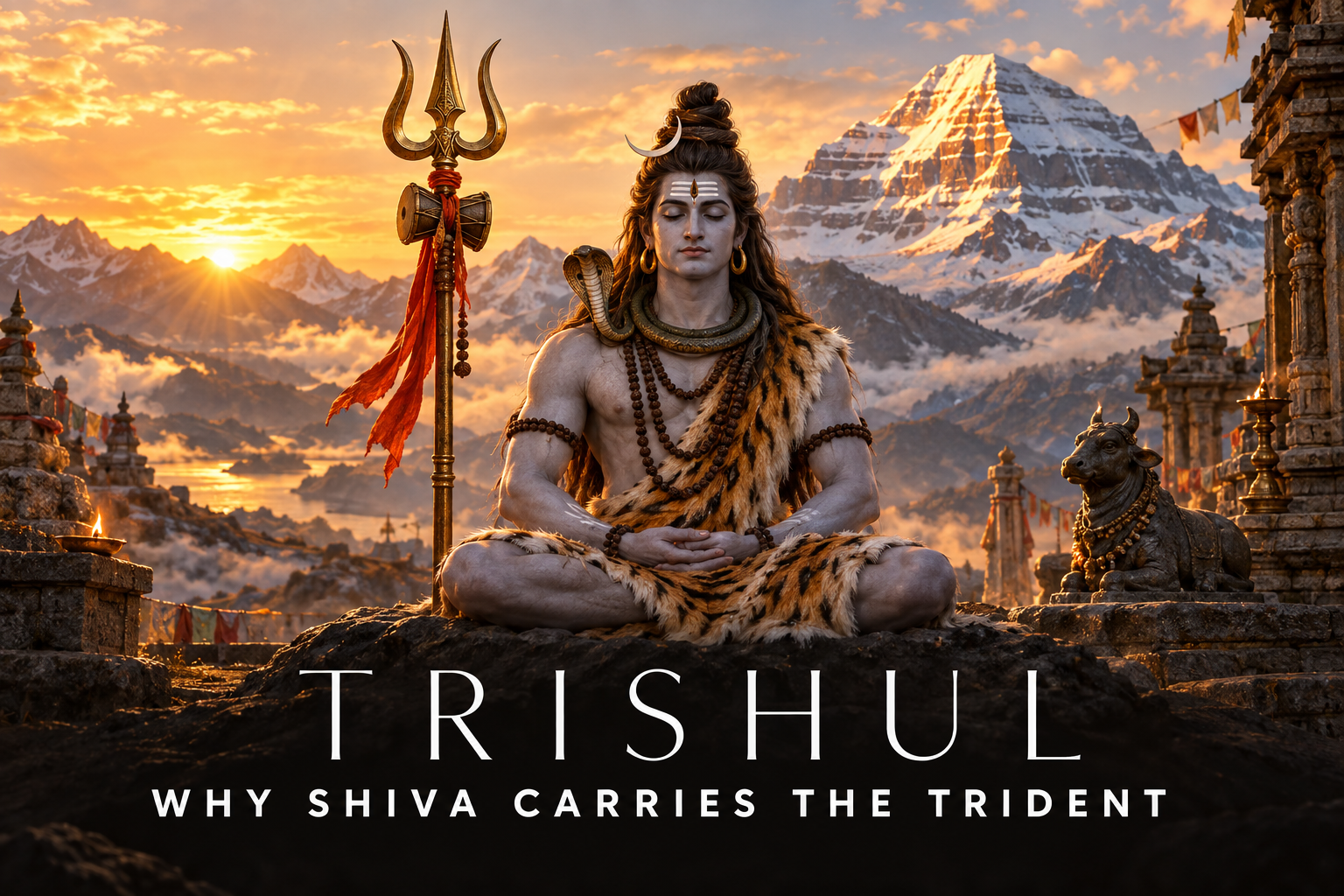

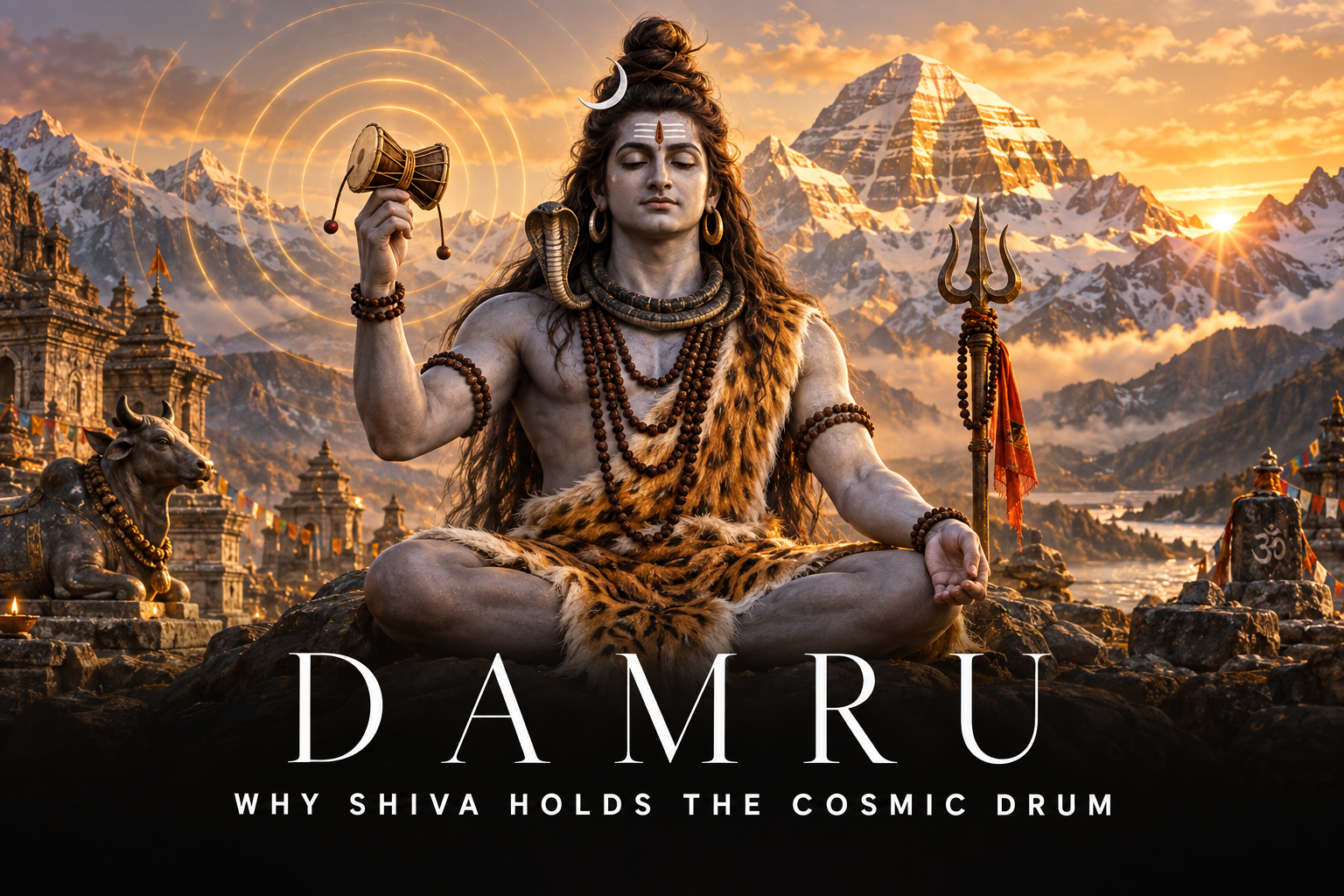
Look closely at almost any image of Lord Shiva and you will find a small, hourglass-shaped drum resting in His upper right hand. It is easy to overlook beside the trishul, the crescent moon and the serpent — yet in the language of Hindu iconography, the damru (damaru) may be the single most important object Shiva holds. It is not an ornament. It is the instrument through which the universe is said to have begun.
To ask why Shiva holds a damru is really to ask a much older question: where does creation come from? Sanatana Dharma answers that question not with light, but with sound. And the damru is where that sound is born.
What Is the Damru? Shiva’s Hourglass Drum
The damru is a small two-headed drum, narrow at the waist and wide at both ends, so that it looks like an hourglass. A cord with a knot or bead is tied around the middle; when the drum is twisted rapidly at the wrist, the bead strikes each face in turn and produces a continuous, rolling rhythm — a sound that has no clear beginning and no clear end.
That detail matters. The damru is not struck with a stick, note by note. It is set in motion and then it sustains itself, one side answering the other, endlessly. Iconographically, this is the point: Shiva does not create once and stop. Creation and dissolution alternate forever, like the two faces of the drum, and the shape itself — an hourglass, an infinity sign stood upright — carries that idea before a single beat is heard.
The Two Triangles: Purusha and Prakriti
The most widely taught symbolism of the damru concerns its two halves. Seen in profile, the drum is two triangles meeting at a single point: one pointing up, one pointing down.
The upward triangle is traditionally read as Purusha — pure consciousness, the still witnessing principle, Shiva. The downward triangle is Prakriti — nature, matter, energy, Shakti. Apart, they are inert. Neither consciousness without nature nor nature without consciousness produces a world.
But at the waist of the damru, at that impossibly narrow meeting point, the two touch. And where they touch, sound is produced. This is the same idea expressed elsewhere in the Shatkona, the interlocking triangles of the Shri Yantra, and in the Ardhanarishvara form of Shiva Himself. Creation is not a thing Shiva makes. Creation is what happens when Shiva and Shakti meet.
Nada: The First Sound of Creation
Hindu cosmology holds that the universe did not begin as an object but as a vibration. That primordial vibration is called Nada, and the tradition says it emerged from the beating of Shiva’s damru.
This is why the damru is placed in the hand associated with creation. Before form, there was frequency. Before matter, there was rhythm. The Upanishadic teaching that the cosmos rests on sound, the reverence for Om as the seed-syllable of all that exists, and the entire practice of mantra japa all rest on this single premise — that reality is, at its root, vibrational.
Understood this way, the damru is not a symbol of Shiva’s power over sound. It is the statement that sound is the power, and Shiva is the one who sets it moving.
The Fourteen Beats and the Birth of Sanskrit
One of the most beautiful stories attached to the damru comes not from a puranic narrative but from the grammatical tradition itself.
It is said that at the close of His cosmic dance, Shiva sounded the damru fourteen times for the benefit of the sages gathered before Him. From those fourteen beats emerged fourteen aphorisms — the Maheshwara Sutras, also called the Shiva Sutras, which arrange the sounds of the Sanskrit alphabet in a precise and deliberate order.
The sage Panini took those fourteen sutras as the foundation of the Ashtadhyayi, his eight-chaptered grammar of Sanskrit — a work so rigorous that modern linguists still study its structure. Panini’s rules are built directly on this arrangement of sounds and, as the commentarial tradition notes, cannot properly be understood without it.
So the claim of the damru is a large one: not only did the universe emerge from Shiva’s drum, but so did language — the very instrument by which human beings would later speak of that universe, compose its hymns, and pass on its teaching.
The Damru in Shiva’s Cosmic Dance
Nowhere is the damru more eloquent than in the Nataraja form, Shiva as Lord of the Dance. In that image, each element of the figure carries a meaning, and together they map the five cosmic acts.
The damru in the upper right hand is creation. The flame in the upper left hand is dissolution. The raised palm is protection — fear not. The foot pressed down on the dwarf figure is concealment, the veiling of truth by ignorance. The lifted foot is grace, the release that liberates.
Read together, the message is unmistakable: the hand that creates and the hand that destroys belong to the same body and move in the same rhythm. Shiva does not sound the drum to build something permanent. He sounds it because the arising and the passing are one continuous dance — and He is unmoved at the centre of it.
If the damru teaches that devotion begins with sound, japa is where that teaching becomes a daily habit. Our Shiv Sadhna Combo pairs a Shivling for your altar with an original Panch Mukhi Rudraksha mala for chanting — the two simplest things a Shiva bhakt needs to begin.
What the Damru Asks of the Devotee
There is a quiet instruction hidden in this symbol. The damru only sounds when it is turned — when there is movement, friction, the striking of one side against the other. A drum held perfectly still is silent.
Devotional life works the same way. The tradition does not ask for stillness alone; it asks for practice — chanting, offering, remembering, returning. The bead strikes, and strikes again, and the sound continues. Shiva, who is stillness itself, holds in His hand the one object that must move to be heard.
That is perhaps the deepest teaching of the damru: the silent one chose a drum.
Frequently Asked Questions
Why does Shiva hold a damru and not another instrument?
Because the damru is a drum of pure rhythm rather than melody. It represents Nada, the primordial vibration from which creation is said to arise, and its two-triangle form expresses the union of Purusha and Prakriti. No other instrument carries that combination of meanings.
What is the connection between the damru and Sanskrit?
Tradition holds that Shiva sounded the damru fourteen times at the end of His cosmic dance, producing the fourteen Maheshwara Sutras. These arrange the sounds of the Sanskrit alphabet and form the foundation of Panini’s Ashtadhyayi, the classical grammar of Sanskrit.
What do the two sides of the damru represent?
The two halves are read as the two triangles of consciousness and matter — Purusha above and Prakriti below — meeting at the drum’s narrow waist. Their meeting is what produces sound, and therefore creation. The alternating beats also represent the endless cycle of creation and dissolution.