
Sometimes the most important part of learning is the moment we realise that we have understood too quickly. The story of Indra and Virochana turns that familiar experience into a sacred inquiry. Two seekers approach the same teacher, hear the same early instruction and begin to walk away. One continues home. The other pauses, thinks and returns.
This episode appears in the Chandogya Upanishad, sections 8.7–8.12. Its subject is Atman, the Self. Its gentle invitation to the reader is to bring patience to spiritual understanding, and to let an honest question deepen our reverence.
1. Two seekers arrive before Prajapati
Prajapati announces that the Self, free from decay, death and sorrow, is to be sought and known. Indra comes from the devas, while Virochana comes from the asuras. Both arrive carrying firewood and remain as disciplined students for thirty-two years before receiving the initial teaching.
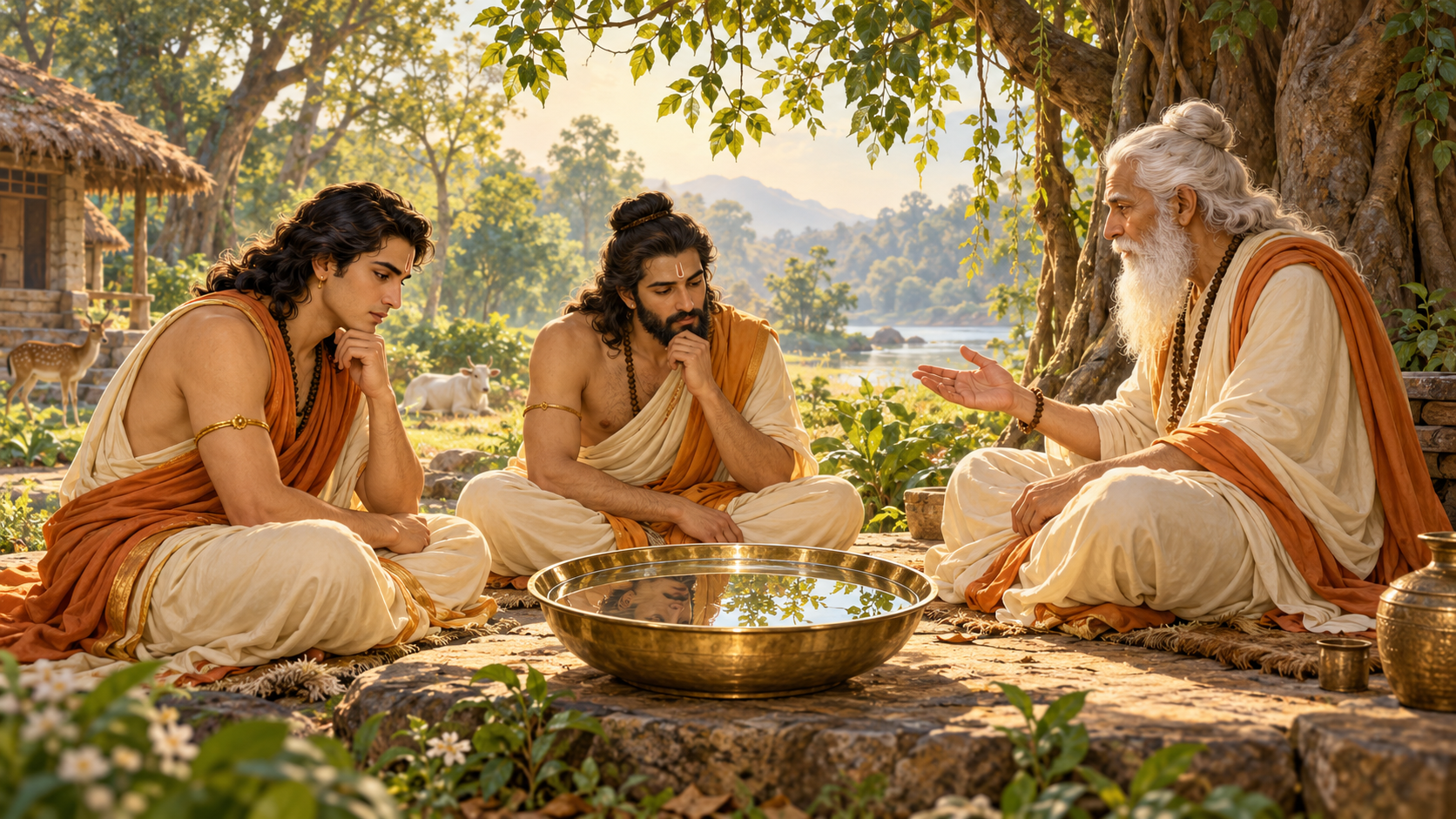
These details are preserved in Oleg Bychkov’s translation of Chandogya Upanishad 8.7–8.12. Prajapati’s first instruction concerns the person perceived in the eye. The students connect it with the image seen in water or a mirror. They examine their reflections, then groom and adorn themselves and look again.
The scene is wonderfully close to everyday experience. We recognise ourselves in a reflection almost without thinking. A face seems such an obvious answer to the question of who we are. The story asks us to stay with that apparent simplicity long enough to examine it.
2. A reflection becomes a stopping point
The reflected image changes with the students’ clothing and grooming. Both initially leave satisfied, although Prajapati observes that they have departed without understanding the Self. Virochana takes the bodily interpretation back to the asuras.
Swami Krishnananda’s commentary on the opening stages explains how the teaching about the person in the eye can be misunderstood as referring merely to the physical image. The difference between hearing words and grasping their intention is central here.
For a contemporary reader, Virochana’s response can be a mirror of our own impatience. We may prefer an answer that confirms what already feels familiar. A phrase copied from a book can begin to feel like knowledge before we have considered its meaning.
There is kindness in recognising this tendency. We all begin somewhere. The useful question is whether we can remain open when a comfortable explanation begins to show its limits. Intellectual humility gives learning room to continue.
3. Why Indra turns back
Before reaching the devas, Indra notices a difficulty. A reflection follows the condition of the body; it changes when the body changes and disappears when the body is destroyed. How could such an image be the deathless Self Prajapati had described? Indra returns with firewood, ready to learn further.
His return is one of the most moving gestures in the story. He is willing to admit that satisfaction has arrived before understanding. He brings his doubt into the relationship with his teacher and accepts further discipline.
We can honour that spirit in small ways: rereading a difficult passage, asking what a word means in its context, or listening carefully when someone shows us a gap in our understanding. These are everyday reflections inspired by the narrative. They need no dramatic display.
For devotional life, this makes patience feel deeply practical. We can approach a sacred text with affection and still ask precise questions. Careful study can be an act of respect for the teaching and for the people who preserved it.
4. Dream, deep sleep and the longer search
After further study, Prajapati directs Indra’s attention to the dream person. Indra again leaves satisfied, then recognises that dreams can contain fear, distress and painful experiences. He returns. The teaching next turns to peaceful, dreamless sleep, but Indra questions the absence of recognition there.
The narrative counts three periods of thirty-two years, followed by five more: 101 years in all. Krishnananda’s discussion of these successive stages follows this progression through dream and deep sleep to the final instruction. In 8.12, Prajapati distinguishes the mortal body from the immortal, bodiless Self.
The sequence gives the story its depth. Each return arises from a specific difficulty in the previous understanding. Indra keeps examining what he has heard instead of simply collecting a new phrase.
Reading this today, we can appreciate the value of time. Some ideas need repeated attention before their implications become clear. A first encounter may awaken interest; later encounters may reveal assumptions we had barely noticed.
5. Knowing the Self and living with care
The concluding teaching also speaks of the one who sees, hears, smells and thinks, with the senses serving their respective functions. Krishnananda’s continuation on the Self and perception emphasises the distinction between the instruments of experience and the Self. His interpretation places the passage within the wider Vedantic understanding of spiritual freedom.
That is a profound subject, and this short retelling is an invitation to study it with attention. The story’s movement towards the Self can also prompt a simple personal reflection: how much of our identity have we placed in appearance, praise or a passing mood?
Alongside that reflection, we can cherish the ordinary responsibilities of embodied life. Rest, nourishment and kindness towards another person remain expressions of care. Looking deeply into identity can make us more considerate towards the people we meet.
Indra’s repeated return leaves a quiet impression. A question held with sincerity can keep the search alive. We can bring that sincerity to the next page we read, the next conversation we enter and the next moment when we discover there is more to understand.
Explore puja essentials for the devotional moments you cherish at home, alongside time for reading and reflection.
FAQ
Where is the story of Indra and Virochana found?
It appears in Chandogya Upanishad 8.7–8.12, within Prajapati’s teaching about Atman, the Self.
Why did Indra return to Prajapati?
He recognised difficulties in identifying the immortal Self with the physical reflection, the dream person and the unknowing condition of deep sleep.
How long did Indra study with Prajapati?
The narrative gives a total of 101 years: three periods of thirty-two years and a final period of five years.