

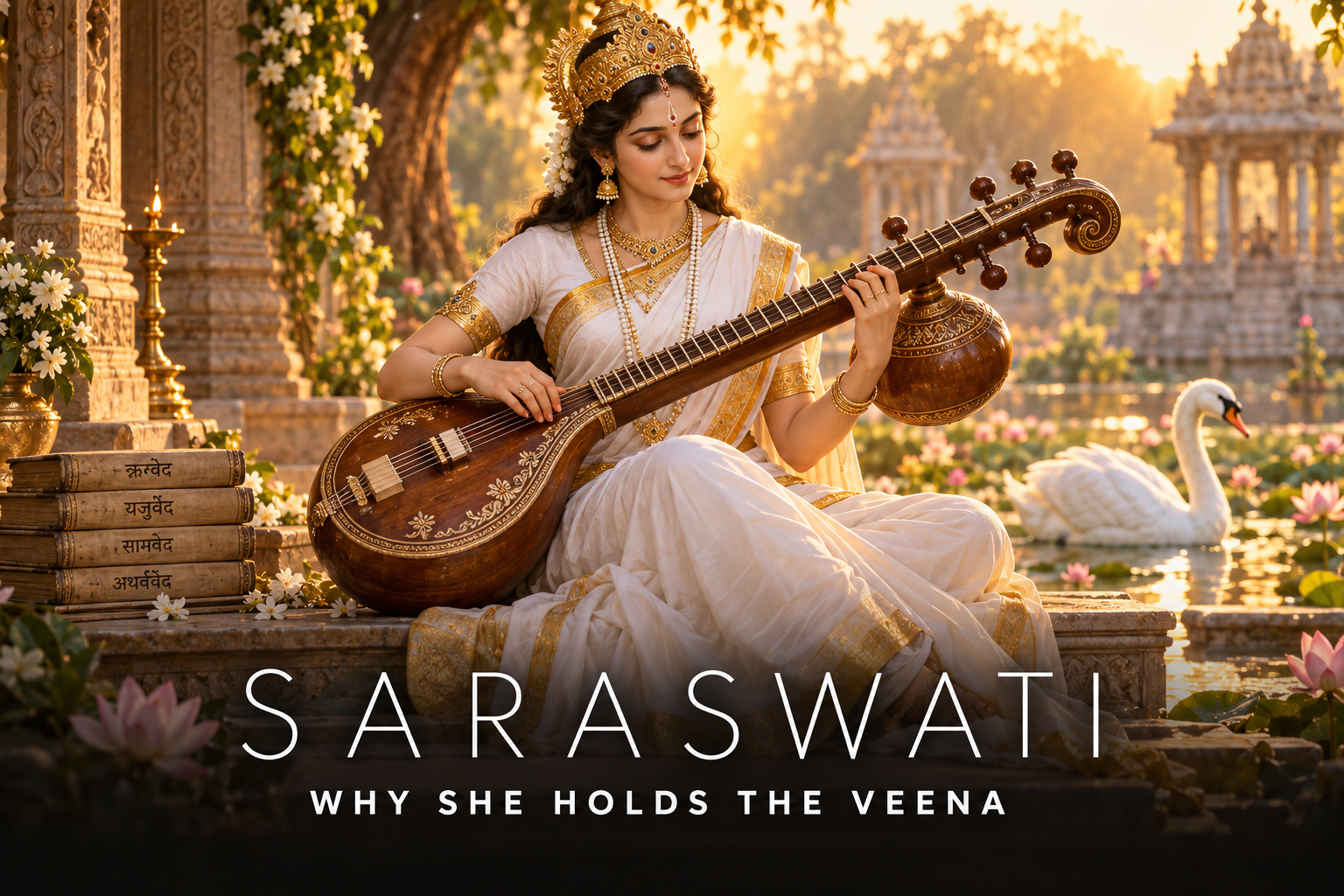
Goddess Saraswati is often pictured in luminous white, seated near a lotus or accompanied by a hamsa, with a veena resting across her lap. The instrument is so closely connected with her that she is lovingly called Veenapani, the one who holds the veena, and Veena Vadini, the one who plays it.
Why does the goddess of knowledge carry a musical instrument? The answer brings together learning, speech, rhythm, discipline, and beauty. Saraswati’s veena shows that true knowledge is not meant to remain silent or rigid. It must be tuned, expressed, and offered in a way that creates harmony.
Saraswati: From Sacred Flow to the Goddess of Learning
In the Rigveda, Saraswati is praised with the imagery of a mighty, life-giving river. Across later tradition, she becomes closely associated with vak, or speech, and with learning, poetry, music, and the arts. This development preserves a shared idea: knowledge flows. Like water, it moves between teacher and student, thought and word, inspiration and creation.
The familiar four-armed image of Saraswati belongs to later iconographic tradition rather than the earliest Vedic hymns. A government museum record from the National Gallery of Modern Art, for example, describes a Mysore-style sacred icon of the four-armed goddess holding the veena. The instrument is therefore part of a long visual language through which devotees recognize her presence.
Why the Veena Represents Knowledge in Harmony
A veena produces music only when its strings are tuned and played with care. If a string is too tight, it may break; if it is too loose, it cannot give a clear note. Devotional interpretation sees this balance as a lesson about the mind. Study needs effort, but also patience. Speech needs confidence, but also restraint. Creativity needs freedom, but also discipline.
Saraswati does not merely hold the instrument as an ornament. She is commonly shown playing it. Knowledge becomes complete through expression: a lesson taught clearly, a poem spoken with truth, a melody shaped through practice, or an idea used for the good of others. The veena turns learning into living harmony.
This connection remains visible in the instrument’s name. The Metropolitan Museum of Art notes that the South Indian veena is often called the Saraswati veena after the goddess of learning and music, and that it is widely used in Carnatic classical music.
The Two Hands on the Strings: Skill and Sensitivity
In many images, two of Saraswati’s hands play the veena: one shapes the notes while the other plucks the strings. Devotees often read this coordinated action as the meeting of understanding and practice. Knowing a principle is one step; applying it with sensitivity is another.
The image also honours attentive listening. A musician cannot create harmony by force. Each note depends on hearing pitch, timing, silence, and the notes around it. Saraswati’s veena therefore reminds students, teachers, artists, and speakers that wisdom includes the ability to listen. Clear expression grows from a quiet, receptive mind.
Such symbolism should be understood as devotional reflection rather than a single compulsory scriptural definition. Hindu sacred art often invites layers of meaning, allowing the same image to guide a musician toward disciplined practice and a student toward focused study.
How the Veena Complements Saraswati’s Other Symbols
The veena becomes clearer when seen beside Saraswati’s other attributes. A book represents preserved knowledge and study. A mala, or rosary, points toward concentration, contemplation, and inward awareness. White clothing and the white lotus evoke clarity and purity of intention. Her hamsa is traditionally associated with viveka, the discernment to recognize what is true and lasting.
Together, these symbols describe a complete education. The book asks us to learn. The mala asks us to reflect. The hamsa asks us to discern. The veena asks us to express what we have learned with grace. Information alone can fill the mind; Saraswati’s iconography points toward knowledge refined by character and made beautiful through right expression.
Not every historical image carries every attribute, and regional traditions may show variations. The British Museum, for instance, records a popular print of Saraswati playing a veena while also holding a crystal rosary and a prayer book. The recurring combination shows how music, devotion, and learning are woven together in her visual form.
What Saraswati’s Veena Means for Everyday Life
For a student, the veena can symbolize steady practice rather than anxious comparison. For a teacher, it suggests arranging knowledge so another person can receive it. For an artist, it honours inspiration shaped by technique. For anyone who speaks or writes, it asks whether words bring clarity or confusion.
The image also offers a gentle correction to the idea that wisdom must be severe. Saraswati teaches through music: ordered, precise, and yet full of rasa, or feeling. Thought and beauty need not be enemies. When knowledge is joined with compassion and rhythm, it can touch the heart as well as inform the intellect.
To remember Saraswati as Veena Vadini is therefore to remember the responsibility within every gift. Talent needs practice. Learning needs humility. Speech needs truth. When these are tuned together, ordinary work can become an offering.
Explore thoughtfully chosen essentials for moments of prayer, reflection, and everyday devotion.
Frequently Asked Questions
What does Saraswati’s veena symbolize?
It symbolizes knowledge expressed with harmony, creative skill, disciplined practice, and sensitive listening.
Is the veena mentioned with Saraswati in the Rigveda?
The Rigveda praises Saraswati with river and sacred-flow imagery. Her familiar veena-bearing form developed in later religious art and iconographic tradition.
Why is the instrument called the Saraswati veena?
The South Indian classical instrument bears her name because Saraswati is revered as the goddess of knowledge, music, and the arts.