
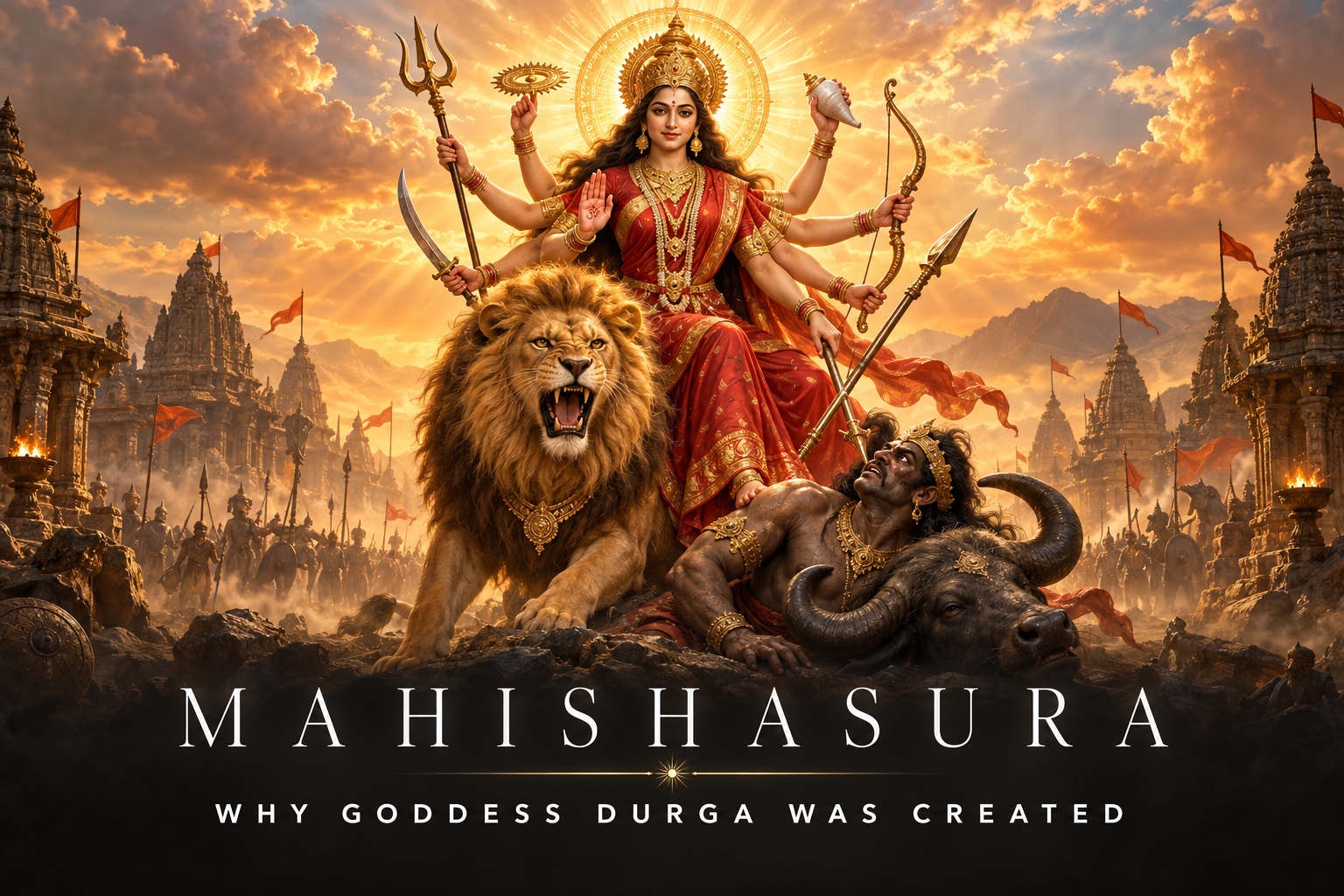
Every autumn, millions of homes light lamps for nine nights and call on a goddess seated on a lion, ten arms outstretched, her trident driven into the chest of a buffalo-headed demon. The image is everywhere — on pandal backdrops, on calendar art, on temple walls. But the question behind the image is rarely asked: why was Goddess Durga created at all?
The answer lies in one of the most dramatic narratives in Hindu scripture — the story of Mahishasura, told in the Devi Mahatmya, a section of the Markandeya Purana also known as the Durga Saptashati. It is not simply a tale of good defeating evil. It is a story about what happens when the old order runs out of answers, and a completely new kind of power has to be born.
Who Was Mahishasura? A Demon Born of Two Worlds
Mahishasura’s name is a compound: mahisha, the Sanskrit word for buffalo, joined to asura, a being opposed to the devas. The name is also a description of his nature.
He was the son of the asura king Rambha. The Puranic accounts tell of Rambha falling in love with a she-buffalo named Shyamala — a princess who had taken buffalo form through a sage’s curse. From that unusual union came a child who could shift at will between the shape of a man and the shape of a buffalo.
This is not a cosmetic detail. His shapeshifting becomes the central difficulty of the battle later on — an enemy who will not hold one form cannot be pinned down or predicted.
The Boon That Made Him Untouchable
Like many asuras in Puranic literature, Mahishasura rose not through brute force but through discipline. He performed an austerity so prolonged and so severe that Brahma appeared before him and offered a boon.
Mahishasura asked for immortality. Brahma refused — nothing born may escape death. So Mahishasura chose what he believed was the next best thing: that no man and no god would ever be able to kill him.
It was granted. And in his mind, that settled it. He had surveyed the field of possible enemies, seen only gods and men on it, and closed both doors. The oversight in his request is the hinge on which the entire story turns — and it is a deliberate one on the part of the text. Arrogance, the Devi Mahatmya suggests, is not merely loud. It is a failure of imagination.
When the Gods Ran Out of Weapons
Armoured by the boon, Mahishasura went to war on the heavens. The devas were routed. He drove Indra from his throne, took over the functions of the gods, and seized the offices of sun, wind, fire and moon for himself and his commanders. The displaced devas wandered the earth like exiles.
They went, as they always do, to Brahma — and together to Vishnu and Shiva. And there the story reaches its most interesting moment. The three great gods listen, and they understand that they cannot help. Not because they lack power, but because the boon was written precisely to exclude them. Every weapon in the divine arsenal had been rendered useless by a single clause.
Mahishasura had shut out men and gods. He had not thought to shut out a goddess.
The Birth of Durga: A Goddess Made of Light
What follows is one of the most striking passages in all of Hindu scripture. Vishnu, Shiva and Brahma are seized by anger, and from their faces a great tejas — a radiant energy — blazes forth. The other devas add their own light to it. The separate radiances do not stand side by side; they fuse.
From that single mass of fused light, a woman emerges. The Devi Mahatmya maps the gods’ energies onto her body limb by limb — Shiva’s light forming her face, Yama’s her hair, Vishnu’s her arms, Agni’s her three eyes.
Then each god gives her a weapon. Shiva offers his trident, Vishnu his discus, Varuna a conch, Agni a spear, Vayu a bow with quivers of arrows, Indra his thunderbolt. Himavan, lord of the mountains, gives her a lion to ride.
This detail matters more than it first appears. Durga is not a goddess the devas summoned to fight on their behalf while they watched from a safe distance. She is what the gods become when they stop acting separately. Every power in creation, pooled and poured into one form.
Nine Nights, and the Buffalo That Would Not Stay Still
Mahishasura heard a laugh that shook the three worlds and sent his generals to investigate. They did not return. He came himself.
The battle lasted nine nights — the nine nights that Navratri still marks. Through them, Mahishasura used the gift of his birth: he fought as a buffalo, then as a lion, then as an armed man, then as an elephant, shifting shape each time the Devi closed in.
On the tenth day it ended. As the demon began to emerge from the buffalo form yet again — caught between shapes, for one instant unable to be either — Durga pinned the buffalo body beneath her foot, drove Shiva’s trident into him, and severed his head with her sword. From that victory she takes the name by which she is invoked to this day: Mahishasuramardini, the crusher of Mahishasura. The tenth day is Vijayadashami, the day of victory.
What the Story Is Really Saying
First, that ego defeats itself. Mahishasura was undone not by a weapon he failed to anticipate but by a category he could not imagine. His boon was airtight against everything he respected enough to fear.
Second, that the divine feminine is not an accessory to the masculine but its necessary completion. When the gods reach the absolute limit of what they can do individually, what emerges is Shakti. The Devi Mahatmya is explicit: she is not lesser, not derived, not borrowed. She is the ground on which they stand.
Third, that the buffalo is us. Commentators have long read his shapeshifting as the mind’s own restlessness — the way inertia, appetite and pride change shape the moment you confront them. You defeat a buffalo not by chasing every form it takes, but by holding steady until it is caught between shapes. That is what the nine nights of fasting and restraint are actually for.
The nine nights are where this story is actually lived. This guide covers all nine forms of the Devi, Ghatasthapana vidhi, the kathas, Kanya Pujan and the aartis — one reference for the whole festival, delivered instantly.
Frequently Asked Questions
Why could only a goddess kill Mahishasura?
Because of the exact wording of his boon. Mahishasura asked Brahma that no man and no god be able to kill him, assuming those two categories covered every possible threat. He did not name women or goddesses, and that omission left the one opening through which Durga could act.
Which scripture tells the story of Mahishasura?
The principal source is the Devi Mahatmya, a set of chapters within the Markandeya Purana, recited during Navratri as the Durga Saptashati. Versions of the episode also appear in other Puranic and regional traditions, with variations in detail.
What does the name Mahishasuramardini mean?
It combines Mahishasura with mardini, meaning one who crushes or destroys. As Mahishasuramardini, Durga is worshipped specifically in her victorious form — lion beneath her, trident in hand, the buffalo demon at her feet.